


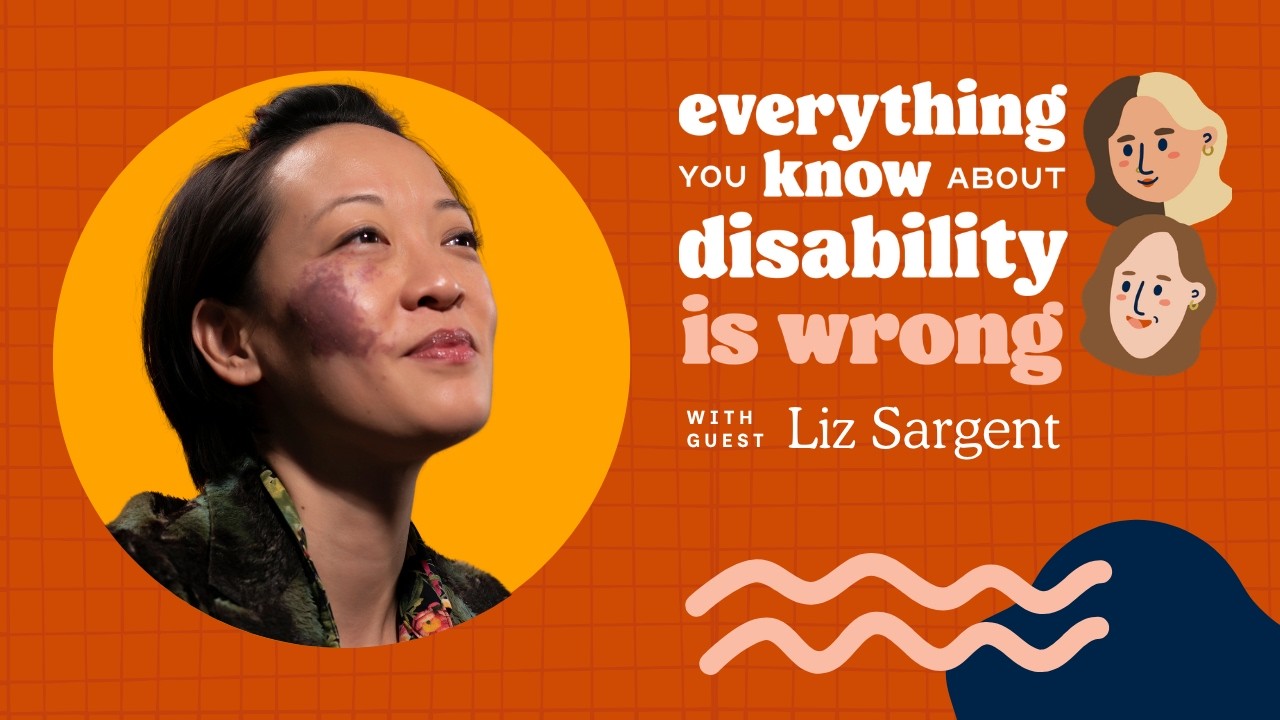
Episode 58: Creative Possibility and the Dignity of Risk with Liz Sargent
Filmmaker Liz Sargent discusses “Take Me Home,” disability representation, caregiving, family, and the dignity of risk on and off screen.
Listen Now
Published on November 9, 2026.
Watch Video
Episode 58 Show Notes
In this episode, we sit down with writer, director, and producer Liz Sargent to discuss her debut feature film, Take Me Home, and the stories that shape our understanding of disability, caregiving, and family.
Drawing from her own experiences as a Korean American adoptee and growing up in a family of eleven siblings, Liz brings a deeply personal perspective to these stories. Her film centers her sister Anna as a multidimensional protagonist whose stubbornness, humor, independence, and love make her unmistakably human.
Liz shares what it took to bring Take Me Home to life, including creating an accessible film set, working with an accessibility producer and acting coach, and allowing Anna to take creative risks as an actor. The conversation explores the dignity of risk and why accommodations aren't about lowering expectations but about making meaningful opportunities possible.
The conversation also turns to caregiving and the systems that shape it. Liz reflects on the isolation, shame, and bureaucracy that families often encounter when navigating disability services – and why our culture’s emphasis on independence can make asking for and receiving support feel so difficult. Together, we explore what it might look like to recognize caregiving as a shared responsibility and disability as an ordinary part of the human experience.
Liz also shares her involvement with Caring Across Generations and its One Million Care Conversations initiative, which invites people across communities to share their caregiving experiences and help shape a better future for care.
"Take Me Home" is available to purchase and rent beginning November 15.
Take Me Home is proud to support 1 Million Care Conversations, a bold, national effort to listen to a million people about their experiences with care and ideas for the kinds of support that would make it easier. Insights gathered through 1 Million Care Conversations will fuel a vision and proposal for a reimagined system in this country. Text CONVO to CARING or visit careconversations.com to take part.
Transcript
Liz Sargent:
But actually that mess is the aliveness and the originality that we're trying to create. The money thing around disability, I've been thinking about a lot and I haven't totally broken down the script, but I've been on a lot of sets as a directing shadow and there is so much waste in the film. So to say that accommodating disabled people is too much money is hilarious because there's so much waste in film.
[Music]:
One, two, three, let's go! Everything you know about disability is wrong!
Lily Newton:
Hey listeners, and welcome to another episode of Everything You Know About Disability is Wrong. Today on the show, we have writer, director and producer Liz Sargent.
Erin Hawley:
Liz Sargent is a Korean American adoptee and film nature whose work explores adoption, disability, and family dynamics. With a background in choreography, she brings emotional depth to her storytelling shaped by her experience growing up as the middle child of 11.
Lily Newton:
In 2026, she received the Waldo Salt Screenwriting Award at the Sundance Film Festival and the Lighthouse Award at the Lumen Awards for her debut feature, Take Me Home. Now in limited theatrical release, the film is set to be for purchase and for rent on November 15th, so in just a few days, which is perfect timing for National Adoption Month and National Family Caregivers Month. As you know, we at Easterseals, we love caregiving, we love National Family Caregivers Month. This is a really exciting guest to have on the show for this month. Welcome to the show, Liz. We're so excited to have you.
Liz Sargent:
Hi, thank you. I'm very excited to be here. Thanks for having me.
Lily Newton:
We're so happy to have you. And before we dive into the interview, let's go ahead and do our audio descriptions. I can start. This is Lily speaking. I am a mixed race person with half blonde, half brown hair, and I'm wearing my usual turtleneck and the necklace that I will probably fidget with through the whole episode. And behind me, there's a bunch of disability related books in a stack. And I'll pass it to Erin.
Erin Hawley:
Hi, this is Erin speaking. I'm a white woman with red hair and blue eyes, and I'm sitting in my room and you can see my air purifier behind me and you might see my partner in the back. So yeah, I'll pass it to Liz.
Liz Sargent:
Great. Hi. Hi, I'm Liz Sargent. I'm a Korean woman in a navy collar jacket. I have a birthmark on the right side of my face, port wine stain birthmark. And behind me, I'm in my kitchen. I have, you can see the bottom half of a dance film poster that I did.
Lily Newton:
Perfect for a director producer to have a film poster behind you.
Liz Sargent:
So obvious, yeah.
Lily Newton:
Very on brand. I love it. All right, well let's get into it. We have so many questions for you.
Erin Hawley:
Yeah. Before we get into your film, I'm curious about your own path to filmmaking. What made you want to tell stories through film?
Liz Sargent:
Yeah, I mean, my mother is a lover of the arts. She studied the flute and just really loves music and dance and all things entertainment. So I grew up taking tons of lessons in violin and art, and I feel like I actually wanted to be an actor, but I wasn't very good. So I got pushed into dance, which I loved. But I studied dance in college and then I also did some work in experimental theater. But in my 20s, I never really thought about film as a career. I guess it was my age and my experience, it made no sense to me. It just seemed too big and too scary. But in my 20s, I started thinking about my poor artist life and thinking about my family and how my parents were going to age out of taking care of some of my siblings with disabilities and how I could help and what my responsibility to them was.
And so that story, I tried to do a documentary in 2015 because everyone was so fascinated with my big family, but it felt totally uncontrollable. So I sort of started condensing all of those ideas and feelings into narrative film because I could actually control it in some way.
Lily Newton:
So you had this amazing big family that people were curious about. When you set out to make that first film, did you think that the themes of adoption, disability and family would become central to your work or has that just happened naturally?
Liz Sargent:
I think because in dance, it's a very generative art form where it's to me, the kind of modern dance I loved is you look at the person's body, their physical capabilities, their creativity, and you sort of build from that. I really love the originality of people. And so also when I was writing or thinking about narrative storytelling, I steal from my own life. It's sort of cheating. I just know all the answers if it's personal. So of course, adoption and disability are a piece of the story because that's the norm in my life and my childhood. But what I really wanted to do also in this film was not make it that adoption or disability was at the forefront. It was a family, a human story rather than feeling like it was a lecture or homework or something. Disability is a piece of our life.
It's not everything about who we are.
Lily Newton:
Yeah. I love what you said about loving the originality of people. I feel like growing up in a family with 11 siblings, there had to be this need for individuality. How did you relate to your own individuality in that set of 11, knowing that there's disability involved as well?
Liz Sargent:
Yeah, I mean, I think my parents, and especially my mom, loves wild children. I think she let us all be ourselves as big and irritating and creative as we all were. And I think nature and nurture are real and we're all very, very different people. And I think she didn't try to repress that in a way as much as possible. Yeah, I don't know. It's a lot of real big personalities and 11 of them in a house. It's a lot.
Lily Newton:
Yeah. To me, it makes complete sense how you would end up a filmmaker growing up in a house with, I mean, 13 people in the house. That's a lot of stories. There's a lot of storytelling, I imagine.
Liz Sargent:
Yeah. I mean, I think the people in my family confuse me a lot because we have such different perspectives. So I feel like I'm always just wondering how we were all raised the same way, but we have such different perspectives and opinions. And I think in my work, I'm trying to be fair to all of those perspectives as much as possible. So I'm sort of learning how to appreciate those differences through the work maybe. I'm not a totally evolved person at all, so this is all a process.
Lily Newton:
Oh, we are in process, aren't we?
Erin Hawley:
Yeah. Was there any particular movies or shows that influenced you to start your storytelling journey in film?
Liz Sargent:
Yeah. I mean, you know what? I grew up in a suburb of Chicago where all the John Hughes movies were made.
Lily Newton:
Cool.
Liz Sargent:
So I grew up on Breakfast Club and Uncle Buck and Lucas and whatever. And I didn't really watch prestige criteria in movies or film. And then I met my husband in New York and he brought me to Tree of Life, and it was my first Terrence Malick film, and I was in love and was so moved by it, and it covers such an epic life and hits things about nature and nurture and God, and I was just blown away. So that was late in my life that I had that entrance into film. But for this film, I think every film is different, who I want to reference or who I'm inspired by. And this film, to me, felt very clearly in process and in what I was trying to accomplish. My references were Chloé Zhao's early work, the writer film, and Sean Baker's process, and Mike Lee, who doesn't have a script and just works off of his relationship with the actors.
So yeah, I was pulling pieces of that.
Lily Newton:
Very cool. I'm trying so hard not to just let this veer into a filmmaking conversation because I've listened to some of your interviews talking about the way you got to improv on sets and figure out what was going to work best. And I think there is something very Sean Baker about that. I like the way that letting the film find itself and being the director and writer, I feel like you had so much. You could have had a lot of control, and it seems like instead you allowed the film to evolve on its own.
Liz Sargent:
Yeah. It's a different way of using control maybe, right?
Lily Newton:
Okay.
Liz Sargent:
Is to let it all fly and be chaos. And maybe that's also something I learned from my mother to just let everyone be themselves on set. And if I can capture that, that's what's going to resonate the most. But I mean, if we're referencing those filmmakers and in the disability space as well, I feel like what they did in the writer, I feel like that whole film is about disability, but she doesn't center it. She makes it about the humanity and disability is a very clear piece of it. But then in that sense, it makes it universal and it doesn't make that character feel like other. And I think what I'm so proud about in this film is that Anna is the true lead and people identify with her and understand her as a super-dimensional human being who's stubborn and can get angry and is also full of love and incredible humor.
And to me, that's the best statement I could make about disability.
Lily Newton:
Yeah, I think the humanity of it, there's something really beautiful about not separating disability from humanity and disability just being such an epic part of humanity because we all have these bodies and these brains that makes a lot of sense and I think is probably why your film is doing so well and reaching so many people. There's a real truth. And it's interesting that you went with narrative, but it has the heart of a documentary in the -
Liz Sargent:
It's amazing. People get confused for - Yeah.
Lily Newton:
I mean, speak on that a little bit. What was it like doing this narrative film with a family member that it could feel more like a documentary style? What was that choice that you made?
Liz Sargent:
Yeah, I mean, I think it feels so lived in because we filmed it in my parents' home, Anna's home as well. I always wonder, I think the documentary, when people feel like that, it makes me so proud because it means they really believe the actors. I also wonder if a piece of it is because people don't believe that Anna could be such a great actor in the film. Just a piece of it, right? She just feels so natural and that's because of, I think, the space and the time that we allowed. And to me, I feel like maybe you guys are in a circle of entertainment where you're seeing great work by disabled actors, but I think in the Hollywood landscape, there are not tons of great performances, and it's not because of the disabled actors, it's because of the way that we're making film and creating space for these people to do their best work.
And so I was very obsessed in the process to make sure that Anna was number one in everything we were doing was to make sure that she was great and she wasn't just a canvas for people to project on.
Yeah, I don't know. It was all an experiment.
Lily Newton:
Well, yeah, I think that's a theme that's come about in the years we've been doing this podcast is when we get to talk to people who have great experiences of actual disabled representation, it feels kind of singular or unique because that's not the theme in Hollywood. And I think that an accommodating set is still something that people in Hollywood maybe can't wrap their minds around. There's almost this idea of the struggle on set is going to get the better work. People will talk about some major directors and that's like there's no chairs on that set and my body personally could not handle a set with no chairs. And I think about that, we have these ideas about struggle and hardship, but then in practice, through what I've seen at least, is the most accommodating sets are actually where real creativity can bloom because people are not worried about access.
Liz Sargent:
Yeah.
Lily Newton:
Were there... Go ahead.
Liz Sargent:
No, I mean, I guess the thing is it's about accommodations doesn't mean that disabled people aren't doing work. It's just like -
Lily Newton:
Darn it.
Liz Sargent:
Because Anna was doing work. She worked hard. She was 12 hours a day. She was pushing herself in every way physically, emotionally. She was in uncomfortable spaces all the time, but we just had to make some adjustments to make it possible for her to take on those challenges and also have the support so that when she was struggling with those new challenges as a professional, there was someone like her acting coach and the accessibility producer and a team to help her through that growth. Yeah, I mean, through my work with Caring Across Generations, who's a very close partner, I learned the term the dignity of risk, which I'm sure you guys all know, but it's basically the idea that a lot of disabled people don't get the chance to take big risks because people are afraid they'll fail. And to me, in that sense, it means they'll never reach their full potential because we don't give them the opportunity to do that work and go into uncomfortable spaces.
And this film was all a risk, and Anna was really challenged in every way as a human and a professional, and she got past it. She grew out of it, and now she's so confident, and it's amazing. And I think that's part of us taking the chance for her to be on a set and in a room where she was treated like number one and had great responsibility on her. And it's awesome to see her know that she's that important.
Lily Newton:
Yes, that must be so empowering for her.
Erin Hawley:
Yeah. And like you said, there's this kind of stigma around accommodations, and it makes it seem like you're making it easier and you're just making it equal to everybody else who is putting you in arc so she can put in the work as well.
Liz Sargent:
Yeah. And I would also say that the adjustments that we made to maybe process so that Anna could work in this structured improv, I feel like it is a different process for the actors, but every director and every set is a different process. So why can't they adjust to this? And they did. My actors were amazing. And for the crew, it's an adjustment for them. But again, every set is totally different. And why can't we have creative thinking? I think people are afraid to open up that creativity because they think it will be messy, but actually that mess is the aliveness and the originality that we're trying to create.
And sorry, I just want to say the money thing around disability, I've been thinking about a lot and I haven't totally broken down the script, but I've been on a lot of sets as a directing shadow and there is so much waste in the film. So to say that accommodating disabled people is too much money is hilarious because there's so much waste in film. And this film was a small indie film, and Anna had, again, an accessibility producer, an acting coach, and then caregivers for the evening and in between. And having that many people on set to advocate and support you is the same as we would have for maybe any number one actor. So it's not a lot to ask, it's just our relationship to having that kind of support for a disabled person.
Lily Newton:
Yeah, it reminds me of the shift in Hollywood towards having intimacy directors as well on sets and the kind of pushback that there was of, well, why would we need this extra person? It's going to cost money and all this. But then you listen to the actors that have got to experience sets with and without them and feel so much more comfortable or able to access so much more of their creativity in the set with a intimacy coordinator. So you brought up an accessibility producer for people who are listening that maybe have no idea what that means. What does that role look like?
Liz Sargent:
Yeah, I mean, it was imperfect for sure. And our accessibility producer, Cassie, came on later in the game, and I wish she was earlier, and we gave her a producer title. Usually it's a current coordinator, but we gave her a producer title because we wanted her to have more power to help us guide this ship. I don't think it was totally successful. It was just such a hard indie shoot and such a new thing we were trying to do. But I think it's so important because I think people complain about how hard it would be to be accessible. So then why don't you just hire an accessibility producer so it's easy? You don't actually have to do the work, you can have somebody else do it. So just like an intimacy coordinator, right? It is hard, and that's why you get a professional and invest in a professional.
So yeah, it was a learning experience, but we're very proud to have gone through all the messiness of this project to understand where the roadblocks were.
Lily Newton:
I so appreciate your honesty in that, in talking about the imperfection of it, because I think that as we want more accessible sets and we want more authentic disability representation, it could be really easy to put the pressure on for these smaller indie films that are trying to be absolutely perfect. But I like what you said that it's actually in the mess that you can find really incredible things.
Liz Sargent:
Yeah, you want people to be trying, right? And again, it's the creative problem solving, and I think the people who were on board for it were so engaged in the project and were so active, and the people who were like... It's a very revealing thing when you're doing the work about who actually really cares and it's going to go the extra mile. And everybody was game for it, but some people were above and beyond and are true champions of why we succeeded, and it's because they were so present and creative and about making things work. And they loved Anna. Charming.
Lily Newton:
Yeah, there's something about when you bring disability to a set, I think that people who don't have experience with disability would expect there to be a rigidity, but in reality, it's kind of the opposite because us disabled folks, we've had to be innovative our entire lives. We've had to work around things that get in our way or are inaccessible to us. So there is a level of true innovation that comes from just allowing disability to be free on set and allowing access to be prioritized.
Liz Sargent:
Yeah. I mean, in this day and age, I think there's not enough critical thinking and people get exhausted. It's like I can't do handwriting anymore because I haven't practiced it and my hand cramps up. And I feel like some people, because they just want the answer and they want it to be fast, can't sit in the uncertainty and decide what the right process is or what the right choice is in a moment.
Lily Newton:
Totally. And that kind of lack of critical... Yeah, the lack of having the real thoughts or being willing to discuss things that are messy, that actually transitions really well into our next question, which is your film is about caregiving and the uncertainty that caregivers and people with disabilities face in our country. And for Erin and I, we're talking about caregiving all the time in our work, but caregiving often still is kind of left out of public conversation. So I'm just curious in your thoughts on why do you think that caregiving is something that so many families experience, but it's so rarely talked about openly?
Liz Sargent:
Yeah, I mean, I think that's exactly why I made this film or what I was trying to explore in this film, because I felt really, really lonely wondering about the future for my family. And I feel like there's just an obsession with American independence and people have a lot of blame on why they can't afford the resources or why they can't figure out the bureaucracy of the system. And when I was advocating for my parents to get power of attorney and another sister who has mental health disability and looking at Anna's future of guardianship, it was like I'm a freelance, so I have the time to sit on a phone and shift my schedule and fight a system, but it was a full-time job. And I was like, how does anyone else do this? And how do these people advocate for themselves if they have a mental health disability or if they're aging or it takes somebody and often the family member and often the female family member to do that work?
So anyway, I think there's a lot of blame. We have a lot of self-blame and shame for our situation, and then everyone's silent about it and we just sort of disappear and it's never addressed. But a big part of making this film is to share this story, and it's been amazing to see how it resonates with so many people and it affects all of our lives and people feel so lonely in this experience because it's universal. You guys know the whole disability thing of the only minority group anyone can join at any time. You know the stats on that. There's 130 million caregivers in this country. That basically means that it affects and touches everyone. So why aren't we talking about it and why aren't we building the better systems in this country to support all of us? It's not siloed for just disabled people or caregivers or whatever.
Anyway, yeah, I don't know. I went on my own rant.
Erin Hawley:
No, I also wonder sometimes is that the reason people don't talk about caregiving as much or just out in the public as much because it's tied often to disability and there's also stigma around disability. This is the flow of my head. I don't know. Caregiving is something my family is supposed to do and people feel uncomfortable getting recognized for something they think they're supposed to do. Do you know what I mean?
Liz Sargent:
Yeah. Yeah. I mean, I think it's all of the things, and I think the more we talk about it, we understand all the different dynamics of it and how normal it is. And I don't think we're meant to do this alone. Yeah, I think we all need accommodations in some way. In my most fit and capable, I need assistance. We just look down on it in different ways in this country. And I think, again, it's the obsession with independence in America. But a big part of what we're doing too with this film is our partners at Caring Across Generations are leading an initiative to do one million care conversations, and it's tied to the film and trying to outreach to a broad community, to everyone across all communities to share their stories about caregiving and to talk about what their needs are so that we can be a part of how we make solutions and shift the systemic problems in this country.
So I can give you guys that link if you want to share it, but it's an amazing... They're such amazing people. Ai‑jen Poo and Lydia Storie are just doing great work around caregiving for all of the reasons that we're talking about now.
Lily Newton:
Yeah, listeners, that link is in the description below because Liz is going to send it to us and we're going to put it there. So whatever platform you're on, it's usually below because yeah, it's so important. And I remember when I first heard the term sandwich generation, that was one of the first times I was like, oh, there's a whole vocabulary around this, but it's just kind of hidden away or you don't talk about it. And Erin, you brought up that family obligation. There's such a... Yeah, I guess you already said it, the tie to independence of you have to do it alone, but also you have to take care of your family and you're weighing so much. So I think this story definitely needs to be told. And I think that there are people out there who are caregivers that don't realize they're caregivers.
Liz Sargent:
Yeah, absolutely. I think I didn't realize, I'm not the sole caregiver to anyone in my family, but I do a piece of the work for many people in my family. My sister and my brother-in-law actually are now guardian Anna after the film, she went to live with them and they're doing the bulk of the work. But I'm the rep payee for my sister with mental health disability, and I helped get the guardianship for Anna. And I'm like, "Oh, well that was just a piece. That doesn't make me a caregiver." But that is all a part of it. And I think that's why it should be a community coming around people. These resources should be available. Yeah.
Lily Newton:
Yeah, absolutely. And I mean, just playing a part or being a piece of the caregiving full story, that's really is how it should be. And then you think about people who are only children and they're looking after their aging parents or people who only have one sibling. Yeah, we just don't really talk about the way that... I mean, the phrase it takes a village has been around for forever, but we don't really in this country actually allow there to be the need for a village.
Liz Sargent:
Yeah. Yeah. The world is just set up in a totally different way where we're all so separate. I think the thing is people want to be there for their families in some way or in as much as they possibly can. And it feels impossible and futile. And I think that's because there aren't many resources in this country and they're impossible to get at and that we don't have options for people to live independently or good options for them to live with assistance. I don't know. I think it's been really gaslit into us to think that that's our problem.
Lily Newton:
Yeah, I think that that is one of the takeaways you should take away from this episode if you're listening. That shame, the feeling of I'm alone in this, that is because of the system we're in. It's not on you. And these systems, I wish I had the answer to how we change them immediately, but I think acknowledging that the systems are not set up with care in mind has to be where we start because if people are too ashamed to be able to actually speak on it, we're not going to see any change. And I do think that that shame keeps a lot of people from talking.
Liz Sargent:
Yeah, absolutely.
Erin Hawley:
I want to circle back a bit to your film and I'm curious how you navigated working with your sister and were there any moments where your sister challenged your assumptions about the story that you were telling?
Liz Sargent:
Anna's very stubborn. She'll do what she wants to do. So let's start from that as the base. She's also so loving and will do and is a caregiver herself. And I feel like there was a gift that she gave me of being in the film and looking out for me. And I think she was concerned about me a lot and my stress levels, as you can imagine. Working with her, again, the reason we had an acting coach is because in the short film, the proof of concept, we learned that Anna is my sister and she can only hear my voice for so long without wanting to punch me. So a big part of going into this was anyone can direct Anna. We have a conversation and if it feels like you need to go in there and talk to her, then that's fair game in a way.
But really we just did everything on a structured improv where she has very little short-term memory where we'd start with the script, I would tell her the lines, she would repeat them. They wouldn't sound good because anyone repeating things doesn't sound good. And then we'd slowly pull away and they would keep doing the scene and Anna would figure out what was going on and it would build in an organic way. And then we would just shoot for 15 minutes for a scene that's probably going to end up 30 seconds or something and keep rewriting. So in that sense, her reactions to the scenes are really honest and organic and however she was coming to it each day, which I think is how a lot of actors work. But I mean, she surprised me because I think she fell in love with the actors and some of the scenes where she was angry, she didn't want to be mean to them, which was a huge problem.
But also it was her going through a growth phase of understanding real and pretend and understanding and being able to take on these big emotional acting moments and then knowing how to let them go. And that was a part of our support system. And I think it feels uncomfortable for people who don't know her, but for me, I know she's done much more challenging things and much harder things and had bigger emotional moments than any of this and that she can do it. And now I feel like that's why she feels invincible on the other end. But I guess to be more specific, there is a scene that Allie on likes to talk about where the sisters are fighting and Allie's emotional in one room and Anna's coming in and out and Anna just sort of went rogue and just started yelling at her and coming in and out of the scene.
And she continually just kept saying, "I don't love you anymore. I hate you." And this was further into the process and we were a little bit worried about her, about Anna because she was really going all out. And then we called CUT and checked in on her and she had to bring her body down because she was fully in it, but then she was also fine. She had figured out acting and she was so great. Yeah, I mean, she continually surprised me just by doing the work and showing up every day. I mean, it was a really hard, painful shoot in Orlando in August in the rain and long days. And both of our parents had just come out of the hospital. They were in it for three months before. They were both in the ER and Anna and I were together living this meta life.
And so we had just gone through all of that emotional experience and then did a film together. And then she moved in with my sister in Colorado and my brother-in-law. And she's just this year or year and a half has just been huge. And I'm so happy for her because she lived a very isolated life before where my parents really, they got her out and she did Special Olympics and was active in the world, but not as much as a 37-year-old woman wants to be. So I'm excited that she's really living a full life right now and did all that hard stuff, was a caregiver through the hospital and was such a huge support system to me and then did a feature and now is independent. What an awesome life she's living.
Lily Newton:
Yeah, that's really incredible. It makes me think of when you were a child, if you could tell your child's self about this experience of making this film, what do you think your child self would think about this? Yeah, I'm just curious, that seems very cool.
Liz Sargent:
Through this process, I also realize that I have so many things converged during this, all of that. And then I'm like, oh, I'm going through perimenopause. I'm pretty sure I have CPTSD from my adoption and just the stress I grew up with. And I definitely have ADHD. And I say that because I think growing up, I look at these moments where I would have a lot of insomnia and anxiety. And what I used to do was just stay up all night and plot how I was going to fix all of the problems in the world and in my family. And I think a huge part of making this film was that. So I feel like my younger self would be like, "We finally figured it out." I've been plotting forever wondering what system would make people's lives just a little bit easier. Why is life so hard?
Lily Newton:
Yeah, good question. Yeah, I appreciate you sharing the experiences you're having with understanding your own neurotype and your experiences. I would imagine growing up with Anna and siblings who have other disabilities, I would imagine it might be difficult to consider your own needs sometimes or your own disabilities. What has that been like in adulthood to look inward and recognize what's going on there? And also, I love that you brought up perimenopause and ADHD at same time, because I think there's a whole conversation that needs to happen around being that age and how many women of that age discover neurodivergence because of the changes in dopamine and whatever else is going on with hormones. I think that's also a conversation that's not being had enough.
Liz Sargent:
Have you listened to the podcast ADHD for Smart Ass Women? So that was my entrance into it. I just went on that podcast and it was crazy because that was my education and learning so quickly about ADHD. And every time I listened to an episode, I was like, oh my God, this is my life. This is exactly how my brain has been functioning. And I actually, I don't know, maybe because I'm an idiot, thought everybody else could think or did think in this way or was too lazy to think in this creative way or that I was too dumb because I couldn't think in this linear way. And I think being on set is where I learned how differently everybody works and thinks and that my strength in this creative thinking mess where I feel like I think in big circles and I'm just always thinking about this really, really, really big picture is what made this film and the process work.
The creative mess and risk I was going to take is because of the ADHD. So that podcast is really great because I feel like it doesn't deny the challenges that people with ADHD have, but it also really centers the skills that people with ADHD have as well, which anyway, I don't know. Did I answer your question?
Lily Newton:
I think so. Did you have any, well, and maybe you don't actually identify with the word disabled, but did you have any pushback on accepting these kind of labels or what was that experience like for you?
Liz Sargent:
I guess what your question was before is sort of like, I think I've always been outside of myself because of that experience having so many siblings. And it's not like I didn't have enough, there weren't resources and we were in poverty and I took dance classes and thought about myself a lot, but I think disability to us was in more extreme cases and I was always capable enough to get through to mask my way through life. So I would never even consider that a label for myself. But I think when I heard this podcast and was just in a very vulnerable point and exhausted point in my life, it was a huge relief. And I feel comfortable. I'm deciding in this moment owning it. And I think it's important actually for us all to be thinking about it's like neurodivergence. We actually all think differently, period.
And I know we all have different levels on a spectrum for everything, for physical and for all disabilities. And I think if we thought of it in that way, maybe we would treat disability differently. I think it is a similar thing for being adopted. It was sort of news to me when a friend of mine was like, "You're an immigrant." And I was like, "Oh." I mean, obviously, but if we shifted the way that we thought about things like adoption as being an immigrant, then maybe people like my family or whoever would think about their relationship to immigration differently. We always have these bullshit exceptions for people. I don't know.
Lily Newton:
That was so good. Well, and I think I felt comfortable asking you that question because you mentioned having siblings with mental health disabilities. And I think that there are still a large majority of people that have a hard time considering mental health issues as disabilities because we don't really call any other set of disability issues, but that one is often phrased as mental health issues. And I think that that's kind of a hidden agenda I always am pushing is the chronic illness world and mental health world and disability world are all one world. And I agree with you that maybe if we started to accept that a little more, we'd think about disability differently just in general because it really is the most natural part of the human experience, whether short-term, long-term or chronic. Disability is a lot more of a vast experience than just what people have in their mind of disability.
Liz Sargent:
Yeah. I mean, I think it goes back, I think Erin was saying something too about how disability is still a dirty word, but I feel like in my generation, I feel like we didn't really talk about therapy. That was sort of a dirty word, but now everybody gets therapy. So yeah, not to water down the words, but to think of it as something that we all need some kind of support in or will at some point could be very helpful for, I don't know, for everything.
Lily Newton:
Yeah, for literally everything, because I think then maybe it wouldn't be... I think right now there's so many people who, especially when it's parental caregiving, but also sibling or loved one, there's a level of people like, "Oh, now I'm a caregiver. I didn't necessarily expect this to..." Versus, "I wonder what the world would be like if we all accepted that throughout our lives we will all be disabled and caregivers. We will all be both because both are a really crucial part of the human experience.
Liz Sargent:
And people are surprised by that.
Lily Newton:
Love it.
Liz Sargent:
But everyone's surprised by it. You're like, "Why are you surprised?"
Lily Newton:
So surprised by it.
Liz Sargent:
It's part of life.
Lily Newton:
And you mentioned that there was kind of a two-way caregiving going on between you and Anna on set. And I think that people are really surprised by that because I've said this on past episodes that people have this idea of caregiving and it's one extremely non-disabled person and one extremely disabled person. That's the vibe all the time. And in reality, extreme doesn't have to play a part. And there's also just back and forth. And I wonder if we do recognize that there are so many different types of disability, maybe that we could understand that there's so many different types of care and people would realize being the friend that your friend who has some kind of psychiatric disability going on, being the friend that you can reach out to and say, "I'm going through a hard time, can you come hang out with me?" That's care.
That's caregiving. That's right there is cure care. I don't know, I just think caring is really cool and we live in a society that doesn't necessarily think that, but maybe that's the next merch we make is just caring is cool.
Liz Sargent:
I love that. Yeah. Yeah. I mean, yeah, I could go on and on about that, but it's a deep dive.
Lily Newton:
Well, maybe go on a tiny bit more because this episode is going to come out in November. It is National Family Caregivers Month, and you mentioned the literal millions of caregivers that are across the country, many of whom's work often goes unseen. What message do you want caregivers listening to this episode to take away from this episode or from your film? Is there one thing you really want caregivers to hear?
Liz Sargent:
Oh, gosh. If there's just one thing I feel like we've talked about so much, this has been an amazing conversation. I mean, I guess in this film, it offers a vision of a world that I think is possible and within reach. And so my hope is that it offers hope and a vision for people who are caregivers and disabled, that we can do the work in this country to provide. Yeah. The message really for me is just I just hope people fall in love with Anna and understand her and connect with her because I think just even being in this space and having this conversation with the three of us who are so, so different, but have the same root values in a way for being a human and supporting the people we love, if it shifts you like that, then it will infect the rest of your life and the world and how you vote and relate to people in your life.
So that's a big non-answer. I've been trying to get more concise about it, but I...
Lily Newton:
All of your non-answers have been great answers. I really love that you used... I like the word shift because I think that there's something in... Circling back to the beginning of this conversation, you mentioned when you set out to make this film, you didn't want it to be a lecture. You wanted to have these conversations. And I think that the goal of shifting people's perspective really comes through when you are not just lecturing about something. And I hope sometimes that's kind of what I want from this podcast is if you can just hear us having these conversations and we can make it a little more normal to talk about disability and care, maybe we can just shift people's thinking a little bit because it is going to take some big shifts. We need people to care and we often try to get people to care at Easterseals by bringing up the anyone can become disabled at any time, but I almost wish the reality of that could just be disability is a part of this life experience.
It is, and you have to care about it because you cannot be someone who cares about humans and not have a stake in disability and caregiving. I really believe that.
Liz Sargent:
Yeah. In a way, it's like disability is a minority group we can be part of. It feels like a threat and people are like, "Oh, I don't want to do that." But if it's just like, actually, this is a piece of your life no matter what and/or will be in different extremes. So recognize it in yourself and the people around you and accept it. Maybe that's helpful.
Lily Newton:
Absolutely. And then you think about being a kid and breaking your bones or getting sick or these are parts of humanity and we just don't really use that word disability, but that's what it is all along. That's really it. We have a word that encompasses all of it.
Liz Sargent:
It's a piece of it. And also those two events could have changed your life permanently as well, right?
Lily Newton:
Absolutely.
Liz Sargent:
And the people around you. So consider all of the pieces of that.
Lily Newton:
Yeah. And I think if there's... I've said this before, but this is my crusade. If there's anyone who's listening and is like, "They're talking about using this word, I don't know if I don't want to take up the space." I just always want to remind my listeners that disability is not a pie. We are not going to run out of the identity, and that's a beautiful thing. We can all identify as disabled and caregivers, and it doesn't take away from anyone else's disabled identity because disability as a word encompasses that full spectrum, and that's really cool. That's why disability can't be a bad word. It's just too good of a word.
Liz Sargent:
I love it.
Lily Newton:
Well, my, I think, final question here is just, I know you're still in the thick of this release, and I'm sure there's lots of more press and things you have to do, but you're a filmmaker, so I must ask, is there something next for you? Are you thinking about what's the next thing you want to work on or any ideas that are brewing?
Liz Sargent:
Yeah, I mean, there are a couple things. I'm open to many things. I just want to make something soon. There's often a thing where they say that for filmmakers, it takes seven years between each film, and I feel like I'm becoming an old lady. I don't know how long I have, so I'd like to make more movies, so I'm trying to move faster. But I'm working on a story that is in the disability world, and we have the life rights to this amazing man. And I don't know, I think that's all I'm going to say about that right now. And then I'm trying to create an adoptee reunion slow burn thriller that would be very, very personal and maybe hit upon things like CPTSD and other psychological challenges that I think a lot of adoptees experience. So we'll see. I'm going to go into a dark, dark place after this, and I'm excited, actually.
Lily Newton:
That's a filmmaker right there. I'm going to go into a dark place and I can't wait if there's going to be beautiful art that comes out of it.
Liz Sargent:
Yeah.
Lily Newton:
Well, thank you so much for coming on our show and this conversation. This has been just such a great conversation. I feel so much hope. That's the best way to feel at the end of a conversation.
Liz Sargent:
Yeah. I mean, people are doing the work like you guys are doing, so it's possible. We just have to listen and uplift the people around us. There's so many people doing good work, and you guys highlight so many artists and advocates doing it. Anyway, sorry, Erin, I cut you off.
Erin Hawley:
No, I was just saying thank you so much. Great conversation. I think our listeners are going to get a lot out of it, so thank you so much.
Liz Sargent:
Thank you. Thanks for having me.
Lily Newton:
Thanks for being here. And listeners, in just a few days, you'll be able to watch the film on your own, and you should, if you haven't seen it yet. Take Me Home is out November 15th for a purchase, and I'm sure there's links below that you can click on. And then yeah, we'll see you next time for another episode of Everything You Know About Disability is Wrong.
Legal
Sign up for Emails from Easterseals
Get exciting news, helpful resources, & inspiring stories delivered to your inbox each month.