


Episode 57: A Place to Work, a Community to Belong: Inside HB Threads
What makes employment meaningful? Cody Ross and Carter Sanders share how HB Threads creates opportunities for skills, connection, and belonging.
Listen Now
Published on October 29, 2026.
Watch Video
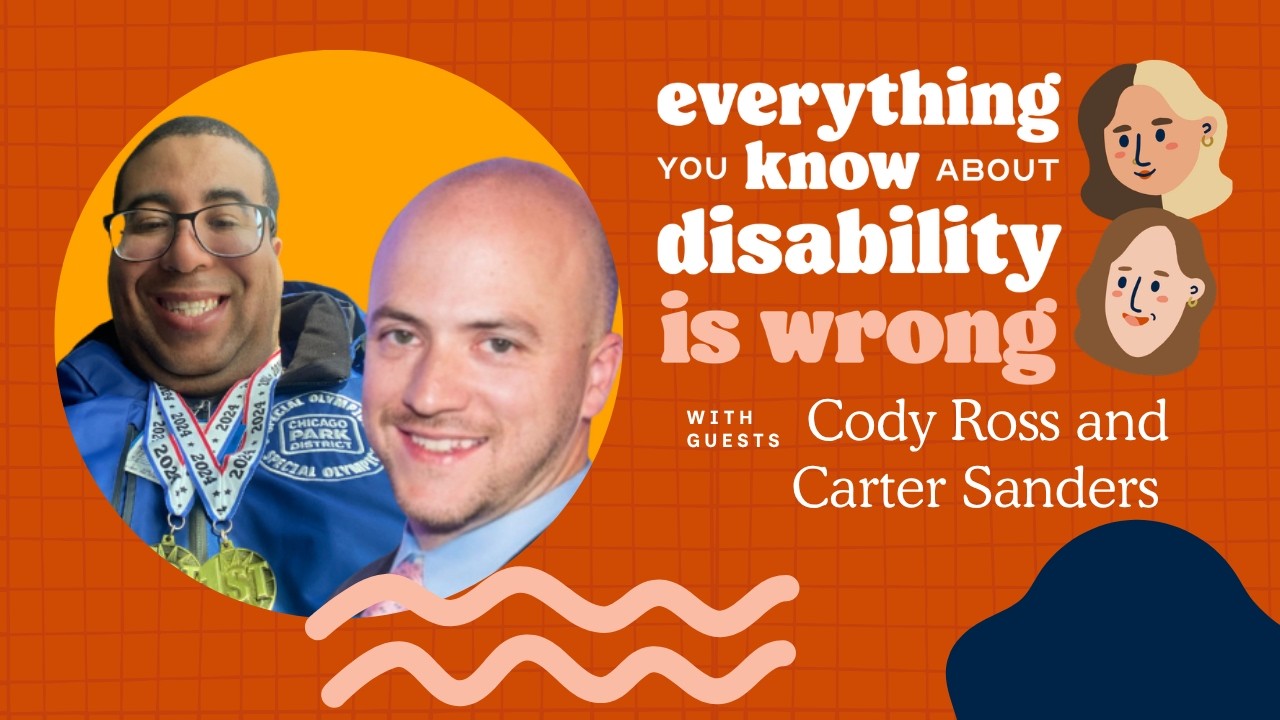
Episode 57 Show Notes
What does meaningful employment look like when people have the opportunity to build skills, take pride in their work, and feel like they belong?
In this episode of Everything You Know About Disability Is Wrong, we sit down with Cody Ross and Carter Sanders of HB Threads, an Easterseals Chicago and Rockford region workforce program that creates employment opportunities for people with disabilities through custom apparel, buttons, and other personalized products.
Cody and Carter share how HB Threads goes beyond production to foster transferable job skills, workplace friendships, and a culture where people feel supported. From producing more than 40,000 buttons for the Chicago White Sox each year, to creating opportunities for employees to grow their skills, their stories show what meaningful employment can look like in practice.
The conversation expands on the importance of vocational training, the role of community and collaboration in building inclusive workplaces, and the everyday accommodations that can make work more accessible for everyone. Cody and Carter also discuss the value of listening to employees, creating space for people to learn from mistakes, and recognizing accomplishments throughout the workday.
As we celebrate National Disability Employment Awareness Month, this episode offers a reminder that inclusive employment benefits individuals, workplaces, and communities alike. As Carter puts it, disability employment is a must. And as Cody reminds us, fear should never keep us from recognizing someone's potential.
Learn more about HB Threads and explore their custom products.
Transcript
Carter Sanders:
Working at HB Threads means tons and tons and tons to me. When you complete an order, especially a large number, you feel this feeling of accomplishment and you feel like you want to gain the same feeling of accomplishment with future tasks. And it keeps you motivated for the next task and the task to come. When you get a task and it's a big number, on paper you're like, "Oh, how am I going to get all this done?" But it takes a village.
[Music]:
Two, three, let's go. Everything you know about disability is wrong!
Erin Hawley:
Hi listeners. Welcome to another episode of Everything You Know About Disability is Wrong. Today on the show, we are joined by Cody Ross and Carter Sanders.
Lily Newton:
We are so excited to have Cody and Carter on the show. Today we are highlighting HB Threads, which is an Easterseals Chicago and Rockford region workforce program that provides employment opportunities for people with disabilities. It's so much more than just a print shop. HB Threads creates jobs, skills, and community connections through really cool custom apparel. And I'm so excited to highlight HB Threads today.
Erin Hawley:
Cody Ross joined HB Threads in 2023 as Director of Social Enterprise and Employment Opportunities. Previously, he worked with the Marriott Family Foundation's Bridges From School to Work program, helping connect individuals with disabilities to employment opportunities.
Lily Newton:
And our other guest, Carter Sanders, joined HB Threads in 2023 after graduating from Easterseals Academy where he previously worked as an office assistant. He also serves as a ComEd Energy ambassador and is a decorated Special Olympian with multiple gold medals. Outside of his work, Carter enjoys wrestling, Hallmark movies, video games, and spending time with his niece. Welcome to the show, Cody and Carter.
Carter Sanders:
Good morning everyone. Thank you for having us here.
Lily Newton:
Thanks for being on our show guys. This is so exciting.
Cody Ross:
We're very excited to be here. Thank you for having both of us.
Lily Newton:
This is so great. I have been working with HB Threads for a little while now, which listeners, we have some amazing merch that we're I'm sure going to talk about today, but the link is in the description. So go check it out and look at the amazing stuff HB Threads is producing because I have had such a fun time collaborating with these guys. I think this is going to be a really great episode. So before we get into the questions, let's go ahead and do our audio descriptions. I'll start. This is Lily speaking. I'm one of your co-hosts and I am a white presenting woman with green eyes and I have half blonde, half brown hair split right down the middle. I'm wearing wired headphones that I'm going to fidget with throughout the entire episode. And behind me is a bunch of books related to disability.
And I'll have Erin, you go ahead next.
Erin Hawley:
Hi, this is Erin speaking. I'm a white woman with red hair and blue eyes. I have on a white sweatshirt and I'm sitting in my room. I'll pass it to Cody.
Cody Ross:
Hi, this is Cody speaking. I'm a white male. I'm a guest on today's show. I have a shaved head, a dark beard, a blue shirt on, and some glasses that I'll probably also be fidgeting with throughout the episode. And I'll pass it to Carter.
Carter Sanders:
Hello, my name is Carter Sanders. I'm a black male, 43 years old, wearing glasses, short haircut, wearing a blue Easterseals shirt with a white Easterseals logo in it.
Lily Newton:
Thank you so much. I should have known the apparel guys would come in great looks. I mean, the matching blue shirts is really... If you're just listening right now, they are repping Easterseals and it looks really cool. Well, welcome to the show guys. I'm so excited to have you here. Just to get us started, how are you both doing today?
Carter Sanders:
We're doing good.
Cody Ross:
Doing great. Yeah. It's a Friday morning in Chicago. We're busy at HB Threads and I think we're both feeling really good. We're really excited about this podcast. We've been looking forward to it.
Erin Hawley:
Nice. Us too. I just love HB Threads. It's so cool. So this month is National Disability Employment Awareness Month and HB Threads is an amazing example of employment opportunities. Can you each tell me what HB Threads is?
Cody Ross:
Carter, do you want to start?
Carter Sanders:
Yes. HB Threads is a social enterprise within the Easterseals Chicago and Rockford regions. It is one of the many pillars within the organizations. What we do at HB Threads is we make various buttons with Mylar, graphics, shells and pin backs of supporting organizations. We have made some for the Chicago White Sox. We have made buttons for various unions and we made some for, I believe, schools and religious organizations. Is that correct?
Cody Ross:
That's right.
Carter Sanders:
And also we've made various apparel. We heat press logos on apparel, specifically polos, t-shirts and sweatshirts. We do it for staff, for those who have been there for many, many years. Each color sweatshirt is based on the number of years they've been there. It could be from one year, five years, 10 years, even 25 to 30 years. We also do pop-up shops in-house and within neighboring communities.
We not only do apparels for Easterseals, we also do apparels for other organizations.
Cody Ross:
That's right. Yeah. And on top of all of what Carter said, Carter, you did an amazing job explaining what we do, but we're also building skills for our associates. They get fair and competitive wages and work that they can be proud of, that they can see in the community. So they're also learning transferable skills for career growth as well. So if they're not with us the whole time, we're looking for other opportunities. HB Threads has so many different skills and different facets that Carter and his peers can learn. So it's not just making a button, but we're also doing shipping and receiving, invoicing. Carter loves computers, so there's data entry, inventory. So when you think of a production space, we also do a lot more than that, which it's exciting to see all the associates learn so many new skills as well.
Lily Newton:
Yeah. And I've visited HB Threads and it's also just such an incredible team environment. It really feels like everyone's working together and everyone's using their best skills, and it's just a really fun place to be. I imagine it's a very fun place to work. Do you both enjoy working there?
Cody Ross:
I love working there, and I think you got some experience when you visited, right? I think I had you on the heat press or making a button, but -
Lily Newton:
Yeah, Carter showed me how he makes the buttons. Carter is ridiculously fast at making buttons. It was very cool to see. What is your favorite part of working at HB Threads, Carter?
Carter Sanders:
Well, being very productive, fulfilling orders because I know those people need them and we do everything in our power to make sure orders are fulfilled and the items are delivered in a timely fashion. I also like the overall camaraderie and the customer service that we provide people, whether it's within the Easterseals Chicago and Rockwell regions, even national Easterseals and within the entire community that we've interacted with over the years that I've worked at HB Threads.
Lily Newton:
Yeah. When I visited, you were working on a huge project for the White Sox. Can you tell me a little bit about that?
Cody Ross:
Do you remember how many buttons we had to do for the White Sox this year?
Carter Sanders:
I don't know the number, but we've made at least four or five figures.
Cody Ross:
Yeah. So every year, so the White Sox have been loyal customers of ours. They've also been great partners with Easterseals Chicago and Rockford region. Every summer, some of the coaches come out and work with the academy and teach them different baseball skills and batting. And so the White Sox have been more than just a customer to HB. They've also been great partners, but we make over 40,000 buttons for the White Sox every year, which takes us three to four months to make. So if you're ever at a game, a White Sox game, and it's your first time there or you're celebrating a wedding or a birthday, you can go to customer service and get a button that says, "It's my first game or we're celebrating." And those were made by Carter and his peers and the staff at HB Threads. So again, it goes back to being proud of your work and also being able to see it in the community, the apparel.
I think it adds a level of pride for the work that our associates are doing when you actually get to see the work on display, which that's one of the best parts for me working there is seeing our associates just thrive and be really excited about different orders and different projects that we're working on.
Lily Newton:
Yeah, that seems really, really fulfilling. Pardon my pun, fulfillment.
Cody Ross:
Yes, fulfilling.
Lily Newton:
Very fulfilling. You both mentioned Easterseals Academy a little bit. For our listeners that don't know what that is, can you tell us about Easterseals Academy and what it was like to go there?
Carter Sanders:
Yes, I sure can. Easterseals Academy is a school for students with autism. I'm very proud to say that I was a former student and a graduate of Easterseals Academy. It has provided me and my peers various life skills for the duration of the times we were enrolled there, and it has given us transferable skills for both me working at the front office and working at HB Threads. I have impacted both aspects in very unique ways, and those lines of work combined has been beneficial to my growth.
Cody Ross:
Right. Yeah. As Carter mentioned, so it's a K through 12 academy. Carter went through a lot of the associates from HB Threads have been graduates of the academy. We have a Chicago Academy and two other academies in the suburbs. That's the Chicagoland and Rockford region in our title. So there's also post-secondary and vocational training programs. And so HB has been working with the academy to see how we can work with the vocational students at HB to get transferable skills or get some resume building before they leave the academy. That's always been a huge passion of mine is as an individual graduates from the academy, what do they have to take with them? So whether we have an opportunity at HB Threads or not, we're not always hiring, so we can't hire everybody. We'd love to, that's why you should order. But yeah, at least they're leaving with some real world life experience that they can put on a resume and then go in the community and look for jobs in their areas.
Lily Newton:
Yeah, your answer kind of explained this, but just for any of our listeners who are kind of new to the world of disability services, can you explain what you mean by vocational and what those kind of services are?
Cody Ross:
Yeah, so the vocational program within Easterseals and other high schools or post-secondary programs really focuses on skill building and figuring out interests and what may be good fits for an individual in a career or a job moving past high school. So they take that opportunity to be through a number of different things, community involvement, going to your local grocery store and job shadowing events, resume building, job clubs, your learning introductions. It can be as simple as learning how to shake hands and introduce yourself or how do we introduce ourselves to employer? How do you fill out applications? So it's great to see Easterseals have that in their curriculum because oftentimes that's kind of overlooked. It's just like when you graduate, good luck, but we all know how difficult the job market is for any individual. So I think vocational training while you're in high school, you still have a net to fall back on.
You still are in school is a key aspect to gaining meaningful employment.
Lily Newton:
Definitely. And Carter, do you remember some of that kind of training that you did while you were at Easterseals Academy, and did that help grow your confidence for your current job?
Carter Sanders:
Yes. Back then we were taught how to write checks. We worked at the store. We did community outings. We went to places like 7-Eleven. And this place, I don't know if it's still open, hopefully is because they have good pizza. Luigi's Pizza, it shows basic customer interactive skills showing if you have enough money for this and that.
Lily Newton:
That's awesome. That sounds like a lot of confidence building along with skill building, which is really important.
Carter Sanders:
Yes. And we know customer service skills, that's very valid, what to do if you have a very difficult customer, you try to maintain your calmness, you try not to feed into their negative energy, and most importantly, you try not to snap back at them.
Lily Newton:
That's some skills that I think everyone could go through. I think everyone needs that kind of reminder that sometimes other people might stink, and that doesn't mean that it has to make you react like that. That's very important. And I think in our world, more people could understand that kind of training. That'd be really good.
Carter Sanders:
Lastly, I forgot to mention another vital skill is using and utilizing public transportation.
Lily Newton:
Oh, that is a super vital skill.
Carter Sanders:
And I have been using it ever since I was taught, and I've had the most experience using public transportation since graduating from the academy. I have 21, 22 years of experience of riding the CTA buses and trains under my belt.
Cody Ross:
Yeah, it's incredible. Carter's been able to come out to the community with us because of his ability to navigate the crazy Chicago transit system. There's different trains, different buses, each have different numbers. So super proud of Carter for that. To touch on that a little bit, I've noticed over the 19 or 20 years I've been in the field of disability employment that transportation is one of the biggest barriers for a lot of individuals. We're lucky to be in Chicago and have such a robust transportation system, but like I mentioned, we have two academies in the suburbs. They don't have the luxury of the trains and the buses all the time. And unfortunately, there's highly qualified candidates who are interested in the job, job openings, but can't take that job because of transportation. So I wish I had a solution for that. I wish I could give the audience a solution, but I think a lot of it is kind of working with the support system around the individual, including the employer, to come up with a plan to see how they can make it work.
I think where there's a will, there's a way, and you'd be surprised that the support system for individuals in this demographic really come together when it's for the greater good and for employment. So it is exciting when you do see somebody get that job who needs it, who needs that extra step of help for transportation, if that makes sense. But it's a real barrier that people have to be aware of and should get the assistance they need. Reach out to your local chamber of commerce or the mayor's office in your town. And a lot of places now do have that kind of, ours is called PACE or paratransit. You can schedule ahead of time. So not to get way off subject, but as we think about employment, that's definitely something you need to consider.
Lily Newton:
Absolutely. And I think it's important that you bring that up because it is a massive part of employment is how you get to your place of employment. Erin, I didn't mean to cut you off. Were you going to say something?
Erin Hawley:
No, I was just going to ask Cody, what made you want to work in this field, in disability employment?
Cody Ross:
That's a really good question. I've always, as long as I can remember, I've always had a passion. It's kind of hard to explain except for passion or fire to help underserved overlooked populations. And I was in hotels for a while and there was an event at the hotel I was working at for the Bridges program, and my boss allowed me to observe that event, and it was celebrating individuals with disabilities who had successfully gained employment and stayed on the job for a long time. And I fell in love even more with this line of work after going to that event. But I grew up at a stepbrother with a disability.
In the school I was in the high school, we were lucky enough to have integrated classrooms, which not to date myself, but when I was in school wasn't super popular. I think we've come a long way since then, but I really appreciated the school system I was in to... It was inclusion, and that's what I continue to fight for because I was able to see that these individuals are no different than you or I or anybody else. It's just maybe they communicate different, maybe they learn a little bit different, but so do I. And so what makes them any different? So them having the same opportunities I had, I was like, "I need to do this with my life to make sure I can give everything back to make sure it continues when I'm not here anymore."
Lily Newton:
Well, I think I love that you just started with it's passion because I think that there's something really beautiful in that, just the passion for inclusion. We really need that. It's very important. Carter, based on the things Cody just said, what does working at HB Threads mean to you and your friends who work there? What does having fulfilling employment mean for you?
Carter Sanders:
Well, working at HB Threads means tons and tons and tons to me. When it comes to fulfillment, I think what Cody mentioned earlier, when you complete an order, especially a large number, you feel this feeling of accomplishment and you feel like you want to do the same to gain the same feeling of accomplishment with future tasks, and it keeps you motivated for the next task and the task to come. When you get a task and it's a big number, on paper you get like, "Oh, how am I going to get all this done?" But it takes a village.
Lily Newton:
That's right. Tell me more about that village. Have you made friendships with the other people you work with? What's it like to have... I've met some of your colleagues and they're amazing, so what's that like working with the people you work with?
Carter Sanders:
Well, for one thing, I've known them since childhood and adolescence, so that should speak volumes.
Lily Newton:
Absolutely.
Carter Sanders:
And the ones that have been new and that came into my lives staff-wise for the last five, 10, 15 years, you slowly got to know them and you build that rapport.
Lily Newton:
Absolutely.
Cody Ross:
I think you mentioned it earlier, Erin or Lily, the environment is just... There's something about walking into HB Threads and there's a real energy that you can feel. And we often have staff from other programs or from the academy join us every morning. We have a morning meeting at 9:30. It's kind of like a group huddle to go over the day's production, but we also do an icebreaker every morning, whether it's, "What are you doing this weekend?" Or, "Let's get up and stretch." It really helps build teamwork and for the associates to express how they're feeling before the day starts, get a pulse on the day. But like I said, there'll be other staff coming down to experience that because unfortunately in today's society, you look at corporate America and how busy everybody is, they don't have time to really check in or you're walking down the street, "How are you?
Do you really mean how are you? Do you want to hear about my day or not?" So we take great pride and the associates really lead this in really caring for each other and wanting to know. So when I ask Carter how he's doing, I'm ready to listen or vice versa. Carter wants to know about how I'm feeling and it's okay not to be okay, which is another plug. We made a button and a shirt that says that on there, but we really do believe that. The world is a hard place, there's hard circumstances, but HB Threads is a light in that, and we're kind of trying to spread that. If you ever have a chance, we'd love visitors, Carter loves friends stopping by, right?
Carter Sanders:
Definitely.
Cody Ross:
Look us up. We'd love to have you.
Lily Newton:
Man, I think that's so important. I love that you bring up that it's okay not to be okay, one, because I love that merch, but two, because in the workplace especially, that's something that I have struggled with and being autistic myself, having the question of am I supposed to be honest? Am I supposed to give real answers? Or am I supposed to give a corporate America everything's great all the time and have to mask what's really going on? And getting to work in the field of disability services, I feel extremely lucky because I can say I'm having a really hard day, and especially with some of the mental health things I face, sometimes it feels like I'm constantly sending my team messages of just not quite feeling great today, but my team is always there for me, and sometimes even just being able to say I'm having a bad day is the thing that allows me to then have a good day.
So I'm interested for you, Carter, how do you get through if you're having a bad day and you have to work that day anyway? How do you get through that?
Carter Sanders:
Well, I guess leave all your problems back at home in the street or wherever it is and try to make the most of your day, put all that stuff in the back of your mind and just be around a very supportive atmosphere. That's how I look at it.
Cody Ross:
Are there things that we're doing at work to help because I'm not always in a great mood either. What are some things we do together at HB that may brighten our spirits or get us out of that kind of place we're in?
Carter Sanders:
Well, I noticed that... Well, I don't know if this is relevant, but we do play music throughout the whole day. We have a smart TV or smart board that has internet capabilities and one of them has YouTube. When you click on the app that turns on the internet, YouTube is on the homepage and they play music. We've played things ranging from 80s, 90s, 2000s. We play some uplifting music.
Lily Newton:
Yeah, I think that's very relevant. I think good music can totally turn a day around. Actually, something we started doing at the Easterseals National Office is we have, they're called Music Mondays, and you can join a Zoom call and they take turns rotating who's the DJ, and it's just a good way to start out your week. I got to experience that at HB Threads, watching you guys pick out what you were going to listen to for that day, and it felt very communal. It felt very like we're setting the vibe and that's really fun. What kind of music were you listening to this week?
Carter Sanders:
Well, we've listened to things, I think we've listened to... I think it was a pianist. I think he has passed on George Winston, I think that's his name. He plays, I think music that they play in yoga class, and we play music like Michael Jackson, and about a month or so we'll be playing Christmas music on, I don't know if this town has this, on Live FM. If you don't, you have to listen to it, even if you have to get on the app.
Lily Newton:
Yeah, I know exactly.
Cody Ross:
Yeah. We also, apart from the music, I mentioned the morning meeting that we have at 9:30, but we're also starting to do an afternoon check-in. So after lunch, we notice you get your food, there's kind of a sugar spike, your energy, and then 30 minutes later we're tired, we're exhausted, at least I am. And so we're trying to do a check-in in the afternoon, get up and stretch or from your chair, however you can, it's kind of like a movement break/check-in, which kind of brings us all back together as a group. And it also, we can check in, "What have you done today?" And everybody goes through their accomplishment of the day, which is amazing to see. It's like you've done so much work from 9:30 to one o'clock, so it's important to recognize that because oftentimes you get through the whole day and you're like, "Well, what did I do?
Did I do anything?" And so we're celebrating in the middle of the day instead of waiting until the order's complete three weeks. We'll celebrate then too. Trust me, we like to celebrate, but I think it's important to celebrate throughout the day little victories that keeps you out of that not being okay space and Carter's joy brings me joy, my joy It brings Rachel Joy. And I think we can all learn from that and try to take it out into the world too.
Lily Newton:
Yeah. I really like that midday check-in. I might steal that and start doing that because I think -
Cody Ross:
Yeah, you could stop that one and you could list off everything you've done this morning and that would probably uplift us all.
Lily Newton:
Yeah, because I think you mentioned with corporate America, capitalism, there's just this need to be so productive and there's always more to get done that it can be really easy to just feel like you didn't do enough always because there's more to do. But that kind of mindset of, well, what have I done? Oh, actually this is a lot of things. I need to take that from you. And I hope there's some listeners who start implementing that. That would be a good alarm to set on your phone to once a day.
Cody Ross:
Would be a great alarm. Yeah. Yeah. A positive alarm. I think there's so much weight put on or pressure put on workers that when there's a mistake made, that's all they think about or all I think about. When I mess up, I can't seem to get that - I'll lose sleep. I'll wake up early. And trying to turn that around for our associates. For me personally, it's what have I accomplished in a positive way? Oftentimes that list outweighs the one mistake I made for the day, but why are we always thinking about the one mistake and not the 10 positive things we've done? So I'll get off my soapbox there.
Lily Newton:
It's an important soapbox. I think that's really important. And with the camaraderie you mentioned, Carter, do you and your colleagues, when one of you makes a mistake, do you guys kind of help each other not get upset about it or help each other move through it?
Carter Sanders:
Yes. We help each other instead of browbeating them and making them feel bad about themselves.
Lily Newton:
Yeah. Knowing you have people you work with that are going to be supportive when you mess up versus are going to be disappointed or cranky, that really makes a difference. It's really important to have people that you just feel safe around and you feel like you can be, I think what do they call it? Permission to fail in the workplace is really important actually. And I think that that can be overlooked sometimes, but it's actually very, very important because when you have permission to mess up, that's when you can actually take risks and do things and try to hit your stretch goals.
Carter Sanders:
Yeah. Because some associates, they do offer constructive criticism and there is a difference between constructive criticism and destructive criticism.
Lily Newton:
Absolutely. Can you tell us more about that? What do you think helps make something constructive criticism versus destructive?
Carter Sanders:
You know how sometimes you start for a sentence with so and so I noticed, so Cody, I would advise that you try to slow down with the buttons and please check to make sure it's not defective versus, hey, what are you doing? Or things like that. And using words that I'm not even going to say in the podcast.
Lily Newton:
Yeah, no, I think that makes a lot of sense. Constructive criticism of not destructive. I like that. It's important. And maybe that should be the next shirt you make. Constructive, not destructive. I like that.
Cody Ross:
All right. I'll make the design. Carter will make the button. We'll send them to you guys.
Carter Sanders:
You got to go for it.
Cody Ross:
Got to go for it, Carter says.
Lily Newton:
Wait, what'd you say, Carter?
Carter Sanders:
Got to go for it.
Lily Newton:
I like that. That's a good mantra to have.
Carter Sanders:
Yes.
Lily Newton:
Okay. So clearly you love your job. When are you the absolute happiest during your day, Carter?
Carter Sanders:
Well, from 9:30 to 2:30, that's when I'm the happiest, primarily because I enjoy working. I have rhythm and making buttons and doing inventory and making shirts to me is therapeutic. Whether you're having a good day or a bad day, it relieves all the tension in your body. And the fact that you're being around people and the fact that you listen to music, everything is so familiar. There's nothing wrong with things not being familiar, but the overall, like Cody said, atmosphere, it makes you feel at ease. It makes you feel nothing can go wrong.
Lily Newton:
Oh, that's so good to hear. I mean, Cody, that's got to feel really awesome to sit there and hear that your program.
Cody Ross:
But I have goosebumps hearing that come from Carter and knowing that he genuinely means that because I feel very similar. My favorite part of the day is my entire day. I think we all kind of believe that and we buy into that and it's a real feeling we have. I really enjoy rolling up my sleeves and getting in the weeds with them, helping in production side by side with Carter, Jamie, Jason, shout out to all our associates and just feeling part of the team. Being able to talk to them on a real level too. While we're doing some of this production, we're talking about what are you going to do this weekend or the White Sox just lost. Well, sports is video games, whatever their interests are. So we try to keep it light also and we try to keep it real. We're all humans, we're all in this together.
We're all dealing with some of the same struggles, some of the same successes. But yeah, I love hearing Carter say that. And I already knew he would say that because it's just kind of who Carter is and we're very lucky to have Carter and all of our associates. Yeah, it's a great place to work.
Lily Newton:
Now I've got goosebumps.
Carter Sanders:
It is a safe space as people call it.
Lily Newton:
That's so beautiful. I'm so glad it's a safe space. Erin, what were you going to say?
Erin Hawley:
No, I love that. It's like when you find a place to work, it makes you feel like that, you never want to leave. At the end of the day, you just want to stay there. But yeah, that's awesome.
Cody Ross:
Yeah. And I think to our listeners, to a hiring manager, to the general managers or CEOs, there's opportunity in your workplace for the same thing. It's kind of removing the fear or the assumptions that you have or may have about people with disabilities that it's going to be too hard to integrate them in the workforce that they're in. Those are all really misconceptions or the fear of the unknown. Maybe you don't know somebody with a disability or you're just afraid to take that next step. Really, it's about removing those assumptions and understanding that the people in general communicate different and learn differently, but being open to that and letting individuals with disabilities have a say and have a seat at the table is very important. And I would encourage anybody in a position to hire or to restructure organizations, whatever you might be going through to really consider that population.
Most reliable workers I've been around, it becomes part of the family like we've talked about, and there's just something that adds to a corporation and organization when you give people a fair chance.
Erin Hawley:
Yeah. I think a lot of employers believe that disability accommodations are expensive or difficult, that really a lot of accessibility is about the culture of where you work and how people understand disability. And why would you not want to have a workplace that is open and welcoming and positive?
Cody Ross:
Yeah, I'm glad you brought that up, Erin. That's super important. And I think it kind of goes back to the fear and the unknown, but ultimately what accommodations do is it's not just for the individual that you might be creating this accommodation for, it becomes for everybody. Like you said, Aaron, it makes the entire workforce a better place to work at.This isn't a redesigning our building, but a small accommodation we recently found was with our graphics, we make tumblers now and we make coffee mugs, and to put the graphic on, you need to put tape on the graphic to hold it. And cutting little pieces of tape with scissors is a disaster. I mean, it's like if you watch me try to wrap a Christmas present, you'd be like, oh, take the scissors away. I can't. So we found a little machine on Amazon or whatever on an online platform that you could put the tape on and roll it and it cuts it for you and you just take it with your hand.
It saved us so much time and just a little accommodation that has made everybody's life easier. Did I have to knock down an entire wall? No. But this has saved us so much time and allowed every associate we have now to be able to place graphics on a tumbler or a coffee mug because of this. So it's not always -
Lily Newton:
It really happened like that, where one thing helps multiple people. At our office, I disclosed to some of my team members that when I get overstimulated during the workday at home, I have a swing chair that I can sit in because the rocking back and forth is really good for calming me down. And when I told that to my manager, she was like, "Let's order you one for the office. Let's do that." And then she also said, she was like, "And let's get a second one and let's put it in the sensory room." And so the Easterseals National Office has two swing chairs. One's at my desk and one's in the, because we have a sensory room that you can step into if you just need to step away because we hire neurodivergent people. So that swing chair, the first day I came in office and it was in there, three or four people came up to me and were like, "Hey, I sat in the swing chair and it really helped my anxiety.
It was really helpful." And I think those people would've never realized that. And it's just fun to see the way that something... It was like we ordered two pop-up chairs that you can fold them up. It wasn't expensive. It wasn't a huge investment. It was just my manager listened to me and said, "Wait, that would make your day easier. Let's do it." And now I don't have to leave work if I feel like I'm going to have a meltdown. I have a way to regulate myself and that ultimately makes me more productive, which is, yeah, I mean, it's the curb cut effect. What you do, accommodation always helps everyone in the building.
Cody Ross:
Yeah. You brought up a really good point with listening, right? I guess just listen. It's so important to listen and allow silence. There doesn't always have to be something in the air, but sometimes within the silence you can learn a lot about people or it offers a person the opportunity to collect their thoughts and how they're really feeling or what they really need. If I don't hear a response from you in three seconds, I'm like, "Well, what's the matter?" Let's let individuals have the space they need. Let's listen to them, and then can we make that work? And if we can't, are there other solutions to do that? Or are there other organizations that might be doing this better than we are? We're not perfect by any means. We love the work we do, but there are other organizations we partner with in Chicago that have some great visual displays or visual supports, and we learn from them.
It's another key piece to disability employment. And as we think about October and what an awesome month this is, we're in it together. We're a social enterprise. We're trying to make money to keep our lights on. All of the money we make goes right back into hiring more people. But if there's another organization who's mission-driven or that is in the same line of work, I'm not going to... I still want to talk to them and I still want to see how we can work together or what practices they're doing.
It takes a village, like Carter said, and so other organizations can be extremely helpful. Don't think of them as competition, but think of them as other resources and partners and trends that we can all be in this disability employment community.
Lily Newton:
Very well said. That's important. So Carter, you've been with HB Threads for many, many years. What do you see is the future of HB Threads, or what do you want to do in your future?
Carter Sanders:
Well, the future of HB Threads, I can see us bringing more people in, more staff. I could see more projects coming in most likely, maybe within the next few years, and I could see us thriving more. I could see us getting more and more clients in addition to the ones we already have. I could see us doing more pop-up events. I could see us take the disability community by storm.
Lily Newton:
I love that. That's really great. What a good celebration of October National Disability Employment Month, take the disability community by storm. I love that. So we've talked. Oh yeah, another button. Let's take the disability community by storm. I feel like you do have a lot of good sayings, Carter. Are there any other mantras or phrases that you're sticking with right now?
Carter Sanders:
That's all I can think of at this point.
Lily Newton:
Okay.
Carter Sanders:
If they come, I'll let you know.
Lily Newton:
Please do. I love your phrases. They're really good. Well, we've talked so much about work and HB Threads, which was the theme of this episode, but I want to spend a little time outside of work. So what do you both do to have fun outside of work? What's your favorite way to spend an evening that has nothing to do with HB Threads?
Cody Ross:
You want to take it? You want me to...
Carter Sanders:
You go first.
Cody Ross:
Okay. I'll go first. Sorry. Well, I have four kids, so I have a 13-year-old, 10-year-old, nine-year-old, eight-year-old.
Lily Newton:
Wow.
Cody Ross:
So they can be very busy. That is definitely... They keep me busy, but it's also the thing that I enjoy most is spending time with them, whether it's outside. We had a great summer, being able to go to the beach or swimming. We like to be outside, and I'd say spending time with them is number one. I enjoy sports. I'm a big sports guy, so I'll watch that or play sports. And then yeah, video games. My kids play video games. I've always played video games, so that's one way we connect as well.
Lily Newton:
That's awesome. I want to hear Carter's answer too, and I also want to say it must be really cool for your kids to get to just see the type of inclusion that you work with every day and just to grow up with that and to just see integrated employment their whole lives. I bet that's really cool for them.
Cody Ross:
Yeah. Yeah. I mean, I think it is. They definitely are interested in what I do, and I've brought all of them down to work before a few different times, and the take your child to work day, and they've all made buttons. They've all met the majority of our associates. So again, it kind of goes back to my introduction is I was lucky enough to be surrounded in the school district that I grew up in with inclusion. And so for my kids to have that same experience and now is super important, and I wouldn't want it any other way. They're going to be exposed to inclusion and that's how it's going to be. It's how it should be. So thanks for Lily. Yeah.
Lily Newton:
Yeah, I love that. All right. What's your favorite way to spend an evening or spend your weekends, Carter? What do you love to do?
Carter Sanders:
Well, while I'm not at Easterseals/HB Threads. I am an active Special Olympics athlete at Marquette Park, part of the Chicago Park District. The sports I am active in are track and field, swimming, bocce, snowshoeing, skiing, bowling, powerlifting, golf, and all of the team sports. I am a proud member of the Special Olympics Illinois Athlete Leadership Council, and I've gotten a very unique opportunity a few years back, along with 15 of my fellow Special Olympics fellow athletes to participate in the Special Olympics Hawaii holiday bocce invitational back in 2023.
Lily Newton:
That sounds amazing.
Carter Sanders:
Yes. In which me and my doubles partner won silver. It was a seven-day trip, and it was a trip of a lifetime.
Lily Newton:
That sounds amazing. How did you get into playing these sports?
Carter Sanders:
I don't know. I guess I did Special Olympics during my time at Easterseals as a student, and then it eventually transitioned to me joining the parks.
Lily Newton:
Well, that's incredible. I knew you did power lifting. I didn't know there were so many other events as well. That is so cool.
Carter Sanders:
Yes.
Cody Ross:
I'm still learning all the events. He comes in and said, "I just competed and got a silver and snowshoeing." So now you do snowshoeing and the list just continues. Very impressive, Carter.
Carter Sanders:
Yeah, it's by season.
Lily Newton:
That's amazing. That's really cool. I feel like what a good way to get your energy out and have a space to play. It seems like it's probably really playful.
Carter Sanders:
Oh, yes, because that's the Chicago Park District's motto, come out and play.
Lily Newton:
Love that.
Carter Sanders:
We still use that.
Lily Newton:
That's really fun. How often do you get to do that with the Chicago Park District?
Carter Sanders:
We have a program from Tuesday to Saturday. There's no program on Sunday or Monday.
Lily Newton:
Oh, nice. But it's every week. That's amazing.
Carter Sanders:
Yes. On Tuesdays, we do bowling. Wednesday, we do seasonal sports. Thursday is sports league/intramurals where we have scrimmage games with different parks and other agencies that does Special Olympics. Friday, we do power lifting. We do classes early on the day, but I'm at work. Saturday, we have morning practice and afternoon social club where we go on various trips to the museum. We went to the Sox Same. We went to medieval times one day. We even do events at the park, like game night of the park, movie night of the park. Some companies come by that we have... I forgot the name of that place that does improv. I don't think it's -
Cody Ross:
Improv Olympics? Second City? Yeah,
Carter Sanders:
That.
Lily Newton:
Second City. Oh, cool. Second City's so fun.
Carter Sanders:
Yes. So yeah.
Cody Ross:
What about CAN TV?
Carter Sanders:
Oh yeah. Thank you for telling me. CAN TV, Special Olympics Athletes/Special Children's Charities participants. We have our crew members there. We talk about the happenings within the Chicagoland area with Special Children's Charities participants.
Cody Ross:
Tell them what CAN TV is.
Carter Sanders:
Yeah, we have TV shows. We make TV shows that we're on TV.
Cody Ross:
It's like a public access TV network?
Carter Sanders:
Correct.
Cody Ross:
Yeah.
Lily Newton:
Cool. Well, that's awesome. And I love that. I mean, your life sounds very fun. That sounds really awesome to like your job and to get to play multiple days a week. That's really exciting. Being such an athlete, are there things that playing sports has taught you that you use in your everyday or work life?
Carter Sanders:
Teamwork and friendship.
Lily Newton:
Yeah. Teamwork and friendship. I like that. Kind of feels like that's a through line of your life at work, in sports, everywhere, teamwork and friendship, which are two very good things to live by. I love that. Well, before we wrap up, is there anything else you want to say about HB Threads or disability employment or just say to our listeners because you've got a captive audience?
Carter Sanders:
I'd say there is something for everyone when it comes to the disability community that disability employment is a must.
Cody Ross:
Yeah, ditto. I definitely agree. That's very well said. I'd say kind of, and I may have already said it, but don't let fear keep you from recognizing someone's potential. So to the captive audience, don't let fear keep you from recognizing someone's potential. I've seen that in my own life and fear can be ugly, but it can also be overcome.
Lily Newton:
Mic drop. Yes.
Cody Ross:
Dropped a pen.
Lily Newton:
That was so good. I think we have to end the episode there because it was so perfect. Thank you guys so much for coming on today. This has been the most perfect way to celebrate National Disability Employment Awareness Month, to actually get to talk to people who are living and doing this work. I'm so grateful for you both coming on the show, so thank you so much for being here today.
Carter Sanders:
You're very welcome. I'm glad to be on here. I hope we connect in the future.
Lily Newton:
I do too. I actually go to school kind of near HB Threads now, so I'm going to start stopping by more because I love you guys over there. Well, listeners, thank you so much for being here. If you're watching us on YouTube right now, thanks for spending an hour with our faces and tune in next time for another episode of Everything You Know About Disability is Wrong.
Legal
Sign up for Emails from Easterseals
Get exciting news, helpful resources, & inspiring stories delivered to your inbox each month.