


Episode 56: Steve Way Has Something to Say!
From Furious to disability advocacy, Steve Way brings humor and honesty to a conversation on accessibility, Medicaid and media.
Listen Now
Published on September 29, 2026.
Watch Video
Episode 56 Show Notes
In this episode of Everything You Know About Disability Is Wrong, we sit down with comedian, writer, producer, and actor, Steve Way.
Steve Way currently stars as Alden on Hulu’s Furious and previously appeared on Ramy and Ramy Youssef: More Feelings. He has written for TIME and has been profiled by Forbes, Variety, Esquire, and Vulture. He also writes about disability and health care policy, bringing his trademark humor and directness to conversations about disability rights, accessibility, Medicaid, and health justice.
Steve joins the show to talk about his role as Alden, his experiences navigating an inaccessible world, and what it means to be a disabled person in the public eye. He also shares why he refuses the pressure to be the “perfect” representative for disabled people and why telling your own story can be a powerful way to make space for a much bigger conversation.
We also discuss accessibility, public transportation, Medicaid, health care, and health justice. Steve explains why making complicated policy issues understandable to everyday people is an important part of accessibility, and why plain-language communication can help more people understand how disability policy affects all of us.
And, of course, there’s plenty of Steve’s signature humor along the way.
Read blogs by Steve Way:
Transcript
Lily Newton:
Because you're that guy, you're the one you have to be right now.
Steve Way:
I'm the guy, that's it. Final year. And I'm grateful that I'm the guy to do it, but some days I want to take off. Some days I want to start drinking at noon and watching wrestling all day.
[Music]:
One, two, three, let's go! Everything you know about disability is wrong!
Erin Hawley:
Hey listeners. Welcome to another episode of Everything You Know About Disability is Wrong. Today on the show, we had comedian, writer, producer, and speaker Steve Way.
Lily Newton:
We are so excited. Steve currently plays Alden on Hulu's Furious and previously appeared on Ramy Youssef: More Feelings. He's written for Time and been profiled in Forbes, Variety, Esquire, and Vulture, which those Variety and Esquire photo shoots are some of the coolest photos I've ever seen. And he also publishes a Substack on disability and healthcare policy. We are so excited to have you on the show. Welcome, Steve.
Steve Way:
I love that you didn't call me an actor because most people tell me I play myself in Ramy and Furious. So yeah, I'm not acting. Just play Steve.
Lily Newton:
I mean, I think it's pretty impressive to have your characters have been pretty much made for you, which is very cool.
Erin Hawley:
You did.
Lily Newton:
Well, audiences got lucky too.
Erin Hawley:
So yeah. It's not just luck, it's talent.
Steve Way:
Thank you. Thank you.
Lily Newton:
Yeah. On this show, we refuse to let disabled people undermine their talent. No luck involved.
Steve Way:
That's tough.
Lily Newton:
I know your self-deprecating humor is going to have a hard time on this show.
Steve Way:
That's good.
Lily Newton:
Well, before I get into the official questions, let's go ahead and do our audio descriptions. This is Lily Newton. I'm one of your hosts speaking, and I am a mixed race white presenting person with half blonde, half brown hair split down the middle. If it's giving what it should, it kind of gives Cruella de Vil. I'm also wearing a necklace that I will fidget with the entire episode, and my background has a lot of disability and health related books behind me. Erin, take it away.
Erin Hawley:
Hi, this is Erin. I have red hair and blue eyes, and I'm sitting in my little chair in my bedroom. I have a flower print shirt, and yeah, I'll pass it to Steve.
Steve Way:
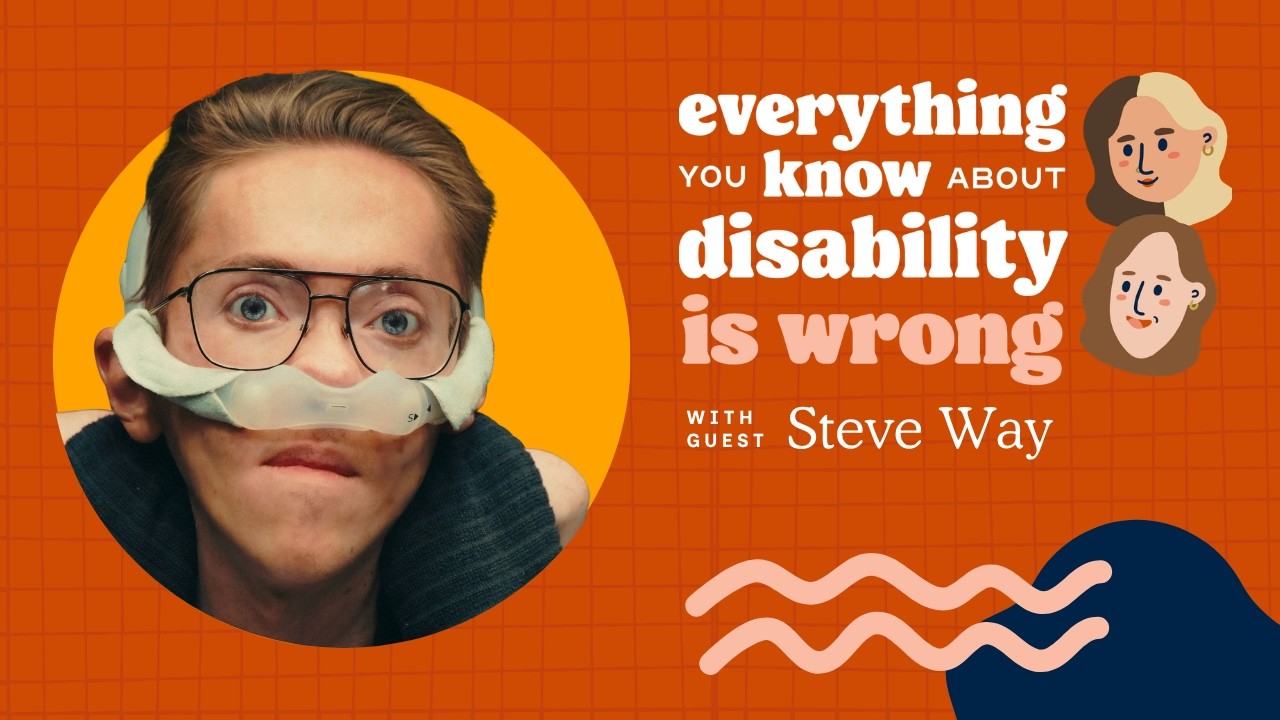
Thank you. Jersey, white tie, glasses, blondish hair, blue eyes, white shirt, blacked out around my neck. Ventilator mask. This is the wheelchair.
Erin Hawley:
Nice. I love that we have two people here today from New Jersey.
Steve Way:
That's the best. It's the best. I don't ever - Yeah. I don't want hear New Jersey slander. Jersey's the best. Any New Jersey shit talk will not be tolerated.
Lily Newton:
I'm half Indian, so New Jersey is where a lot of my family is and it's the best. I love New Jersey. Also, the Jonas brothers are from New Jersey, so I don't have anything bad to say.
Steve Way:
And me.
Lily Newton:
And Steve Way and Erin Hawley. So I think New Jersey has got it big. Are you ready to dive into questions? The first one's pretty fun.
Steve Way:
Do your worst.
Lily Newton:
Okay, cool. I'm going to. I'm just going in. Audience, I told Steve before we started recording that I am giddy with excitement. I don't know if you can feel it. And I do want to spend this whole episode just glazing Steve's talent. I've been a fan for a long time. Listeners, I hope you're as giddy as I am. Let's go. You right now are in Hulu's Furious. What is making you furious right now?
Steve Way:
Wow! Wow. That's great. Well, I'm having a beef with public transit. I took the bus two and a half minutes ago and the lift broke. So the fire department had to get me off the bus. What else is making me furious?
Lily Newton:
Wait, pause. The fire department had to kick you off? They couldn't get the door open in any other way. I saw your social post about this. I don't think it clicked that they had to call the fire. How long did you have to wait?
Steve Way:
I was on the bus probably 45 minutes. Yeah, it sucked. But that's public transit for you.
Lily Newton:
Well, I did see your post about that, so I like that you're trying to do something about it. That kind of seems to be your thing, Steve. You're going to say something about that and I really appreciate that.
Steve Way:
Yeah. I've had many incidents over the last 20 plus years. So I'm trying to strategize, but something has to change.
Lily Newton:
Yeah.
Steve Way:
Because I've been asking them to change for two decades and they won't. So I have to make them.
Lily Newton:
Yeah. And you've got a lot of new influence, new followers.This is a good time for you to have something you want to advocate for. I think that was really exciting.
Steve Way:
Perfect time and sucks for them.
Lily Newton:
Yeah. And for transit on the wider scale, because this is just NJ Transit, but I live in Chicago and supposedly it's supposed to be very accessible, but how often are the elevators down at the actual train stations? All the time.
Steve Way:
Yeah, same in New York. Same here.
Erin Hawley:
I don't even bother taking public transit in New York City, because I'm terrified of getting stuck.
Steve Way:
I think there's a part of me that really hates myself, so I don't care what happens. If I get stuck, I'm not going to die there. Yeah, we'll be fine, but it's a good story to tell. Do it for the plot.
Lily Newton:
Absolutely. I feel like "do it for the plot" takes on a whole other world of what that can mean when you're dealing with just complete inaccess.
Steve Way:
Yeah. I just grew up with Vine, but nobody used to do it for the Vine.
Lily Newton:
Oh yeah.
Steve Way:
Now we do it for the plot.
Lily Newton:
Yeah. I love Vine. I loved Vine so much.
Steve Way:
I miss Vine. I miss it so bad.
Lily Newton:
Vine had just this aura that TikTok could never capture. It was so incredible.
Steve Way:
It was a better time.
Lily Newton:
True.
Steve Way:
Better time.
Lily Newton:
It was a whole cool time.
Erin Hawley:
I never used Vine. I think I missed that one.
Steve Way:
Vine was the tits.
Lily Newton:
It was amazing. Erin, this is so exciting for me to know that you missed. I love being Erin's Gen Z counterpart and getting to be like, "Oh, I have so many videos to show you. I've got compilations of Vines that I'm going to send your way because Vine compilations are like - they've done more for my mental health than many therapists I've had.
Steve Way:
Yeah, that's real.
Erin Hawley:
Steve, you probably don't remember this, but 15 years ago, I think, I had a podcast and you were my first guest.
Steve Way:
I remember.
Erin Hawley:
A lot has changed in that time and I've seen your career take off and I'm wondering what has been the most unexpected part of becoming such a public thinker.
Steve Way:
I think it's crazy that I'm still alive. That's wild. But I think the fact that I'm still doing this, this industry is not always the most fun. And when you're doing this and disabled, that has another layer to it where it just completely sucks your soul. And I've done this through COVID. I've done this through the strengths and we're still here, but I feel like I'm really popping off. I've also discovered vodka and espresso, which has done wonders for my productivity. So a lot of growth.
Lily Newton:
Oh, an espresso martini sounds so good, right?
Steve Way:
It sounds fantastic.
Lily Newton:
I think it's such an interesting. You said you're kind of popping off right now. I'd imagine that this must be such a kind of confusing juxtaposition to live in, to have this, you're taking cover photos for Variety and Esquire, you look like you're the coolest person in the whole world and every day you're probably like Erin and I reading news stories about how our rate should be taken away or how we're going to lose services.
Steve Way:
And I'm writing about it too.
Lily Newton:
Yeah.
Steve Way:
So I'm looking up the hard facts and they're terrifying. I wrote about that in my op-ed for time. It's confusing. It keeps me up at night. I'm not afraid for myself. I'm afraid for other people. We're going to lose a lot of people. And it feels like we're on this clock, and this clock is counting down faster than it should.
Lily Newton:
Yeah.
Steve Way:
And I don't know what to really do other than just make people aware of it, try to prepare people, and then eventually try to undo it. I don't know how much of this we can completely undo, but I don't know if that's me being cynical, but it's not going to be good.
Lily Newton:
Yeah. It's certainly not hard to be cynical about everything. And listeners, if you're like, "What are they talking about?" If you haven't looked up what's going on with Medicaid cuts that have already happened and cuts to Medicaid that are coming and the services that will be affected by it, this doesn't have to become a full explanation podcast, but actually Steve wrote an incredible blog for Easterseals talking about Medicaid and how important it is as a program. Because the thing that I've seen in just trying to get people to understand why these cuts are such a big deal is that the general public does not know what Medicaid does, and they don't know that some of the services that people use are Medicaid. So I'm grateful we have advocates like you Steve that keep writing and educating and talking about it because it is really scary.
Steve Way:
Thank you. I hate it because I shouldn't have to write about this. I don't mean that like. I don't want to make people aware that this shouldn't be happening at all. I feel like there are two layers here. One, you're getting the healthcare for the most vulnerable population of this country. And two, you're doing that so the top 1% can get even richer. I don't know. What are we doing in the richest country of the world when you're taking from the poor and given to the rich? It's literally the reverse Robin ood.
Lily Newton:
Literally.
Steve Way:
It's just so cartuitously evil.
Lily Newton:
When we say life saving services, these are life depending services. And I think it's hard to have these conversations because it feels almost like the only way to talk about it is it's like, well, this is catastrophic, but it is. It really is. And you mentioned being able to undo all of this, and obviously Erin and I being at a disability service company, we're really hoping that we can undo everything, but once harm is caused, it's really scary. And I don't want to lose so many people in our community, especially those who are already having a hard time paying for and having access to care right now. It's going to get even worse.
Steve Way:
Yeah. And it's like we're not even fighting for good healthcare. We're fighting for subpar healthcare. It's disgusting.
Lily Newton:
Yeah. It's almost like it should be a right. Even the subpar, I take it. I take the right to subpar healthcare.
Steve Way:
Better than nothing.
Lily Newton:
Yeah, absolutely.
Steve Way:
It's better than nothing. But soon, it's basically going to be nothing.
Lily Newton:
Yeah. And maybe this is my disgusting optimism, but I do wonder what cool things we'll be forced to come up with as a community. We tend to be pretty innovative, but it's hard to use that part of my brain right now to be hopeful.
Steve Way:
I know it's going to be tough. People are burnt out on a good day, but it's hard to rally people together. I'm really big on solidarity and I'm not feeling it this time. I'm really not.
Lily Newton:
Yeah.
Steve Way:
And it hurts because you don't have to be disabled to be on Medicaid if you live long enough. I'm disabled. So get ahead of it now because if it doesn't affect you now, it might affect you tomorrow. Yeah.
Erin Hawley:
Yeah. What you said about everyone will become disabled at any time in their life, so they should care about disability rights. Yes, obviously, but I hate that people just can't care for other people. It's always like - No, they don't. Yeah. How will this affect me? It's like maybe it doesn't right now, but does that matter? Do you care about people?
Steve Way:
I get it because our news cycle changes every hour.
People are tired. Things are terrible and people don't want to think ahead. That's the idea that it could be worse, but most people view disability as the worst thing in the world. And it's not. It doesn't have to be. And that's why healthcare is my number one issue. I just want everyone to have great healthcare because then everything else gets better. But that also means having affordable, healthy food, having affordable rent, high wages, a good education. And that's health justice, but we don't have any of that. They just keep taking. And I'm sorry to get my soul going about this, but I don't have a choice. It's our lives. They're rolling back our civil rights and no one knows. No one knows that they're trying to take away our right to live in our own home. It sucks.
Lily Newton:
Yeah. It's that no one knows. And you mentioned other issues get solidarity and rallying behind. It's so frustrating. I talk to other disabled people, we all have the same thing on our minds, and then I talk to someone else and it's like, "I didn't even know that was happening." It's like, "What do you mean you didn't know this is happening?" But that's really a big part of it. And I want to go back to something you said. A lot of people really do believe that becoming disabled is the worst thing that could happen. And I think there's two things I want to say about that. One, the level of - that's because of barriers that are put in place. The thing that's the worst thing that can happen is inaccessibility is what people are failing to see, is that you being disabled is not the reason you were stuck on the bus.
The bus lift being broken and a lack of funding for public transit is the reason that you were stuck on the bus. And people kind of miss those.
Steve Way:
Bingo!
Lily Newton:
Yeah. And I just want more people to understand that. And again, this is me being very optimistic, but I do believe in my heart that there is a portion of it does have to do with just people not seeing fully fleshed out disabled characters, the fact that disabled people have been. Community living is not that new of a thing, or I mean not that old of a thing. It's still generally pretty new. People are still just completely unaware to how common and what an average part of life disability is. And I do think that really good characters might be one way that we can get people to care.
Steve Way:
I hope so.
Lily Newton:
I do. I mean, even the way people are talking about your character on Furious, it's really cool to see mainstream entertainment outlets talking about disability and not being weird about it. It's really awesome.
Steve Way:
Yeah. Took long enough, you know. Final year. And I'm grateful that I'm the guy to do it, but some days I want a day off. Some days I want to start drinking at noon and watching wrestling all day, pick someone else because there are plenty of us out there and they're just as good as I am. So let's platform all these other people. I want a day off, but I can't.
Lily Newton:
Yeah, because you're that guy. You're the one you have to be right now.
Steve Way:
I'm the guy, that's it.
Lily Newton:
You're the guy. And this actually leads really well into our next question because I think that in general, when underrepresented groups do get screen time, there then becomes so much pressure on both sides of the actor and the character to be representative of whatever group they're representative of. And that's just something that your average actor is not having placed upon them with each role they get. And so I haven't seen the finale yet, but I'm loving what I've seen of Furious so far. And one of the things that I'm really loving about it is that none of the characters who are representative have to be perfect at any means. I love that the survivors of trauma are not perfect victims. I love that the heroes of the show are not perfect agents. I just love it. And I think that this role being made for you is probably why it's such incredible disability representation, but I just love to hear, do you feel that pressure?
How do you say no to that pressure of being the perfect representation?
Steve Way:
Something I learned from Ramy in 2019 is that he told his story. He's not here to tell the universal Muslim story.
Lily Newton:
Right.
Steve Way:
And I really took that to heart. I'm speaking words from a page. Sometimes I pull them out of my ass, but I'm portraying a character. When I'm interviewed, I'm telling my story. Of course I can talk about this greater struggle with healthcare and civil rights and services, but at the end of the day, I'm just telling my story. But as a consequence of that, I'm raising awareness to the greater population of disabled people. I don't give a fuck what anyone thinks. I'm going to give my story. I'm going to live my life the way that I want to. And if you don't like it, I don't care. I'm not going to lose sleep over it. Probably my favorite quote of all time is art is for the artist, and I feel that way whenever I speak. If you don't like anything I do, I'm not doing it for you.
I don't care if that makes you happy or sad. I really don't. I can't please everybody. It's a fact. That's a fact. So yeah, it's two parts, but at the end of the day, I'm telling my story and I'm going to help people, but I'm really proud of that.
Lily Newton:
You should be very proud of that, I think. And also that answer was phenomenal. So it was so good. And I think I love the art is for the artist. I know you got to work a lot directly with Elizabeth Meriwether making this character. Is there anything about Alden that feels like playing this part of him is so for you?
Steve Way:
Well, I think Alden is the opposite of Steve on Ramy. Steve on Ramy is very brash, honest, outspoken. He's not afraid to set up for himself. Alden is timid, doesn't leave his house, stays to himself. I don't think he has many friends. He's attached to this woman he loves, and he's happy with that. But I think both characters are two sides of myself. There are days where I don't want to leave my room. I don't want to talk to anybody. I just want to be on my computer. And I'm really grateful that Liz gave me the opportunity to portray that side because we did it in a way that's not dehumanizing and you don't pity him.
Lily Newton:
I know you worked a lot with Elizabeth after table reads. Was there open space for you to say like, oh, that's reading as pity. I don't want to do that.
Steve Way:
No, not really. It was just more about the specificity. What would I say? What would I do? Like the shower scene. That was my shower chair. That was my soap. When we first meet Alden and I say howdy. I say howdy to everybody. It's just a word I use. Yeah, I was given a lot of freedom, but also a lot of trust to say the right thing. And they kept most of it and I'm so thankful for that.
Erin Hawley:
That's awesome that they kind of let you bring yourself into the character to be authentic. That's awesome. During your first tour, you said that it's rare to see disabled characters fall in love on screen. Can you talk about why this love story is so important to show?
Steve Way:
Well, it just is. It just is. Catherine is not with Alden because she says, "I don't want him to be alone." But Alden is the only character where she feels her fingertips, right? Says, "I can feel my fingers." She doesn't ever say that with anyone else. What they have is special, but it's a very unique kind of love. And usually it's a disabled guy who wants to lose his virginity or who wants to die. But this isn't that. Alden is very important to this whole story and that's sick.
Lily Newton:
Yeah, it is sick. It's also such, I think at where we are in history right now, such an important story about caregiving. And I know you've talked about this a lot, but yeah, that two-way street of caregiving, I think it's so special. I love that you used that word because their relationship. I mean, even the very, very first time that you see Catherine and Alden together, that scene where you say, Howdy. When I first watched that, I was like, "Oh, Steve's character's here. I'm so excited." Then it was like, "Oh, this is going to be an important relationship." You can tell from the way that Catherine's completely different around him. A lot of people think that caregiving is this one way street and it goes from whoever looks the least disabled to whoever looks the most disabled. And that's just not the case at all. And I think that this show does a really great job where obviously you're seeing the caretaking happening, but you're also seeing the way that he's taking care of her.
And I think that's just really, really beautiful. And I know that you and Elizabeth met at a caregiving panel that day. I mean, did you expect this at all after speaking with her?
Steve Way:
No. No. It's so funny because I traveled a lot by the 48 hours leading up to that panel. I took three train rides. I did two setup shows, two different cities. And my body was killing me. I was a lot of pain. I remember the panel and we're talking about everything we're working on and I'm like, "I'm in a void." So if anyone has other work, I take it. Always shoot your shot.
Lily Newton:
Always. Well, and the fact that you being so open about that is kind of. I've watched some of Elizabeth's interviews talking and she's like, "I was just like, this is so amazing. He's doing this bit about needing a job and needing health insurance." And it's like, "It's not a bit. This is your reality." And the fact that she saw that and was so inspired by that, I think is so incredible. Usually I hate the word inspiration, but hey, if it means that you get a TV show written about you...
Steve Way:
Yeah! Yeah. I think this is a fair time to use that word.
Lily Newton:
Yeah.
Steve Way:
Yeah.
Erin Hawley:
We can use it and we can use it like disabled people. I mean, non-disabled people can say it as well. It means something very different, coming back in our community.
Lily Newton:
Yeah. Or like, "Oh, you've inspired me to tell a different story than I maybe would have," is a lot different than like, "You're inspiring me to get out of bed." Yeah.
Steve Way:
And there's nothing wrong with the first part.
Lily Newton:
Right.
Steve Way:
I love that.
Lily Newton:
I mean, it seems like everyone involved, these characters took. There was so much care to each of them and all of you that are playing the characters had such roles in really crafting who they are. I think that it really translates through the show.
Steve Way:
Yeah. Fantastic staff. It's wild. Yeah. It was such an honor to work with everybody. They really brought out the best in me. I tried to match their energy, their caliber, and we did that for each other.
Lily Newton:
Yeah, because I mean, your first show with Ramy, you guys were already friends for so long, so it must have been quite the experience getting to set that first day of years filming.
Steve Way:
Very, very different.
Lily Newton:
Do you have a favorite memory from set?
Steve Way:
I loved the shower scene. It was so different. So different from what I used to. The scene where Catherine stabbed Hal in the eye, it was so funny just talking to that actor. You know, off screen. We're just chilling. I just got this prosthetic over his eye, Bob. On Halloween, I filmed and I dressed up as a labubu, but I drove through set in my labubu costume and I got dropped off from my sprinter van from set to a bar. Yeah, it was sick.
Lily Newton:
That's incredible. Oh, that's so good. So we've talked about a little bit getting to see love on the show. In real life, I'm curious, our show is called Everything You know About Disability is Wrong, and in getting to portray love on screen and also having love in your real life, what do people get wrong about disabled love?
Steve Way:
I'd rather just comprehend that someone would commit to me unconditionally without being my nurse or feeling bad for me.
It's just two people who love each other. But like you said before, I'm not caregiving. They don't understand that there are ways pretty much I take care of my girlfriend. It's a two-way street. We are devoted to each other and that's the only way it works.
Erin Hawley:
Yeah.
Lily Newton:
Yeah.
Erin Hawley:
I noticed what you said, people don't even think it's possible. It's just the basic understanding is not there. And I think it's getting better, but it's still a very prevalent though.
Steve Way:
Yes. Yes. And to your earlier point about having more disabled characters, we have people like Cole and Charisma, Shane and Hannah, who have so graciously put their lives out there for the masses to see. And I think that's helped a lot. Here's the thing, and this might be a controversial take. I love how you both like... I think disabled people, especially influencers, have to stop talking about the online hate. Stop acknowledging it. Stop giving it a platform. Stop boosting it. Just ignore it. Just ignore it. It'll never go away. It'll never go away. We're all adults. We can take it. And if you can't, you picked the wrong profession, you picked the wrong industry. I get hate every day and I never talk about it and I just ignore it and I go about my day. That's it. It's the end of it.
Focus on that good. Don't give them a platform. And again, there has been hate for millennia. It'll never go away. Just have fun.
Erin Hawley:
Yes. I got excited when you said that because my mom and I had that very conversation today that if you don't address the hate, and this is not based on any specific person, but if you don't address the hate, you're letting your experiences that you're sharing speak against that hate without having to say it and address it completely, and highlight a text that you got that was offensive. Also, other disabled people are then experiencing the hate that you're experiencing. So you're traumatizing your audience. Not that... do what you want to do with your audience, but that's how I think of it.
Lily Newton:
Yeah, because if you just don't acknowledge, then it allows the nobodys behind their keyboard to stay nobodys behind their keyboard. That's, I think, really important. And yeah, I also think that. Now, I'm sure that there's specific types of hate that our community gets, but hate on the internet just exists. You're right. It just exists. And to think that our community is going to be exempt from that would be like, well, that we just wouldn't be able to get on the internet. So I do get that. And I do think that just sharing joy does have a lot of power. Obviously, sharing authenticity is really exciting and everyone should be able to share whatever they want to share. And I do think that the joy, and I keep coming back to the Esquire and Variety pictures you took, but Steve, you look so cool. I mean, you look cool all the time, but those covers, I looked at them and I was like.
I felt good. I felt awesome. I was like, "I love these." And I felt like I just want more good for our community because that is real and that's really where we should be focusing energy on addressing the bad stuff, not the trolls and the comments. Call your legislators, not the people commenting on your Instagram.
Steve Way:
That's right. Yep.
Lily Newton:
So you have been doing this fight for a long time and you write your own content. You really are that guy. I'm wondering, how do you keep going and why is the educational content so important to you? I say that because you've written two of my favorite Easterseals blogs listeners. If you haven't read them, there's one on the ADA and one on Medicaid and you're really good at taking concepts and just breaking them down for the everyday user to read. Why is that kind of education so important to you?
Steve Way:
I think we have to get a wider audience to understand. I think a lot of people lack critical thinking skills, so I try to convey a message in a way that everyone can understand. These are complex issues. Medicaid is complicated. Navigating an insurance denial is very difficult. So I have to break it down and simplify it so your average person can understand it. But to me, that's just accessibility. Accessibility helps everybody. So I want to apply that to my Reddit.
Lily Newton:
Yes, because you were speaking on health justice earlier and it made me think of the - yes, writing in plain language is a part of health justice. Getting people the information they need in a way that they can understand and digest is really, really important accessibility that some people I don't think would consider accessibility, but it really is. So it's really a skill to be able to take complex topics and make them understandable. I bet you being so good at standup and comedy, that kind of the brain you have to use to make people laugh is actually pretty similar. It's all the same. Yeah.
Steve Way:
It's all the same. Yep.
Lily Newton:
Yeah. Getting people to laugh and getting people to learn are right, right there together.
Steve Way:
Yeah. And it took me a while to figure out how to do it, but now I just apply it to everything.
Lily Newton:
Yeah. How long into doing standup did it take for you to be like, "Oh, I've got this. I'm really good at communicating like this."
Steve Way:
Oh, right away.
Lily Newton:
Nice.
Steve Way:
Yeah. I've been public speaking since I was nine, so I must be doing something right.
Lily Newton:
Yeah. You've had a lot thrust onto you and a lot of pressure to communicate to a lot of people. And I got to say, you've handled it just as class act. You're very good.
Steve Way:
I appreciate that.
Lily Newton:
I really do mean thank you from just being... I also want you to be able to take a day off and start drinking at noon and watch wrestling all day. That is amazing. And I know that there are many days you want to do that that you can't. And I just hope you get the gratitude you deserve because we have a lot to be grateful for in advocates like yourself who are willing to do this work.
Steve Way:
I get it. I definitely feel it. Thank you.
Lily Newton:
Good. Well, I'm glad. And before we go, is there anything else you want to say? Anything you think people get wrong about disability we didn't cover?
Steve Way:
Yeah. I think we are assholes. I think we're freaks, just like everyone else. We like to have fun and we just want to be understood. We're not that different, so stop treating us like we are.
Erin Hawley:
Yes. I love that. That should be our quote.
Lily Newton:
Yeah. We'll start the episode with that and it's our mic drop moment. That was really amazing. I mean, we are assholes and freaks. I really like that. It's really important. Well, thank you so much for coming on our show. I truly was a dream to talk to you, and this has been so wonderful.
Steve Way:
Thank you. I appreciate this.
Lily Newton:
You bring it real every time, like every interview I've seen with you. It's really incredible and I'm really grateful we got to spend the hour with you and listeners. If you haven't watched Furious. Well, actually, I'm taking a moment for one of my favorite shows of all time. If you have not watched Ramy, it is so, so, so good. You should go back and watch the whole thing. It's amazing. And you should watch Furious, which is currently on Hulu. It is in the top shows, and if you haven't watched it, come on, you're missing the cultural zit ice. We're talking about it. Get on board. Erin, as always, I love you. Thanks for hosting this show with me.
Erin Hawley:
Yes, I love you too. I thank you, Steve. This was so awesome. So thank you.
Steve Way:
Thanks, y'all.
Lily Newton:
And listeners, thanks for being here. Every time you release a new episode, if you're watching this episode on YouTube, thanks for spending an hour with our faces. I love doing this show. I hope you loved the episode, and we'll see you next time for another episode of Everything You Know About Disability Is Wrong.
Legal
Sign up for Emails from Easterseals
Get exciting news, helpful resources, & inspiring stories delivered to your inbox each month.