


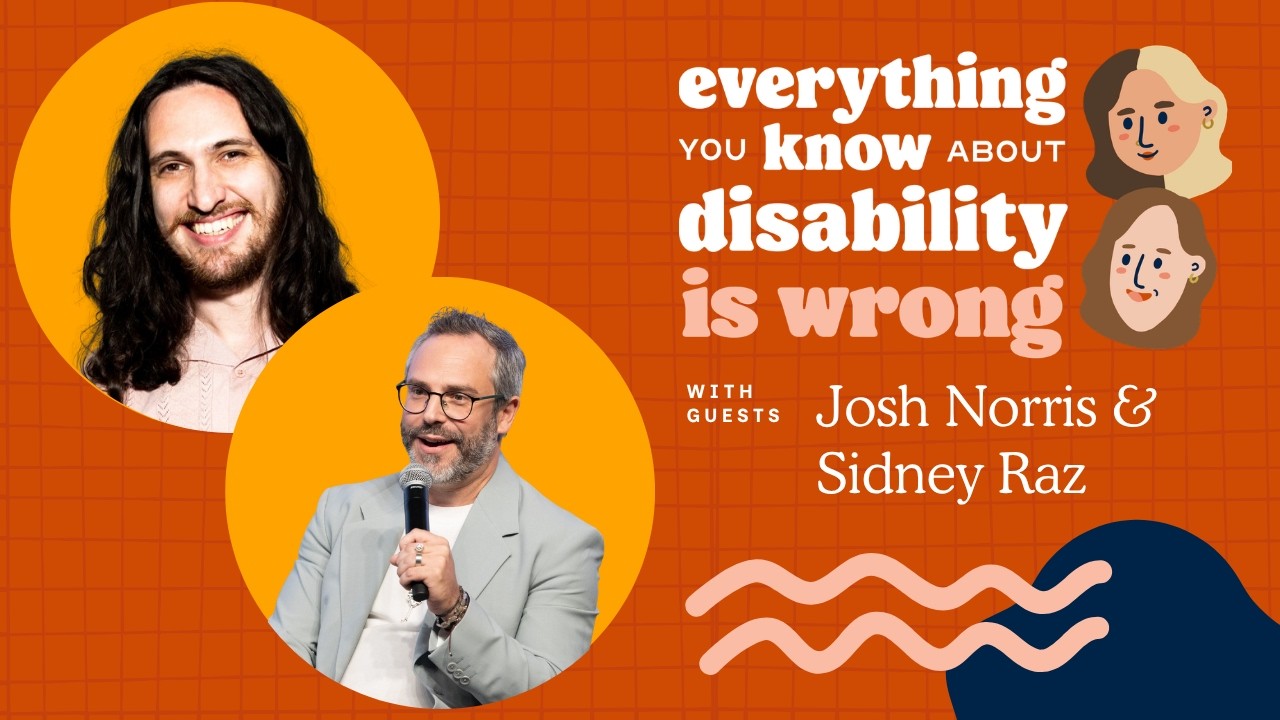
Episode 55: Getting Dressed with Pride: Adaptive Fashion and the Power of Care with Josh Norris & Sidney Raz
Disability pride starts with showing up as you are. Josh Norris and Sidney Raz discuss adaptive fashion, care, access, and identity.
Listen Now
Published on July 9, 2026.
Watch Video
Episode 55 Show Notes
Disability Pride looks different for everyone. Sometimes, it begins with something as simple as getting dressed.
In this special Disability Pride Month episode of Everything You Know About Disability Is Wrong, we are joined by Joshua Norris, CEO of Silverts Adaptive Clothing & Footwear and IZ Adaptive, and creator Sidney Raz to explore how adaptive clothing can be both a practical accessibility tool and a powerful form of self-expression.
Joshua shares the nearly century-long history of Silverts, the world's first adaptive clothing company, and the mission that inspired him to lead an employee buyout to preserve the brand. Sid reflects on his life-changing cancer diagnosis, total stomach removal, and the ongoing process of navigating disability, grief, and acceptance in the public eye. Together, the conversation highlights why accessibility, fashion, and disability pride belong in the same conversation.
The group also discusses the importance of adaptive clothing beyond function, how small acts of care can create meaningful change, misconceptions about cancer and disability, and why making accommodations for yourself is something to be proud of. Whether you're newly navigating disability, supporting someone you love, or simply interested in building a more accessible world, this episode is an honest reminder that disability pride doesn't require having everything figured out—it simply asks us to show up as we are.
This episode is in celebration of a brand-new partnership between Easterseals, Silverts, and IZ Adaptive! From July 6–31, 5% of every purchase at silverts.com and izadaptive.com supports Easterseals programs across the U.S. and Canada.
Transcript
Sid Raz:
Silverts Adaptive, like Josh said, reached out at a time when I was very vulnerable, but also very unaware of needs that I would have. That was something that I was trying to promote the most to my audience when I found out that I was going to lose my stomach completely. The Silverts Teams knows this, but I did not use the clothes as soon as I should have.
[Music]:
One, two, three, let's go! Everything you know about disability is wrong!
Erin Hawley:
Hey listeners. Welcome to another episode of Everything You Know About Disability is Wrong.
Lily Newton:
We're your hosts. I'm Lily Newton.
Erin Hawley:
And I'm Erin Hawley.
Lily Newton:
And today we have an extra special Disability Pride Month episode. I'm super excited because today on the show we have Sid Raz and Josh Norris.
Erin Hawley:
Josh Norris is president and CEO of Silverts Adaptive Clothing and Footwear and IZ Adaptive. Two of North America's most recognized names in adaptive fashion.
Lily Newton:
Sidney Raskin, AKA Sid Raz, has been all over the internet making videos since 2007. After gaining popularity in 2021, he became a full-time content creator. In 2024, he learned he had a genetic mutation that led to the discovery of stomach cancer. Now, along with his life hacks, he advocates for early detection cancer research. And through his videos, he helps others see that living without a stomach is possible.
Erin Hawley:
Sid is an ambassador for Silverts Adaptive Clothing and Footwear and IZ adaptive. And we are so excited to have Sid and Josh with us here today for this episode because today we're celebrating disability pride and also a new incredible partnership.
Lily Newton:
Yes, we are so excited to share that this July, which if you're listening to this, it's July, it's right now. This July, Easterseals, Silverts and IZ Adaptive are partnering together for the first time. From July 6th through 31st, 5% of every purchase at silverts.com...we'll put this on the screen... S-I-L-V-E-R-T-S.com and IZ adaptive, izadaptive.com, supports Easterseals programs across the US and Canada. We're so excited about this collaboration. It is so cool to have two companies whose values come together so much working together during Disability Pride Month. This is amazing and this episode's going to be amazing. Let's bring in our incredible guests.
Erin Hawley:
Yes. Welcome to the show, Josh and Sid.
Josh Norris:
Thank you so much. Great to be here.
Sid Raz:
Hi everybody. Thank you so much for having me. This is so cool. That was such an exciting description. I'm sorry to break the fourth wall, but I was dancing the whole time.
Lily Newton:
You were dancing. It made me really happy. That's why I sound so giddy during that intro. It was amazing and it's always so fun to get to brag about our guests and getting to brag about Silverts and IZ Adaptive and our amazing guests. This is just so much cool stuff happening on the show. So I want to get into the interview, talk about this partnership, talk about Disability Pride. But before we do that, let's make sure this show is inclusive and accessible. Let's start with our audio descriptions. I will start first. This is Lily speaking. I am a multiracial woman with half blonde, half brown hair split down the middle like Cruella de Vil. I have bright green eyes and I have a necklace that I wear in every episode that I will probably fidget with the whole time. And I'll pass it... Oh, I should say there's a bunch of disability books behind me.
I like to have them behind me to kind of show who I am. Erin, over to you.
Erin Hawley:
Yes. Hi, this is Erin. I'm a white presenting woman with red hair that you can't tell because it's very dark in my room. And I have a white t-shirt with stripes and blue eyes and I'm sitting in my chair in my room. And I'll pass it to Sid.
Sid Raz:
Hi everyone. I am a white presenting male, pronouns he/him. I have a fun Hawaiian shirt on with green, black and pink flowers on it. I have a bunch of stuff behind me on some bookshelves, including all of my badges that I've gotten from many conferences and an Adventure Time, one-of-a-kind artwork called Adventure Timeout that I truly love. Some other tchotchkes behind me, including my book, a locker with my production equipment, a microphone is sitting in front of me. I have brown hair with headphones over that. My hair is up right now because it's a little dirty. Don't tell anyone. And I'm just very excited to be here.
Lily Newton:
Well, we're so excited to have you. Over to you, Josh.
Josh Norris:
Awesome. I'm Josh. I am a white male with short brown hair, glasses and a somewhat grayish beard. I also wear a necklace that I'm probably going to fidget with through most of the episode, so wonderful to be here.
Lily Newton:
Yes, love a shared fidget necklace. I have stacks and stacks of fidget toys behind me and nothing will do it quite like whatever necklace I'm wearing.
Sid Raz:
If anyone is a big fan of Doctor Who, I also have the first Doctor and the 10th Doctor from an art exhibit that I went to that is also one of a kind, and I'm very excited about those.
Erin Hawley:
I was about to ask you, who is your favorite Doctor?
Sid Raz:
Honestly, it's kind of hard. I really did love Matt Smith's Doctor just because I feel like he brought the Doctor back in a way that was really fun and not too sad, but you really were rooting for him. But I have a Jodi Whitaker mug downstairs that I got from a Doctor Who convention here in Los Angeles. Honestly, I love the most recent Doctor, even though he cried a lot, but the stories were really cool. I don't know, it's a difficult thing, but if I had to go with anything, I feel like Matt Smith really cemented my love for Doctor Who for sure.
Erin Hawley:
Nice.
Lily Newton:
I feel like that's it. Your Doctor is whoever the Doctor that cemented your love for the show. I have so many, it's hard to pick from, but David Tennant is the one that I was watching. I was watching David Tennant when I fell in love, so he'll forever be my Doctor.
Sid Raz:
Yeah, exactly. And David Tennant's ability to bring you in and then I don't want to spoil anything, but is ever... I mean, Josh, I'm sure you're a huge fan, right? But I know we have questions to get to, but for all the listeners, it's just going to be me air to literally just nerding out about Doctor Who for a little bit.
Lily Newton:
Okay, but there's something that is disability pride in nerding out together.
Sid Raz:
Absolutely. Absolutely.
Erin Hawley:
And really fast, my favorite Doctor is the ninth Doctor, Christopher Eccleston.
Sid Raz:
Oh, okay. Okay. So that's actually good. So we have the relaunch of the series in a lot of ways, nine, 10, and 11, which is great, which is great.
Lily Newton:
This is pretty good. Yeah, I feel like Dr. Who is a world connector and world connectors often have groups of disabled people who connect online about them, which is awesome.
Sid Raz:
Absolutely. Absolutely.
Lily Newton:
Okay. Well, I guess the meat of the episode, we'll get into it a little bit. I guess. Josh, let's start with you. I would love for you to... We know all about this partnership, but for our listeners and viewers and readers, can you just tell us a little bit about Silverts Adaptive and IZ Adaptive?
Josh Norris:
Yeah, absolutely. Okay. So Silverts is a 96-year-old company in the world's first and original adaptive clothing company. It started as a chain of department stores in rural cities that just started listening to its customers and was really a part of the community. And as the customers aged and couldn't make it into the store anymore, we just started driving the clothes to them. And eventually one day we came across someone who was getting much older who couldn't even raise their arms to put on the dress that we brought to them. So the founder of Silverts cut up the back of a dress and wrapped the garment around their arms and secured it at the back and Adaptive Clothing was kind of born from there. Business continued for many years, really servicing the elderly hospital networks, nursing homes. And it was very much a function business, not really fashion, but the clothing was super functional.
Where IZ Adaptive is really, they are the OG adaptive fashion company. Izzy Camilleri, who started the line, is a total icon.
Lily Newton:
Icon. Legend icon. Dressed David Bowie. That's right. Icon.
Sid Raz:
What?!
Lily Newton:
Yeah.
Josh Norris:
One of the coolest people you'll ever get the pleasure of meeting. And a friend of hers who was a quadriplegic after a shooting accident was getting an award at a big ceremony and hit up Izzy to make a cape for her for the event. And that's when Izzy learned about Adaptive and it really spoke to her. And in that time, I guess a couple years later in 2009, she launched her full line and really made Adaptive the bulk of her career, has done amazing work in film, but has really committed her life's work to Adaptive. And she's become easily the best designer of adaptive clothing in the world and became a friend and mentor to me and someone I looked up to greatly. And I really don't know anyone who's fought harder for Adaptive than Izzy Camilleri. And she now works as the chief design officer for both Silverts and IZ Adaptive.
Lily Newton:
Thank you so much for sharing all of that. I love that you led with you are a functional brand and the brand was all about function before that. And then Izzy coming in brings this high fashion to it because I think that's so many times on this show we talk about the ways that a lot of times things designed for disabled people are very much on functionality and there's kind of an assumption, I guess, that maybe we don't really care about what things look like, which could not be more wrong. And I see the amazing people in my life who are bedazzling their mobility aids and we care about fashion. And I think that's such a cool thing that by bringing in this other company, you go from not just function, but function and design. I love that. And now let's move to this partnership with Easterseals.
And I keep saying that to me it just makes sense. 96-year-old brand, 100-year-old organization. There's so much going on here. In your words, why does this partnership just make sense?
Josh Norris:
Well, Lily, you said it, 200 years of service to the disability community between our organizations. I think we share a vision, we share a purpose, and we all work to break barriers and make a real impact. And at Silverts and IZ Adaptive in another way, our biggest challenge is category awareness. Most people don't know that the products and solutions we create exist. And when I look at Easterseals, I see the brand in servicing the disability community. So I feel this is a true unlock in getting to reach so many more people who can just benefit from the solutions that our clothing provide and we can get these goods into the hands of people who we can help.
Lily Newton:
Amazing. And there's no better time to do that than Disability Pride Month. This is such a great time to... We have eyes looking at our page and figuring everything out. If we can bring Silverts and everything you all are doing to new audiences, that's just so exciting because everyone deserves... We're talking about in this campaign to get dressed with pride. It is important actually. And as many of our listeners will know, I talk about it all the time, but I have Ehlers-Danlos syndrome and I often dislocate things while trying to reach in ways I should not. And to think about that, wow, there's people who are innovating out there so that I don't have to contort my body. It's really incredible and it's a partnership that we keep saying it's just the beginning. It makes too much sense to not continue. So I think listeners, viewers, readers, you're going to be hearing more about Easterseals, Silverts, and IZ Adaptive.
There is a cool story in here that I want to get to. Erin, will you go to the next question?
Erin Hawley:
Sure. So how did you first get involved with Silverts and what about the mission inspired your employee-led buyout in 2024?
Josh Norris:
Yeah, so a lifetime ago I was a professional poker player and I did that for about eight years at the highest levels one could compete at. And I was turning 30 and I asked my now father-in-law for permission to marry his daughter. And he said, "Sure, just find a real job."
Sid Raz:
That's so good, man.
Josh Norris:
And just so honest and accurate. So I was like, "Okay, time to do something that's not completely self-involvement. Maybe I could contribute something to the world." So I found this company doing adaptive clothing and the owner happened to be a distant cousin who loved poker. And he was like, "If you can be poker, you can probably help me in my business." So the kindest thing anyone has ever done for me is he gave me the opportunity to learn the business from the ground up. I started in the warehouse 14 years ago packing orders for my first couple years there. And I fell in love with the mission and what we do. I've gone on to work every job in the company from product and marketing operations. All the way through in 2018, were purchased by a big medical apparel company. And eventually I went on to work many other jobs in their business until one day the CEO of the company asked me to make sure I spent no more than 1% of my time on my work at Silverts.
And that's what I knew it was probably coming to an end for Silverts being owned by this large apparel company. So sure enough, a couple months later, they called me up and they warned me they were going to liquidate the company but wanted me to stay in my other jobs that I'd taken on. So I asked them before they wiped out my baby in front of me if they would consider selling it to me. And remarkably they agreed. So I never even thought about it from that conversation. I just dove full in because Silverts and its mission are very meaningful to me. So along with my wife, who's my business partner and the chief communications officer here at Silverts and is, we went for it. And yeah, I mean for the better part of a decade, I've known this is my life's work. And we spent the past, I guess, the year and a half since we acquired the business, just trying to find a way for an adaptive clothing company to really stick around and become more significant because we've seen a lot of adaptive companies come and go along the way.
Lily Newton:
Yeah, absolutely. I think that makes total sense. And I think there's something in this story about how important it is to feel meaningful at your job and to feel like you're doing something. And I urge any viewer listener who is hearing this right now to consider there's a lot of need for service and care for the disability community, whether that's the Easterseals lens of providing services to what Josh is doing with adaptive clothing. I think there's just a whole career field out there that has to do with the disability community and it is incredibly rewarding and also incredibly necessary because when we innovate the world to be accessible and inclusive for people with disabilities, it works for everyone. But like Josh has said, these aren't necessarily the companies that get the most talked about. So a lot of people don't even know these things exist.
And I'm really excited about this partnership and Sid, so excited to have an influencer like you be a part of this because it really is bringing Silverts and also just bringing disability into mainstream conversation. I think we've come such a long way in the last 30 years since the ADA, but at the same time, there's still a lot of conversation that hasn't happened. So I'm interested, Josh, you have all this amazing experience and now you are working with someone like Sid, who is an incredible influencer. And I'm wondering how has working together in this collaboration deepened your understanding of your own mission at Silverts and IZ Adaptive?
Josh Norris:
Yeah. I mean, it's remarkable how worlds can combine. Sid's an awesome creator, but I think we've gotten to learn first from his accounts and then from closer working with him, he's an even better human.
Sid Raz:
For audio descriptions, I am smiling, but I am very honored and like, okay, thank you. I don't deserve that.
Lily Newton:
Sid is deeply uncomfortably smiling right now.
Sid Raz:
Yeah. If any British listeners, you get how I feel. I'm like, okay, thank you. I don't...
Josh Norris:
Well, it's just the truth, my friend. When you shared your diagnosis and the deeply personal moments surrounding it, I think it really helped us all get to know you better. And we sent you over the adaptive clothing just as a gesture of care. We just wanted to help because we believe in what we do and we thought maybe this helps him on his recovery journey a little bit. I think we learned a lot since that time. I think simple gestures of care can lead to big things and caring is always part of what we do and caring for the communities we serve is what really matters. And these breadcrumbs can make a big impact, especially when you get together and you tap into networks to spread the messages. That's how we make these kind of leaps and awareness. And I think it's really helped lead us down the path to working with Easterseals too.
Erin Hawley:
Yeah. I think adaptive clothing and showing care in different ways, I think it can build disability pride, not just in disabled people, but other people too who are doing their part to make a difference. And so my question is, what role does adaptive clothing play in disability pride?
Josh Norris:
I think this is a great question. And I think getting dressed is one of the first acts of self-expression that we do every day. I mean, we all described what we were wearing for the audio description here. And very consciously, almost every day I put on a tie-dyed Grateful Dead t-shirt because I love to spread the joy and magic of the music of the Grateful Dead, and it makes me happy. So if I can play a part and help giving that back to maybe someone who's struggled with dressing or someone who's struggled to dress someone else and we can make one part of this activity of daily living easier, a little less painful, more strain-free for all involved, that's a little bit of magic.
Lily Newton:
That's how we know you're really in this work, Josh. Look at you using ADLs, the real disability terminology. You're here with us. It is so cool to have. I'm actually giddy about this. This is such a fun disability pride episode because just to hear someone care this much and to hear your story, Josh, and the way that this work moved you, it genuinely is inspiring. And that's a word we often avoid on this podcast because it gets used towards disabled people. And we often say, I don't want to be someone's inspiration. But this is a reversed case of this and it's actually really incredible to show I do hope that this episode inspires someone out there to figure out what their passion for these moments of care. That line you said, by the way, moments of care, mic drop, episode end. Real, really great. Sorry, Sid, we didn't get to you.
That was it.
Sid Raz:
Yeah, we don't actually need me. I'm just here for SEO, guys.
Lily Newton:
Well, I guess we could make use of that SEO and ask you some questions. Erin, you want to take us away? Let's get into Sid a little bit.
Erin Hawley:
Hey, Sid. So what makes you excited about being an advocate for Silverts?
Sid Raz:
First of all, thank you so much for having me. This is awesome. This is so much fun. I love being here. Silverts Adaptive, like Josh said, reached out at a time when I was very vulnerable, but also very unaware of needs that I would have. And that was something that I was trying to promote the most to my audience when I found out that I was going to lose my stomach completely. And the Silverts Teams knows this, but I did not use the clothes as soon as I should have. When I was in the hospital, I was in the hospital for a week. I wasn't really moving that much and I was just in those terrible, terrible, terrible hospital gowns. And then when I was leaving the hospital, I threw on the Silverts tank top and I was so mad at myself for not doing that sooner because it was so comfortable.
It was so much better than the hospital gown. And then my eyes were just sort of opened to what I could have had. I put on the pants, all of this stuff. So really what makes me excited about it is just spreading the word of adaptive clothing to people that don't know it even exists that need it. I mean, I was walking around VidCon last week just talking about adaptive clothing and showing them this new shirt that we'll talk about in a second. And people were just blown away by the accessibility everywhere. And I think that it's just a very good thing to be a part of. It feels good, it helps people. And I'm just honored to be a part of it, honestly. I think that a lot of people that are not presenting in a way that need adaptive clothing use it way more than I realized.
And it's just a wonderful community to be a part of. And I'm a small gear and a huge cog, so it's an honor really.
Lily Newton:
Well, I love that story you shared because it's such a through line of our show where we talk about this. There are accessibility tools out there that can make your life easier. And I think that we have still a long way to go for people to feel comfortable with the fact that disability is a very average part of life. It's not even an extraordinary part of life. It's very common and normal. And many of us could use a little bit of help here and there. I wear a lot of braces on my joints because of my EDS, but my dad is a 60-something-year-old man so he has knee problems as well. And I'm like, "You should wear these as well." And I think that there's so many people out there who just have a baseline of daily pain or discomfort that could be addressed, but they don't realize that there's things that could be addressed out there.
And even I think this goes into the larger conversation of people that wear glasses, that's disability. Your friend who gets migraines regularly, that's disability. This is all disability we're talking about. So it makes it so much more important to have adaptive brands and inclusion everywhere and make sure that places are accessible because disability is very, very common and it's just part of the human experience. So I love that you had this awakening to, "I should have used this. I should have helped myself a little earlier."
Sid Raz:
And all of the nurses saw it and they were like, "This is crazy." The nurses don't even know about it. And they were like, "You got to bring this back. What is this? Oh my God." So yeah, it's definitely something that more people should know about.
Lily Newton:
And it's important to talk about this kind of stuff because it is just regular conversation where you're sharing like, "Oh yeah, this is my favorite brand." That's how we get the word out and talk about things. So I just love the normalization of any kind of accommodation. I have a question about it we'll get to later, but I think we've said on this show before that our version of every time a bell rings an angel gets its wings is every time you openly accommodate yourself, another disabled person gets their needs met. And I love that. So for any of our listeners who may not know your full story, let's back up a little. Sure. And I want to talk about in 2024, you learned that you had a genetic mutation that led to the discovery of stomach cancer. This story you've told a million times I'm sure at this point, which resulted in total stomach removal in 2025.
So we're a year later now, which is pretty new still to a disabled identity. So I'm curious as to where you are in what is so often called your own disability journey towards acceptance or pride or wherever you're at. Where are you at in your disability journey audio descriptions? I'm using quotes because journey to me feels like a little bit of a cliche, but it is the word that describes what I'm trying to ask about.
Sid Raz:
Yeah. So my wife and I collectively are in three therapy sessions a week, couples therapy and two individual therapy. A little bit more of the backstory. In 2024, I did discover that I had a genetic mutation that is connected to lobular breast cancer in women and stomach cancer in men. The more common genetic mutation is CDH1, which was the well-known genetic mutation that was discovered probably 25 years ago and has led to a lot of stomach removals in that time. Mine is the cooler version, the less known version, CTNNA1. And it is a protein that is connected to the DNA. So that's where it goes. I discovered it because I had a late-term pregnancy loss at 24 weeks. My wife and I discovered that our daughter Delfina was not growing a brain from a condition called Holoprosencephaly and it was pretty bad. So when we delivered my daughter after she had already passed, I We surrendered her and we tried to find some reason why that happened.
So nothing came back. It was a total nature blip, no reason to explain it, but we discovered that she had the genetic mutation.
So in that discovery, we both got tested. My wife did not have the marker. I did have the marker. I went in for an endoscopy in 2025 and then they found just a soupçon appetizer, a skosh of cancer, a stage one tumor. And since it is diffused gastric cancer, that means it is pretty likely that it's everywhere and it really was. When they took out my stomach, they found 17 other spots where it was ready to explode basically. So a year later, July 3rd was the total gastrectomy, the total stomach removal. And I am still very much getting used to it. I am mentally a little bit better right now because I've been sober for about eight weeks. No booze.
Lily Newton:
Congrats on that.
Sid Raz:
Thank you. Yeah. Because for about 10 months there, I was really not doing well. I was self-medicating for sure.
Lily Newton:
As many, many do when a disability diagnosis comes.
Sid Raz:
Yeah. So I was definitely self-medicating, but now with the sobriety, I've sort of faced a lot more than I think I thought I was. I'm getting more used to it for sure. And my wife is still getting used to it. I think that we are both still in early grief about losing our daughter, but then also me becoming a different person. I lost 45 pounds.
I am eating in a completely different way. I can't drink water the same way. I loved drinking water before. And they always say the year mark is the turning point for your body getting used to it. And I hope that mentally I get used to it more, but every once in a while I'm still very, very frustrated with the circumstance. But again, I try to find moments of, okay, well, I can do this, which is partner with ilverts and be a part of the Easterseals community and stuff. So I'm still in the middle of it, I would say, but it's definitely not as bad as it was I would say six months ago. Just like any type of grief, you get used to it more and more and more, except as this new body exists, I have to literally eat my grief and my new existence every single time I put something in my mouth to sustain my body.
And that's difficult. But I'd rather do that than be dead, but it doesn't make it any less difficult to exist in it, if that makes sense.
Erin Hawley:
Yeah, I think that's really important to say because I think in conversations around disability pride, there's this idea that you have to be proud and okay with your disability at all times where it's like, no, sometimes disability symptoms just suck. And you're fine. I think it's really important to have that conversation.
Sid Raz:
Yeah. Like you said, I think Lilly, you might've said this, but I can see me inspiring people face-to-face. Last week at VidCon, I saw people be inspired by my story and maybe I was playing it up a little bit. I'm still an entertainer in a lot of ways, sure. But at the end of the day, my wife and I were at a dinner, just her and I, and I was just like, "I don't want this. I do not want to do this. This is so unfortunate that I cannot order the thing on the menu that I actually want and I need to order this soup. I don't want to. " And that is very true. It blows. It sucks so much. But again, being able to project and bring light into this circumstance that I'm in is very important. But yeah, it still sucks sometimes, y'all.
Lily Newton:
Yeah. And the authenticity of holding that suckiness, I think is actually where pride grows.
Sid Raz:
Absolutely.
Lily Newton:
Absolutely.
Is it that acknowledgement of grief, that acknowledgement. So I got diagnosed as autistic later in life and right after my diagnosis started working for Easterseals and pretty much was like, "Well, this is a disability company. Great. I'm just going to dive headfirst into how awesome it is to be an autism advocate." And I did, and it was really, really great. And then a couple years in, it was like, "Oh, I have not processed any of the grief. And there is so much joy here, but there's also a ton of grief. My brain is different than I thought for most of my life." And it's interesting because it's actually in that grief where I have found the most pride. And it's in the moments where I miss a concert opener because I know that I can't handle the stimulation for the full time and I have to miss it and go later and I'm feeling really sad because I just want to be normal that then I don't do the thing that I can't do.
I accommodate my needs. And at the end of the night, I get to have this moment of like, man, I had a good time. I dealt with all this bullshit because sometimes my disability feels like bullshit and I still had a good time. And that's a really great feeling, being able to hold the truth of you had fun being an entertainer, telling your story. There's joy and there's so much funness in that. My headphones fell out. I was emoting too much.
There's so much joy and the truth of humanity is that there's no just end goal of joy or pride. So to hold pride means to hold the whole disabled identity. And I feel like Sid, you're early in the journey and you're already making space. I mean, the fact that you're already addressing things in therapy and going to therapy and knowing you need therapy, that's a huge step.
Sid Raz:
Yeah. Yeah. I was lucky to be in therapy before, but when I found out my cancer diagnosis, I really, really went headfirst. I mean, I had been in therapy for a while with trauma, PTSD and stuff, but to be able to have a space to process all of these emotions is really important. So I encourage everyone to go to therapy if you can.
Lily Newton:
Yes, absolutely. Especially if you are dealing with a newer or newish diagnosis. Having a safe space to process is really important. And yeah, we're very pro therapy on the pod. It's great. I have a question that we used to ask during every episode because our show is called Everything You Know About Disability is Wrong. So we used to ask everyone, "What do people get wrong about you? " But specifically, we started to move away from that as hopefully we've been doing this for a couple of years. Maybe some of the things you know about disability are right now, maybe some. But I think cancer is still a pretty difficult topic for a lot of people to talk about. It's definitely in the world of taboo disability in that it can be scary to say the word disability for some people. It can be scary to say the word cancer for others.
And a lot of times I think that people going through cancer diagnosis, something I went through in my family recently, and I noticed this lack of the culture of disability to support. And so I'm interested in your experience and what do you think people get wrong about people dealing with cancer in general?
Sid Raz:
Ooh, interesting. I think, man, that's an interesting question. I don't think people know the different stages of cancer accurately enough. My stage was T1A, which means it was early stage one. So if you say like, "Hey, what stage are you? " And they say stage three, that's way more nuanced and broken down inside the cancer community than outside the cancer community. If you say, "I have stage four metastatic breast cancer," that's actually way more nuanced than I'm going to die in six months because
It might not be. It probably isn't actually. So I have friends that are living with stage four breast cancer, metastatic stage four breast cancer. So I think it's that kind of thing where it's like in TV you see it portrayed as the stage means this, where in care, the stage means a lot and there's a lot of nuance to it. So I think maybe that's what people get wrong sometimes. I mean, even for myself, when I found out that I had cancer, which is still a crazy word to say or crazy sentence to say, "I though I was going to die. I though that was it. And my mom had already died from lobular breast cancer, which is the genetic mutation that I have, everyone. So it's that kind of thing where it's like, all right, well, how do we describe it? Or how do we nuance it from the outside looking in rather than from trying to explain it every single time you meet someone?
I almost want to have a pamphlet of these are the different stages, please stop talking to me about it.
Lily Newton:
Yeah.
Sid Raz:
That kind of thing. So I think that's probably what people get wrong about it the most is just the non-nuanced understanding for sure.
Lily Newton:
Absolutely. And I'm so glad you bring up that because stage four is almost a theatrical term at this point in Hollywood of this means something. And that's just not the reality. And I think that's partially why I'm so eager to have cancer spoken about as a disability rather than what we see in film and TV, which is just this a terminal illness. But that's just not really true. There are hundreds of thousands of people living with cancer, like many people live with other disabilities. And I don't even like the term lives with because it implies just a devastating life and that's not the case. I mean my mother had the cancer I referenced earlier, my mother had thyroid cancer and that resulted in a total thyroid removal. And now that means that she will have to take medication for that and live differently for the rest of her life.
And that's a big entry into the disability community. And I think that my mom luckily had worked in disability and has been around disability, but for so many people that this idea of living with something or that life goes on is really the nuance isn't spoken about. So thank you so much for speaking on that because I think you never want that to become someone's self-fulfilling prophecy that they hear something means a death sentence and they think that means that they have no chance and that's not reality. And I think that's a dangerous thing that Hollywood has done because of course sob stories make a lot of money, but it's not always the case. And I hope that this can change someone's view because I know at one point I thought cancer is the big C word. It means something really bad all the time for everyone.
And in reality, it is a very, very nuanced illness. I mean, even I learned from my moms that there's multiple different types of thyroid and multiple, as you spoke about, you have the very rare cool kind. There's all these different things that we don't know about. So I think that it's really important to talk about things like this.
What made you decide to speak about it publicly on the internet and how has that been received?
Sid Raz:
Yeah, I decided to talk about it because it was mine. I have been through so many other things, death of my parents, all of them, death of my father-in-law, my childhood trauma, the loss of my daughter Delphina. All of these things are not totally mine so I never felt comfortable sharing them completely. Yeah, when I got cancer, it was just sort of those things where it was like, "Well, this is mine. I'm going to talk about it as much as I want. " And I did. And I pushed up load and I was told not to by some people, but I decided not to listen to them. And the minute I told everyone floodgates were open and I felt comfortable talking about it. And it just didn't really seem like a choice so much as a responsibility in a lot of ways to talk about it.
And also from there I learned how little the experience is, especially in the early days of people with this existence, of people that discover these things. So that gave me more of a broad understanding of, "Oh, I need to make videos about what it's like going into this so that when people find out they can not feel alone." Because a lot of the conversation around, especially my diagnosis, you'll be fine six years from now. Cool. What is it like three weeks before surgery? What is it like three weeks after surgery? That kind of thing.
So it just felt like something I had to do as a content creator who had been doing it for again, at this point, almost 20 years, it just sort of felt like a no-brainer. I wasn't afraid of the comments. I wasn't really afraid of anything like that. Yeah, it wasn't a question. It was just sort of like a, you're going to do this and see what happens.
Lily Newton:
I love that. And I think there's even a pride in the, it's mine. This is your real experience and it's what you're going through. And I think even the content that you became known for and went viral for this life hacks after 30, there's a vulnerability in that too, right? You've always had a level of, I didn't even know this thing. And there's something really, I think it's really impressive that you were able to carry that through and then speak on your reality when it was so hard. I think it's just very impressive and I really like your content for that reason.
Sid Raz:
Thank you. I appreciate it. I do think that that's one of the reasons why my videos did well was because usually when you look at a white dude in his 30s in front of a camera on the internet, he's usually talking down to you and telling you you're stupid. So for me to come in and be like, "I don't know how to use a can opener, y'all. Anyone else?" Everyone was like, "Oh, this is nice. This is nice. Okay." So I do think that there was a vulnerability there that really connected with the larger audience that helped my content succeed for sure.
Lily Newton:
Yes. And I'm so glad you said that because I think that there's something about disability in general like that where when you are willing to say, "Oh, I actually can't do that thing. That's not accessible for me. " Especially being someone who maybe doesn't present that people might not expect you to have any kind of accessibility needs. There's something really powerful in speaking on it. So we already got into this, but I love when people accommodate themselves. I think it's great.
Erin Hawley:
Yeah. I do want to say part of the reason I loved your content is the whole things I didn't know until I was 30. Because I feel like in my disability, there are very simple things I did not know how to do just because I could never do them. How do we change a light bulb? I don't know how to do that. So I just love that kind of content I think is fun to watch.
Sid Raz:
Yeah. I mean, I think that also just the idea to talk about the shirt for a second, the idea of being able to put a shirt on with one hand is so incredible to me that even with all of my incisions fresh, I would've been able to put on this shirt. And it would've looked like the shirt that I'm wearing now, which is a Hawaiian print shirt. And to me, that is amazing to be able to showcase this, to be able to say one day after surgery I would've made my doctors mad at me by getting up out of the bed and putting on this sick red print Hawaiian shirt. And it would've clicked up all the way and I wouldn't have felt bad about that. And nobody would've known and they would've been like, "Why did you leave the hospital to get this shirt?" And I would've said, "I didn't.
Ha ha. It's adaptive clothing." So it's that kind of thing where it's being able to showcase that and be a part of that conversation as well and being able to tell people, actually, I can't do this right now, so I am doing my best. And like you said, Aaron, people that don't know how to put in a light bulb, that's beautiful to hear. People that don't know how to do some of these things that are simple, as I put air quotes in the frame, but it's not simple. It's not easy. It's not known to everyone. And that to me was one of the things that I really wanted to connect with my videos.
Erin Hawley:
Nice. Yeah. And speaking of your shirt, can you tell us about your new shirt design?
Lily Newton:
Do you have it?
Sid Raz:
It's funny, it's downstairs.
Lily Newton:
Okay, no worries.
Sid Raz:
I needed to wash it. I apologize.
Lily Newton:
No, you're fine. Well, listeners, you just put out a great video sharing it, so we'll link to that. Yes, I did. We'll link to that in the description. And then listeners, if you go buy this or you buy anything from Silverts and IZ Adaptive, remember that between July 6th through 31st, 5% of those proceeds are going directly to Easterseals across the US and Canada. This is such an incredible... I know I'm sounding like a commercial wrapping it back around at the end, but for real, this is really incredible. And Josh, your joy on your face when Sid was talking about putting on a shirt one-handed, I can see the way that adaptive clothing and the joy of it oozes out of you through in different countries and I can feel how excited you are about adaptive clothing.
Josh Norris:
Yeah, thank you. I mean, it really is an accessibility tool as you I think so well put it. And when you think of in the Silvers world, an 85-year-old individual who was relying on someone else to get dressed and would have to wait for their caregiver or for someone else to come to put on their shirt to leave the house versus being able to do this independently, that makes a difference. And then that expends for anyone with any sort of dexterity challenges or limb differences or whatever it spans. And that's truly why one of the first things we did, I wouldn't highly advise acquiring a second business six months after purchasing your first, but the reason I rushed to do it was because Silverts is a beautiful business. Most of what we make is a little bit older, a little bit more for an aging community.
And we want to be a place that we can help anyone with any challenge they have in dressing from the time they experience it. So more to come there with Easterseals coming, but at least is adaptive for now has bridged us so much further down and able to help such a wider audience. And it's the greatest thing I get to do, and I feel truly blessed to be able to lead these businesses.
Lily Newton:
Well, thank you, Josh. That was amazing. And also I'll just say, yeah, the shirt that Sid's shirt is cool and it looks cool, which that's so important because yeah, actually accessibility is really cool. We're running out of time, so I just have to wrap up with this question. Syd, we talked about your journey a little bit, so this doesn't have to be a fully fleshed out answer, but just what does disability pride mean to you? And your answer could change after being... We're at the end of an interview and this is a disability-heavy interview. I don't know if you've been on these before.
Sid Raz:
I still feel very new to the disability community. I still feel very like I'm in a very much learning phase of the disability community where I am learning terms. I am understanding it more. I am talking with people that have accessibility issues to something like the con that I've never actually thought about before. And I think disability pride really is just not straying away from the obvious thing people are going to ask. So the first thing that I say after I say, "I don't have a stomach. Yep, you're looking at a guy with no stomach and before you ask, it just goes straight down. That's where the food goes." And I think breaking down that barrier of I know the first question they're going to ask, let me just answer it for you. And I would rather do that and be proud of that than wait for them to have an awkward moment of misunderstanding.
So I think that to me is what disability pride is because listen, I know we're all thinking it. So can we just get it out there please? So I think that I'm just proud of who I am. I'm becoming more proud of who I am.
And acceptance of this new reality has been really difficult, but I am happy that I get to be hydrated even if it's way different than what it used to be. So I think that's what disability pride is to me, just stating the obvious and being proud of who you are.
Lily Newton:
Well, I love that. I think that's...
Sid Raz:
Was that a good answer? I hope that was a good answer.
Lily Newton:
Great answer. Thank you. It was a great answer. And it was such a good a year into your disability journey answer because Erin and I, how many episodes have we talked about invasive questions and that being something that our community deals with?
That answer was such a, not that anyone ever needs to prove that they are a part of the disability community. If you are, we welcome you with open arms and you don't have to prove yourself to anyone. But I love the proof there. I know you're in the thick of it because you're getting asked invasive questions. There is nothing more disability community than that. That's part of the reason we started this podcast was to have space to talk about things other than the singular invasive question because we all have one. Yes. So good. Well guys, thank you so much for coming on the show today and for sharing this partnership and also just being so willing to share where you are in your journey, Sid, even though it's very much ongoing, is really incredible. And I'm just so grateful that you have millions of eyes on you literally, and you still decided to be like, nope, I'm just going to be authentically me and this is what I'm going through. That really is incredible.
And listeners, happy disability pride month. Thanks for tuning into our show. I love being disabled. I wouldn't get to host this podcast if I wasn't disabled. And sometimes as we talked about in this episode, sometimes it's bogus, but other times it's beautiful and that is life. So listeners, happy disability pride wherever you are in your journey and if it's today you woke up and went everything sucks, that's so valid. Wherever you are is totally valid. And I hope that everything you know about disability is wrong can be a space where you feel welcomed and like you can tune into some friends chatting about the realities of life because that's what we're doing here. Erin, I love hosting the show with you. I love you.
Erin Hawley:
I love you too.
Lily Newton:
Josh, Sid, thank you so much for being on this show. Thank you so much listeners for being here.
Sid Raz:
Absolutely. Thank you so much for having us.
Josh Norris:
Thank you so much.
Lily Newton:
And we'll see you next time for another episode of Everything You Know About Disability is Wrong.
Legal
Sign up for Emails from Easterseals
Get exciting news, helpful resources, & inspiring stories delivered to your inbox each month.