


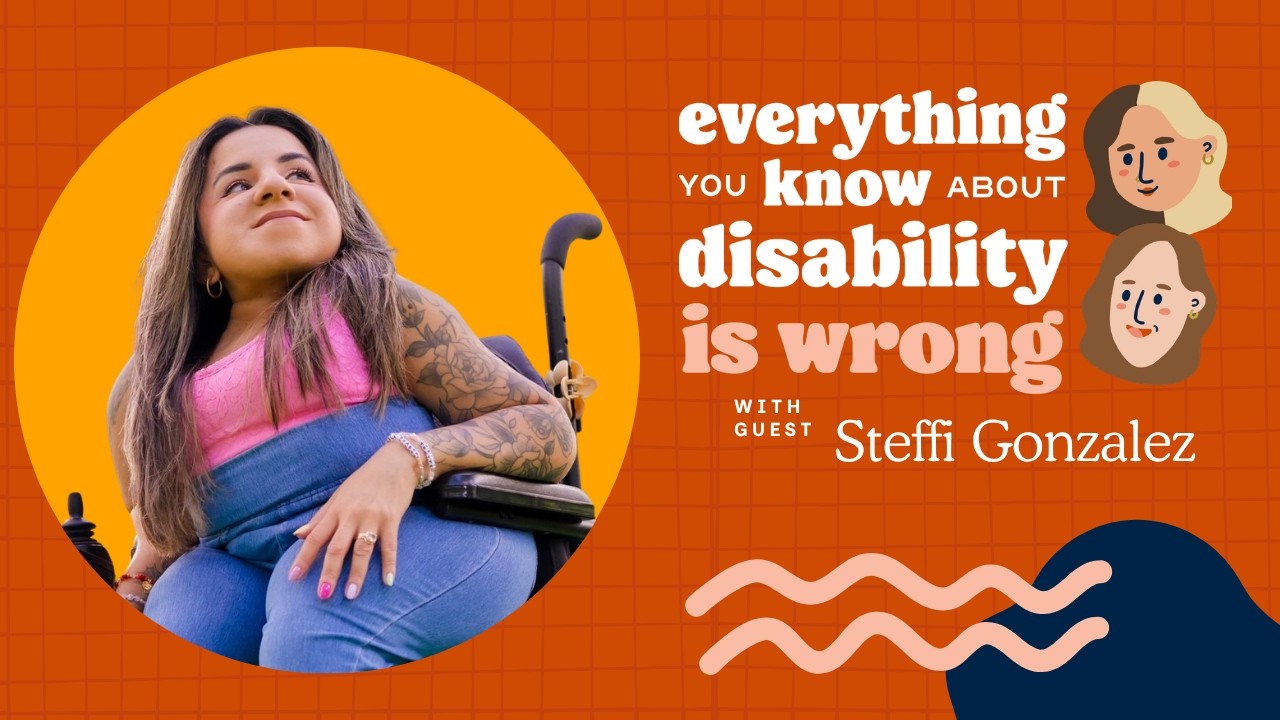
Episode 54: My Normal Is Not Your Normal: Confidence, Community, and Content Creation with Steffi Gonzalez
Disability advocate Steffi Gonzalez shares her journey in beauty, representation, and unapologetic visibility—plus mental health and creator boundaries.
Listen Now
Published on May 28, 2026.
Watch Video
Episode 54 Show Notes
In this episode, we’re joined by content creator, beauty influencer, and disability advocate Steffi Gonzalez for a conversation about representation, disability visibility, and what it means to take up space online unapologetically.
Steffi shares how growing up around photography and beauty eventually led her into content creation, and how a simple moment with her husband changed the way she saw herself — and her wheelchair — on camera. From fashion and beauty influencing, to advocacy work and accessibility conversations with major brands, Steffi reflects on building a platform rooted in authenticity, confidence, and community.
The conversation also explores mental health and boundaries as a creator, navigating online comments, internalized ableism, and the importance of disabled representation in beauty and fashion spaces. Steffi also discusses her Instagram series “My Normal is Not Your Normal,” where she highlights the different ways disabled people navigate everyday life while reminding audiences that different does not mean lesser.
This episode is an honest, funny, and deeply thoughtful conversation about disability visibility, inclusion, and creating the kind of representation you wish you had growing up.
Check out Steffi at @therealsteffig on Instagram!
Transcript
Steffi Gonzalez:
It is not a special location. It is not a once a year, few times a year, special month. It is just as much as you're looking for nine other creators with A, B, and C requirements. That's it right there. I need us to be a requirement. That's my hope.
[Music]:
One, two, three, let's go! Everything you know about disability is wrong!
Erin Hawley:
Hey listeners, welcome to another episode of Everything You Know About Disability is wrong.
Lily Newton:
Today on the show we are so excited because we are joined by Steffi Gonzalez.
Erin Hawley:
Steffi is a Florida based beauty and lifestyle creator who's passionate about all things accessibility as she's an advocate determined to normalize people with disabilities thriving in life. All right and all while educating her audience about what it's like to live with a disability.
Lily Newton:
She is modeled for brands like Victoria's Secret, Airy and Kohl's and she's the first disabled Latina creator to make Sephora Squad since the program started in 2019. She's partnered with well-known and loved brands by all like Rare Beauty, Disney, Amazon, and more. We're so excited to have you. So
Steffi Gonzalez:
Excited to be here.
Erin Hawley:
Yes. Awesome.
Lily Newton:
Before we dive into the interview questions, let's go ahead and do our audio descriptions. This is Lily speaking. I am a half Indian, half white person with half blonde, half brown hair. And I'm going to be fidgeting with my necklace like I do in every episode and I'm wearing my usual turtleneck with my black shirt combo.
Erin Hawley:
Hey, this is Erin speaking. I'm a white presenting Latina as well. I have red hair and blue eyes and I'm wearing a green long sleeve fest shirt.
Steffi Gonzalez:
And I am another Latina light skin morena. Hopefully just 10. I have tattoos on both arms. One of them is a full sleeve. I have black brownish blondish hair and I am wearing a really, really cool. What is this color? Teal baby blue shirt?
Lily Newton:
Yeah, like teal, but it has a lighter color. It's a good color shirt. It's like a highlighter. If you're listening. If you're listening, Steffi looks gorgeous on screen, which we would expect nothing less from our lifestyle and beauty influencer coming to us today, but the background is incredible. Your Sephora squad bag behind you. Obviously we're working with a content creator today.
Steffi Gonzalez:
I don't hoard boxes, I promise.
Lily Newton:
Yeah, that's a tasteful amount. That looks great up there. So let's just start at the beginning. When did you start making content and when did you decide this could be my life, I'm going to pursue this?
Steffi Gonzalez:
Okay. So long story cut short. I grew up around cameras because my daddy's favorite hobby in the world was cameras. And I was so spoiled that he used to let me play with them. Please don't ask how much those cameras were worth. I knew they were very expensive and I dropped all of them simultaneously one day. But I grew up around cameras and he taught us kind of the importance behind photography. It was kind of like documenting. As I grew up more, I started seeing the value in photography. In the '90s, videography wasn't that much. So as I continued growing up, when Instagram started coming around, Facebook started coming around, it was always really exciting for me to document things, but it was on a friends and family scale. As I did it more, I guess people started finding me and it was half, what is she doing here and half, it's so cool to have her here.
So eventually I picked it up as a hobby and then I started seeing the impact that it had on me. Not the impact that I had online, but that being online brought for me. And I started seeing a lack of community for my community and I was like, where are we? All I keep seeing is people who don't look like me online. And I am a problem solver. So I was like, "You know what? I'm about to become everybody's problem right now." And that's when I started taking it a little bit more serious, started sharing more, started sharing my inside thoughts and a little bit of my stories, which apparently are very controversial. And I'm like, "Wait, what do you mean that was ableist? I didn't think of until now." So to me, it has been really cool to see both the impact of the disabled community showing up online and then what I can do for that community too.
Lily Newton:
That's amazing. Wait, tell me a little more about that. As in people were coming into your comments and pointing out the things you were going through, you didn't realize that you were dealing with ableism?
Steffi Gonzalez:
Right. There was certain times that I shared a story and either in real life or online somebody would message me and be like, "Oh, I'm so sorry you went through that. " I was like, "What do you mean? Should I be sorry? What's going on? " And because I think I grew up in such this world isn't made for you mentality.
And my family brought me up in the only thing you cannot do is walk or fly mentality that I'm very used to figuring it out. I'm very used to if something is not accessible for me, I'm now hyper fixated. I'm making it accessible for me one way or another. So when I started coming into terms with I deserve accessibility, I remember this was at work. No one wanted to make things accessible for me. And I was like, "I cannot keep up. Physically, I cannot keep up with the demands that you're asking of me. " And that's when I started realizing, "Hey, the accessibility, I don't think it's a privilege. I think I'm like, I need to start speaking
Lily Newton:
Up." Yeah, that's incredible. And I love that you started with the impact it had on you. I feel like often when we talk about content creators, there is that kind of like I felt a pressure to become something for other people, but that makes so much sense. Your content feels so authentic and so joyous and that makes total sense that that was your journey and that there was a level of like, "Oh, this can help me also understand myself." I love that. And so when you started making content, were you already in the kind of beauty fashion space or did that just find you as you were making things?
Steffi Gonzalez:
So it kind of found me, but I think I was kind of gently guided towards that anyway because this is a very, very fun story. When I started making content, my poor saint of a husband has been the director of everything from the very beginning and he was the one who used to take my pictures or used to make the video and I would always get out of my chair.
I would always tell him like, "Hey, close up, focus. Let's not show the chair." And I remember one day, I remember very vividly, it was Thanksgiving vibe. It was November and we went to one of those pumpkin patches and I was like, "Oh, I want to take pictures here. I can post them." And he was like, "Okay, there's a sunflower field. Do you want to go there?" And I was like, "Oh my God, yeah." So then we went there and side tangent, I was terrified because it was full of bees, but I was like, "The content, got to make the content. I am committed." So we go to this field and I start telling him, "Okay, you can do a closeup here. You can do a close up there." And I remember the look on his face of just sheer confusion. And he was like, "Hey, it's okay.
I can take your picture from afar. You're very beautiful with your chair. You don't think that? " I should have sued that man for emotional distress at that point, but the shift in me, I was like, "Wait, the chair can come out in the picture? What do you mean? That's an option." It was over with from ... That was the moment that I began taking content creation seriously because I was like, there's a whole lot of people out there that think exactly like I think and maybe I can change some minds. And that's pretty much how it got started.
Lily Newton:
Incredible story. And I love your husband.
Steffi Gonzalez:
He's very loved.
Erin Hawley:
I love that. Finding somebody who can build your confidence as well is really, I think, important in a relationship for anybody. It
Steffi Gonzalez:
Literally unlocked something. I was like, I just never thought that was an option. Who told me that? Absolutely no one.
Lily Newton:
Yeah. Even as you tell this story, you can see where a shift happened and I imagine feeling a shift like that would be such a joyous feeling that you'd want others to then get to feel that shift as well.
Steffi Gonzalez:
So then to answer your question, sorry, tangent number one, done.
When I was starting to make content, I was like, "Okay, what do I want to do? What do I want to show? What do I want to talk about? " And I was like, "Well, I am brand new to this whole full body picture thing, so I'm going to do a whole lot of that. " So I started just showing up. I was very into captions before too, so I would write very cute cool captions about it's okay to show your entire body, blah, blah, blah. And it started with fashion and two months into that Ari picked me up as an ambassador and I was like, "Oh, now I'm committed, committed." So that was the very first one. It was fashion. And then eventually I grew up with beauty all around me. My mom, my muse forever, that lady introduced me to L'Oreal Suseto, all the big brands since I was little, I used to sit in a counter just to watch her do her 15-step skincare routine.
So when I started doing this whole content thing, I was like, "Well, I'm not an expert, but I do my makeup. Maybe people want to see that. " And I think it was seven months later after I started making beauty content that I got an email from Sephora.
Lily Newton:
Wow. What a testament to if you follow what feels right to you, your story, you don't have to know exactly where it's going to go as long as you stay to what is true to you. Even the fact that your content creation start, the first thing you tell us is making things with your dad and this is your mom's beauty. Clearly it's so aligned with you all.
Steffi Gonzalez:
But the writing was on the wall.
Lily Newton:
Yeah. And the writing was on the wall and you allowed it to blossom into this gorgeous thriving life you have because you just stayed true to yourself That's just so incredible.
Erin Hawley:
So May is Mental Health Awareness Month. So I'm wondering how do you take care of your mental health as somebody who makes published videos?
Steffi Gonzalez:
That's a really good question. And I love one of my favorite things to talk about is mental health because I think we always need to talk about it more.
There's always someone that is going to hear it for the first time and something's going to shift just like something shifted me. How do I take care of my mental health? This is going to sound very cliche, but I put the phone down. Just put the phone down. I love creating content. I love engaging with my community, but if there's one thing that I love even more is my real life, like being at home, being with my people, being with my dogs, doing things that do not require me to have a phone in my hand. I think it's very important for us to stay incredibly well connected with our real life so that we don't get lost in the sauce.
Whenever I find myself doomscrolling, I'm like, "No, I'm not. I'm researching. I'm working. This is overtime." But when I'm doing it a little too much, I'm like, "Okay, it's time to put the phone down." Sometimes you start going down little rabbit holes of comparison and I always catch myself very early on and I'm like, "Nope, that's unhealthy." We take a break, put the phone down, go do other stuff. And for me, that's very important just to make sure that I am healthy brain-wise to bring the best to my community. If I am ever feeling burnt out or I don't know what to post, I don't know what to talk about, I don't know. I never feel that commitment that I always see creators apologizing for like, "Hey, I'm so sorry I didn't post for a week." No, I'm not. I have the time in my life and it's okay.
You guys are still here because nothing's going to happen if you put the phone down for a little bit. And I think we need more of that. You don't have to feel bad. It's okay. Just as much as you take care of your job, which for me it is my job, content creation is my full-time job. I need to take care of me. So if I'm taken care of, then I can show up more. I can show up more authentically. My creative juices are going to be all over the place. It's going to be great. But if I feel like I never can get a break, I never can stop, then it's just going to go downhill from there.
Erin Hawley:
Yeah. No, I think a lot of content creators feel the pressure to just put out content every day because a lot of the platforms reward you the way you post. And I think that pressure on a content creator could be really damaging to your mental health.
Steffi Gonzalez:
I'm also very strategic about my content creation, my schedule, my posting schedule, because again, I'm not just a content creator. I am a content creator that lives with a disability. So that disability is going to get in the way sometimes and that's just inevitable. I understand that I'm not going to get up, shower, get dressed, put makeup on, probably go outside, film 10 videos every single day. Who does that? Not me. So I try to put myself on a schedule, make sure that you want to spend a few days couch rotting. You better make the videos for those days and then I'm okay. It's fine. So it definitely does take a little bit, I think, of extra strategy when you do live with a disability because you're trying to fit the puzzle of when am I going to be healthy enough and feeling good enough to make all these videos?
But I think the only way to get a hang of it is to do it and you're going to fail. I've failed. I continue to fail sometimes and that's okay. It's not the end of the world. It's free.
Lily Newton:
Yeah. I love what you've said here and that you mentioned that this is your job, this is what you do. And I think that what you're talking about is really important for people who are disabled in any workplace because there is kind of this ... I won't speak in generalization. I'll just speak from my experience being autistic and knowing that sometimes I can't be as amazing in a meeting as I want to be or something. And I almost start from a place of apology where I'm like, "I have to do so much because I have a disability." And then I start to think about it and I'm like, "Wait, that's internalized ableism speaking because there I'm making my disability a bad thing when I know my disability brings a lot to the table actually." And so I think that there's something like everything you just said would make a very cool video for someone.
Our experiences are part of our story. I think that that's just a really important takeaway for anyone listening of that accommodating yourself and having boundaries around how you're going to spend your energy in any workplace is a crucial step to avoiding that burnout. And burning out as a disabled person, I think it can be really dangerous because we already have a lot of isolation in general. And if you get past your point of being able to self-advocate, that can be bad. You're smiling. What are your thoughts? And
Steffi Gonzalez:
It takes longer to come back too. When you do experience that burnout, it's going to take a lot longer to get back on the horse and to oil the machine all over again. So for me, I am very protective of I am in a place of, I mean, I know no one can do someone else's job, but no one can show up for me. Content creation, I am the face of it. If I am not in a place to show up online, wrap it up. We got to close up shop. So in order to prevent any of that, I just have to make sure that I am protective of everything that comes with showing up.
Lily Newton:
Well, we spoke about how you deal with self-care in terms of putting the phone down and living your real life. What kind of boundaries/self-care exist for you when it comes to comment sections? Because I know that comment sections can online hold a lot of things. So what's kind of your personal brand of dealing with, I'll just say it bullshit in the comments.
Steffi Gonzalez:
Okay. We're going to get very real in this podcast right now. So if you are a sensitive soul, God bless, is about to go downhill.
I have very thick skin. I grew up surrounded by such, you're the best thing after Coca-Cola that it followed me. My family had such an amazing world of positive affirmation for me that when I went to school and because, hello, who doesn't experience bullying and I started experiencing bullying or I wasn't included or I'm not going to lie, I became the bully.
You're going to bully me, I'm going to bully you first. We're not. If to me it was people may think that I will take it because I have a disability, you're going to find out the hard way that it doesn't always work like that. So in school, everybody knew Steffi, everybody I had a big group of friends and good luck bullying me because my group of friends, we're going to bully you like 10 times worse. And that was the theme all throughout elementary, middle school, high school. We lived in a little bit of a different world before social media. I think I started experiencing MySpace when we were in college or seniors, but bullying was still there.
It never got really bad for me. I think I was very vocal. I think I was very in your face in a way, like not allowing ... I remember I used to talk back a lot to my professors because they would be like, "Oh, well, Steffi can do this. Steffi can do whatever she wants. Don't tell me what I can't do. " "Oh, we're going to go do gym stuff. If you don't let me do something, then I have to go to the principal and tell him that you're excluding me. Is that what you want me to go say? "So I think my family gave me a little bit too much confidence and I never allowed people to put me down. So by the time you fast forward to the comment section, I'm like, " Are you kidding me? I'll block you right now. "So to me, the way I always see it is number one, you will never say something like that in person.
And if you do, again, God bless.
So in a way, I don't perceive it, I guess, as strongly as I should because yes, people do say really diabolical things. I just don't think I associate it with myself. I'm like, " Poor soul, what are you going through? This is a reflection of you. This doesn't affect me. "So I've had many issues with content creation and trying to figure it out and trying to break into rooms that people like us have never been in before, but the comment section has never been one thing that I'm like, " Oh my God, this is getting to be too much."
Lily Newton:
I have so many things I want to say. One, this is a recurring theme through our podcast, but just like, hell yeah, to parents who instill confidence in their kids with disabilities. It's just so important. Shout out to your parents for that snaps for them. I don't think they instilled too much at all. I think they did it exactly right. That is so necessary. And to be able to look at something and go, " Actually that has nothing to do with me, "I think is so important. And even managing social media for a big nonprofit, sometimes just random stuff gets said in the comments and I've just had to learn to be like, " That has nothing to do with us. This is a person who just wants to say something on a forum that they would never say out loud and you're so right about that.
It's the say it to my face and see how that goes.
Steffi Gonzalez:
Yeah. I mean, not to mention that I don't know if people understand the fact that there's a bunch of literal children online. So your frontal lobe, it's got a long way to go before it develops. Am I going to get into an online argument with a 12-year-old boy? I have better things to do.
Erin Hawley:
Even on our podcast videos, there's been mean comments and you can't ... I shouldn't say you can't. I also don't take it personally because the same reasons that you have when my parents always instilled in me that I don't have the issues. It's everybody else and their problems, but I think that it's careful to see it in the sense that you realize people actually think this about disabled people and a lot of people think that as well for just not saying it in the comments. So navigating that societal pressure of this is how people think of us is it doesn't upset me on a personal level just as a human being.
Steffi Gonzalez:
Right. How dare you be such a horrible human being to me and to others because whenever those kind of comments land on my socials, I'm like, I know this wasn't your first day on the internet You do this a lot and you can tell. But at the same time, that's why one of my last videos I'm like, can we bring back inside thoughts because that was an inside thought and you're allowed to have them, but can you keep them on the inside
Lily Newton:
Please? Yes. I'm so, so glad you said that because I know exactly what posts you're referencing and I think that it's an interesting take because listeners, you're going to have to go follow Steffi and find the posts we're talking about. So it's the type of comment that I find- I love how we're all speechless. I find so secretly insidious in the way of it's someone being like, "You're so strong and so brave."
Steffi Gonzalez:
And our podcast theme song starts with, "I'm not your inspiration." Cannot roll my eyes enough.
Lily Newton:
Yeah. So it seems like your self-care, your mental healthcare does have a sense of I don't allow other people to project what's going on with them onto me. That's not for me. And one of the reasons I loved your video so, so much, it's like a nice clapback of just like, I don't exist for you. And that in itself, just watching it made me feel so strong and so it did something even coming into this podcast episode of just removing a layer of performance of who I am when I'm in public and this level of just like, "No, actually I'm not going to do that because if I'm vulnerable, I'm vulnerable for me. And if I'm strong, I'm strong for me and because what I've been through." So it seems like you've always had that, but what made you decide to make that video this time and where are you at now?
Steffi Gonzalez:
I've made a choice that the moment you make me roll my eyes, I'm going to become a problem that made me roll my eyes so much. I was like, in the big year of 2026, and it's funny because what angered me was not the actual comment because I know a lot of people feel that way. I have lived through that kind of comment section in real life. I have lived it at the workplace. So you can only imagine I have a book full of comebacks that I could not do at that time, but at the same time, what angered me was, number one, that human being is a follower of mine. It's not just some random on the internet, it's a follower of mine. Am I wasting my time? What am I doing online? I That I've been creating this type of content for maybe three, four years and you are a follower for, I don't know, I don't care how long. It's always the same message.
It doesn't matter.
And you felt comfortable leaving something like that, that's what angered me because I started thinking, how many people in my life, not my circle, but in my life feel this way, even though I am relentlessly never shutting up about this whole advocacy thing and how I live my life and I don't live for your purpose or I'm not a human emotional support thing. And it just angered me like this wasn't just a random person that found me on the internet. He or she, I don't know who it is, has been following me for some time. And then you still thought, I did a big one with this one. She's going to smile big. And then the video came and it was a one take. I did not make it twice.
Lily Newton:
Well, I love how in the video too you talk about if I'm going to inspire you, it should be about my content because you are a beauty and fashion influencer. I've learned from you, I use Lancome Foundation. I had no idea that I should be double. I should do it with a brush and then go in it with the wet puffy thing. I do it every time now and it's much better and I learned that from you. I'm inspired to be better makeup artists. Or you also said, and Erin and I have said this on the show a lot, I'm happy to inspire other disabled people. That's a different intercommunity thing.
Steffi Gonzalez:
Yes, yes. And families of, which is another thing. I am not your inspiration, but at the same time I would like to be your motivation that we could do. And I don't remember if I said it in the video, but things that a person with a disability, whether they were born with it, whether they acquired it later on in life, a family member that's watching me, you know how many times I've gotten stopped on the street with my truck of people saying, "Oh, my insert family member here has had a van for years and they hate it. I didn't know you can convert a truck." I'm not offended by that.
We're going to be besties after that. Can I get your number? So I've had people take pictures of the truck, take a picture of like in the back of the truck there's the company, the conversion company and I tell them, reach out to them, you can talk to them. And we start a whole very productive conversation that yes, it has to do with my disability, but we're both getting something out of it. And that's my favorite part of advocating online and just by existing in the wild when we're both going to get something out of it.
Erin Hawley:
Yeah. I love giving advice to other disabled people that changes their life. It's just weird. Not weird. It's inspiring to me to do that. And I think that's community is really important.
Lily Newton:
Yes. Yeah. And I mean, I think about like we're still so new in this society of disability being visible even in the real world. So when you think about the effects of representation, this is actually really, really important. So just a quick, this might seem like a cliche question to ask, but I feel like in the beauty and fashion space, it's really important on that, what does that representation mean to you, especially being in, you're not a disability advocate online, you are a content creator and influencer and you're going on brand trips and you're doing the thing. So what does that kind of mean to you and what do you hope to come out of this type of representation in the future?
Steffi Gonzalez:
Right back at you with the cliche because it's just what I wanted to see and I didn't get to see it. I couldn't find it. There weren't many of us online maybe 10 years ago. Maybe I would've ... Wow, that's going to be really emotional. Maybe I would've had a whole lot more memories photography-wise to look back on if I would've known that it was okay to take pictures in my chair. And if there was somewhere online that I would've found that message, that's truly what I want to get out of me showing up online. I want to be what I wanted to see one day and I just couldn't find it.
Lily Newton:
Oh, thank you for sharing that. I'm getting emotional. What in service of reason to be doing this work. And I think that it can be easy to be like, "Oh, they're making content. What are they doing online?" But this is so crucial, this type of ... We're talking about mental health in this episode and I think that there is absolutely a component to developing that core self-esteem that can help you navigate mental health ups and downs can come from that seeing yourself as a young person and that makes a whole difference to you. I feel like it must be somewhat rewarding to have little you within you and know that you're making the content for her.
Steffi Gonzalez:
I was just going to say, I live in a constant state of little step would've loved this. Teenager stuff would've been flabbergasted by this. And even five years ago, me, when I started this content creation thing, I was like, "But why would people follow me? " It's nothing special. Clearly other people have much of a better message. And then the imposter syndrome takes over and you're like, "Oh, but why would you follow a content creator with a disability when you can follow content creative without a disability?" And all kinds of diabolical thoughts come in and I would be like, "Well, I can try this content creation thing, but it's not like I'm going to be a creator with a thousand followers and go on brand trips." So even the things that I get to do today, I'm like, wow, five year ago, Steffi, her mind would be blown.
Lily Newton:
Yeah.
Erin Hawley:
That's awesome. I just want to talk about your Instagram series. My normal is not your normal. Can you share what it's a doubt and what inspired it?
Steffi Gonzalez:
So it has been probably my favorite thing to create online from scratch by myself because it all stemmed from little bits and pieces of my life that people have told me along the way. And to me, I was born with my disability. So everything that I learned to do in life is the only way I know how to do it. When people are like, "Oh, how do you drive with your hands?" I don't know, my guy, I've never tried my feed. It's normal to me. But then again, I'm like, hold on, you don't need to be mean about it. Maybe you could just explain it Because to me it's normal, but to the world it's like, wow, she does this so differently than me. Something so simple as washing dishes. I have to spider monkey on my counter and apparently that's not normal. So I'm like, "Well, maybe we can make a video about that.
" And if you could see my book of episodes, Chef's Kiss, because it's a lot of it. Even my makeup, even how I make breakfast, how I drive, how I do my hair, these are things that I would've never thought of. But at the end of the day, if you put me and someone without my disability, we're going to do things very different. And I'm like, "Well, that's content."
Lily Newton:
We all have our own normal actually. And I think that that's so brilliant about that series is it's kind of like see me as the full person that I am. This is my experience. We talked about in our last episode, being seen as your full identity is very important. I don't want you to look at me and say like, "Oh, I don't see you as disabled because --
Steffi Gonzalez:
Do we need a doctor here?"
Lily Newton:
Yeah. That's why I always say, I'm like, "Oh, I have a lot of doctors who would disagree with you.
Steffi Gonzalez:
" But at the same time, my other favorite part of creating the series was that the end goal is the same. The end goal is we both need these dishes cleaned. We both need to
Lily Newton:
Arrive
Steffi Gonzalez:
At our destination. We both need to make sure our hair slays when we do it ourselves, so on and so forth. But it is the constant battle of humanity of my way is the right way and it's not, it's just your way. And that's good for you. That works for you. The same way people may ask me, "How do you drive with your hands?" I'll be like, "How do you drive with your feet? That's crazy." So to flip it on people and be like, "This is my normal. I don't know what you're doing." That has been really fun for me.
Lily Newton:
Yeah. And there's kind of a layer of I implore non-disabled people too to figure out what your normal is. You don't actually just have to do things the way that they're done. You can find ways to accommodate your needs, whatever they are. And yeah, I love what you said about it's the same end goal because even when we talk about the phrase special needs obviously has its place because it's an important term in terminology of what it is. But when we break down the rhetoric of it, the needs are not special. The needs are actually human need, like slaying with your hair. That’s important. That's very important. What do you
Steffi Gonzalez:
Mean?
Lily Newton:
We care about that stuff too. I think it's such a moving series because it's honest, it's real and it's also like this is different and that's okay.
Steffi Gonzalez:
And I feel like it's eye-opening because there are people in my life that maybe they come to my house and they're like, "Oh, let me help you. Let me do this. " And I'm just like, "I live a life when you're not here." Jordy's amazing, but this is my house. I do a lot of things here and that was another thing that kind of sparked the conversation in my head like, do people think that I don't do these things or do people think that Jordy goes above and beyond and sideways to fulfill everything in our lives because that, I mean, I don't want to put them on the spot, but I wash his clothes. So I'm just saying, I do a lot.
Lily Newton:
Get that.
Steffi Gonzalez:
And fold them and put them away, not in the same day, but hey,
Lily Newton:
Look at that.
Steffi Gonzalez:
So my gears started shifting because outside, when you go to a grocery store and you see people frantically trying to help you and I love that because I understand that there are people that have good intentions and sometimes I do take the help, love the help. Thank you for offering. But at the same time, I know you think I can't do these things and I can't. I know I will never forget one time I went to put gas and I'm in my own world. I am not to mention sometimes I'm playing music in my hearing implant and no one knows that. So I am literally in my own world inside my head and I went to put gas and all of a sudden I look up there's like three people staring at me and I was like, "Oh my God, what happened? What's wrong?" And it was just people like she's putting gas by herself and then they started coming.
They started offering, "Can I help you? Do you need help?" And I was like, "I've been driving since I was 16. I got this, but people don't know that.
Lily Newton:
" Yeah. And it kind of goes to show how people's disability just sometimes isn't on people's radar at all. And then when it is, they're suddenly like, "Oh, this must be so horrible.This must be such a sad life." And it's like, "Hey, all those times when I'm not on your radar, I'm still living. I'm having a great time." And I hope that anyone listening who is like, "Oh, I'm that person. I come from a place of good intention." Yeah, we see the good intention. I hope you can see that if you're only offering help right then, it kind of feels like you don't think that I have a life outside of this current moment because I live all the time.
Steffi Gonzalez:
And I think it may be also like an olive branch in my
Lily Newton:
Way
Steffi Gonzalez:
To people to be like, "Hey, I don't want to be mean, but here's how I do this and I do it perfectly fine. It's just a little different." So for those people that tune in to this kind of content from a, she can't do those things, perspective, just watch the video, just give me two minutes of your time, watch the video and I guarantee you that next time you see a person with a disability out and about by the sign your brain has already shifted from, I've never seen this in my life too. I remember that video I watched and she was just fine. So slay.
Lily Newton:
Yes. That's my
Steffi Gonzalez:
Goal with that series.
Lily Newton:
Yes. And I mean, it really is creating brain pathways because we know that a lot of things come out of fear because fear of the unknown. So if you just make it known, there is a layer to just helping people not have that panic, alert reaction and just be like, "Hey, we're just humans. We're just living life." And along with obviously showing that your normal is your own way. You're also doing things that are exceptional. You've had an incredible last few months, but I don't want to say what the amazing things are. I want you to share what have been some of your top career highlights because I've been following along and the highlights are high.
Steffi Gonzalez:
Oh my God, no. I hate bringing up highlights because it's nothing out of the ordinary that I do. I am just incredibly lucky that people think of me and they think that I belong in those rooms and I work really hard to one day be in those rooms. So I do pat myself in the back but very quickly so that I don't get used to it. And I'm just very grateful to be included very often as the only creator with a disability in those rooms, which you guessed it right. It feels very heavy because it's just one of me. And although I love that for me, it's also like that's a lot of responsibility on my little heart sometimes.
Lily Newton:
Yeah. And especially when you are the first of your identity, like first disabled Latina, that's so incredible and amazing and also a lot of-
Steffi Gonzalez:
Intimidating.
Lily Newton:
And a lot of really right now first one 2026, lots of both things can be true that this is amazing and also difficult, but I think that it's incredible to see you in these spaces because it feels like it's so deserved. Like I said, you are just a really, really great content creator in the content you make. I genuinely have learned makeup tips from you that have made me look better. That made my
Steffi Gonzalez:
Day. I hope you know that.
Lily Newton:
No, I really love that. When you use a product, I am going to run to get ... There was a setting spray you were talking about recently that I was like, "I'm running." And it's just really cool to see our community being brought in not from a place of
Pity or like we were finding the one, but from a place of like, yeah, she carved her room and she's in this space and she's doing the thing and we need her. And you are, I think it's really important to remember, especially when you're going on brand trips and doing these things that like you're the prize, you're the person that makes the products incredible and amazing makes us want to buy them. So it makes so much sense and brands are lucky to work with you. Oh my God. I really appreciate your content. I really think it's so cool to have such a firmly like, "I'm going to be here. I'm going to be me and I'm going to be strong and you can't put anything on me in this space." That is so important because for any woman in the fashion and beauty space, there is so much projected onto you about who you should be, what you should look like, what you should sound like.
So for you to recognize that you have this thick skin and this confidence that maybe not everyone has and to enter the space and help those of us that maybe don't have that, develop that kind of confidence is just really, really incredible. So I genuinely love your work and it's been really fun to talk about it.
Steffi Gonzalez:
I'm going to cry. Thank you so much. It's also very rewarding for me because even though I may be the only one, the first one or whatever you call it, it is an opportunity to tell the brands how amazing this kind of inclusion can be. It's an opportunity to teach brands, to educate brands on if I'm coming along, what does that look like for me? What is it that I need from you? Because again, it's not special needs. It's just a different need. Just to give you an example, if we're transporting ourselves from the hotel to a restaurant for dinner, everybody needs transportation. I need the transportation to have a lift. Other people need transportation to have a door and to have stairs.
It's the same bus. It's the same method of transportation that's going to take us to the restaurant. I just need one thing that differs from the others. And we live in a time, we live in a country where you can make it happen and they do. So I feel like when they do these things, because there's a lot of times that I catch them looking like, "Did we get it right? Is this okay? Is this good?" And I'm just like, "Oh my God, I'm so excited. This is incredible." They're like, "Thank God." And then now they're comfortable. Now it's no longer that intimidation of we really don't want to mess this up. We really don't know how to do it. There have been times that people and the brands have told me, "We just don't know if it's okay to ask." And I'm just like, "Girl, ask away.
Ask all the things. I welcome all kinds of questions if it's going to benefit the both of us." And so to know that I am in a way making sure that there is no fear in continuing that inclusion of my community of creators, that's just very rewarding for me.
Lily Newton:
Yeah, absolutely. And I think that that fear of getting it wrong really can be such a barrier. Again, this is your workplace, but this really does extend to all workplaces. But the thing is, just like Steffi's experience of once that van is accessible, or that bus is accessible, now you have an accessible bus similarly in the workplace, once you start changing your office to be accessible, how many times are we going to say curb cut effect on this podcast that when you make something more accessible, it's beneficial to everyone. So you getting to show brands that is really incredible. So I have one final question because you have been working with and attending events at Easterseals, Florida. One of our affiliates, they adore you. Can you just tell us about how you got involved with Easterseals, Florida and what it has been like attending those events?
Steffi Gonzalez:
Oh my God, attending those events has been ... I keep thinking to myself, this is the point. This is the point. This is the whole point of what I do. Finally, finding the core of my community and being able to show up and being able to spend time with people and being able to learn more, learn new ways that maybe I didn't know that we can help. And it's just been really amazing. I did follow Easterseals for a while and it was my wonderful, beautiful, amazing manager, Camila, that made the connection because I would always talk stars about Easterseals like, "Oh my God, I love what they do and I love their mission and they're in Florida." And so finally when we got connected, I see myself, people like me, people that I wish I would've connected with maybe as a teenager, maybe as a younger adult entering the workplace.
It's just to me, connecting with Easterseals has been such an eye-opener of I missed out on so much and this could have been so beneficial to me. So my job now is to make sure that we keep spreading the good word and that it becomes more and more and more available to people that like me, that they don't have to look back and be like, "Oh, I wish I would've found them sooner." No, no, find them right now.
Lily Newton:
Yes, because I think that's something we deal with is just some people don't know that these services exist and that there are nonprofits doing the work that they are hoping to be done. It's really important that we get the word out. So Steffi, the fact that you are willing to use your platform to talk about what we're doing at Easterseals and share our work is so incredible. And that's a way I hope you can be inspirational to other content creators and people who have this space and can realize partnering with brands is amazing. Have you considered, is there a nonprofit out there that has a mission that you care about that you could add your voice to? Because the world of how young people are getting information is changing and with so much information and misinformation online, it can be really beneficial to have a trusted person like, "Steffi taught me how to do my makeup.
I trust what she's going to say." And I think that it can be really important. So I thank you for using your time and your platform for that. And I do hope that it can inspire other content creators to, not even just Easterseals, but whatever mission you want to back, you can provide your voice. I think that's really amazing. And I really appreciate you saying the way that it made you feel and that it can be so empowering to be in these rooms. I just got to go to a few different Easterseals events and it really is when you're in the room with all of these people, it feels magical. In a world that can feel chaotic and hopeless, it is really incredible to be in a room of people who are organizing around hope. It's
Steffi Gonzalez:
Just
Lily Newton:
Really important.
Steffi Gonzalez:
And the stories, I mean, every time we hear the stories of how Easter Seals was able to help this family and was able to help that family, it makes me so emotional because there were so many times where I know that my family needed so much help with me and I don't think we had much.
Lily Newton:
Yeah. I mean, that's really it. And I love that you said that this is what it's about because that really has been for me and even doing this podcast when we get messages from people who are saying like, "Wow, I didn't know anything about disability and my child has a disability and this has helped me. " I'm like, "Oh, that's the stuff that my parents didn't have when I was ... " And it's just really, really cool to be doing this work. I said it was the last question I lied. I have one just final rapid fire, which is, what are you hoping for the future of fashion and
Steffi Gonzalez:
Beauty?That is such a big, big question. What do I hope for brands to pivot from the occasional inclusion to making sure that every list, every campaign, every commercial, every photo shoot, every launch, everything, it's not an option. It is part of your roster to have one of us. It is not a special location. It is not a once a year, few times a year, special month. It is just as much as you're looking for nine other creators with A, B, and C requirements. That's it right there. I need us to be a requirement That's my hope.
Lily Newton:
I need us to be a requirement mic drum. That's it. That's it. That's it.
Steffi Gonzalez:
That's
Lily Newton:
It. We got a lot of work
Steffi Gonzalez:
To do, but that's it.
Lily Newton:
That's it. And you're making it happen. So I appreciate your work. I appreciate you coming to speak with us today. This has been so incredible and I appreciate all the love you've given Easterseals Florida and it's just so good to have you in our corner, Steffi. It's really incredible and I hope you know Easterseals is in your corner always.
Steffi Gonzalez:
Hi, are you kidding me? I am so happy to be here. So happy to be included. So happy you gave me all this time to Yap about what I care about the most and Easter Seals is my VIP to have in my corner. I'm so thankful for that.
Erin Hawley:
We appreciate you. Thank you.
Lily Newton:
Yes. Thank you. We appreciate Yap and that's the best thing ever. That's why I love this show. Listeners, I hope you loved listening to us YAP today. We will be back again for another YAP soon. Erin, I love you. I love hosting this show with you.
Erin Hawley:
Same.
Lily Newton:
Stuffy, thanks for coming on the show. Listeners, thanks for being here. If you're not following along, make sure you're following along. Easterseals is @EastersealsHQ on everything. We've got all of Steffi's information in the below of whatever platform you're listening to this on. Give her a follow. I promise you all I'll regret it and you'll probably get some great makeup tips. Thank you and we will see you next time for another episode of Everything You Know About Disability is Wrong.
Legal
Sign up for Emails from Easterseals
Get exciting news, helpful resources, & inspiring stories delivered to your inbox each month.