


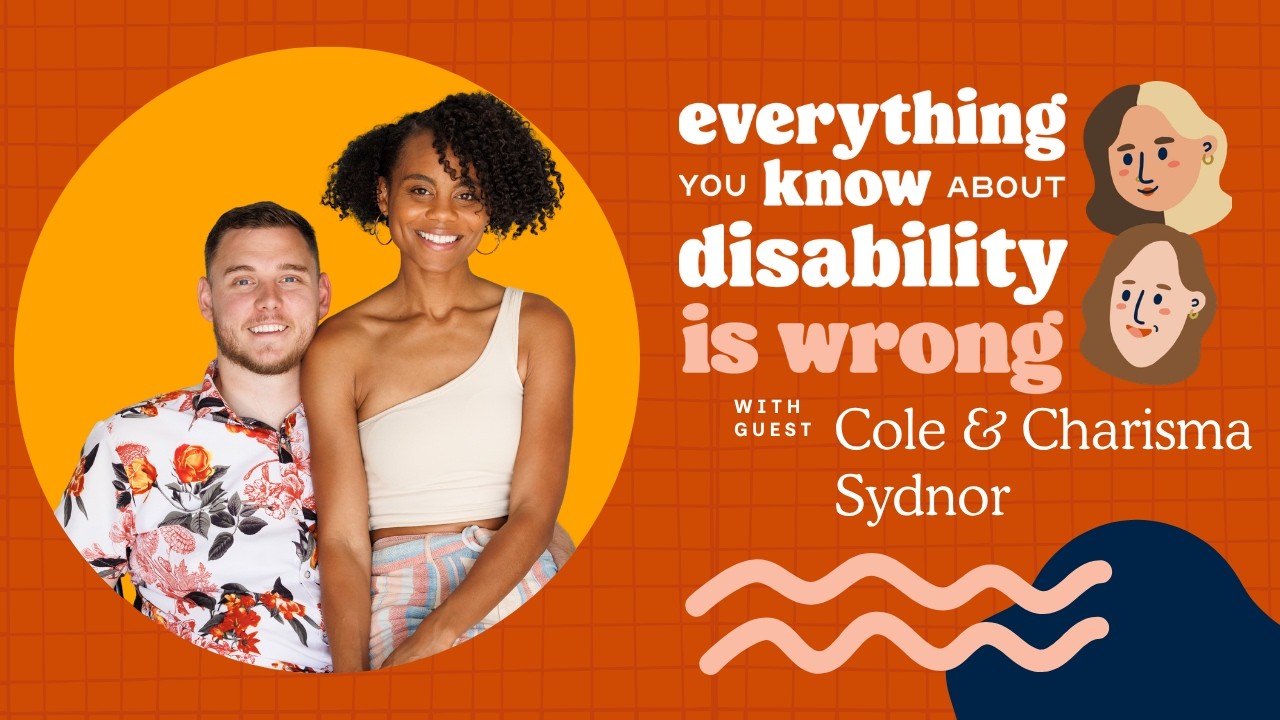
Episode 53: Mutual Support: Debunking the Caregiving Myth with Cole & Charisma Sydnor
Cole & Charisma Sydnor debunk caregiving myths, highlighting mutual support, boundaries, and care in inter-abled relationships and online life.
Listen Now
Published on May 12, 2026.
Watch Video
Episode 53 Show Notes
Cole and Charisma Sydnor, known as “Roll with Cole & Charisma,” are digital creators with a global audience. Together, they share their lived experiences navigating life in an inter-abled relationship, challenging common misconceptions about disability, dependence, and support.
From early relationship vulnerability to navigating public perceptions online, Cole and Charisma reflect on how caregiving has shaped (but not defined) their connection. They also discuss the realities of sharing their lives publicly, including boundaries, mental health, and the impact of online visibility.
This episode unpacks how care exists in many forms—physical, emotional, and relational—and how it often flows both ways in relationships and communities. The conversation expands beyond romantic relationships to highlight a broader truth: caregiving is not limited to one role or identity.
It is something we all give and receive throughout our lives, often in ways that go unseen. It is dynamic, reciprocal, and deeply rooted in connection.
Easterseals is committed to meeting people where they are, with care that honors every role they hold.
Transcript
Charisma Sydnor:
When they think about caregiving, they think of the physical aspect of caregiving. And so when they see our relationship, they see how I am Cole's caregiver physically, but there are so many aspects to caregiving that is oftentimes behind closed doors or even invisible in a sense, like being an emotional caregiver. And we've opened up so much about how Cole is such a huge emotional caregiver for me.
Music:
One, two, three, let's go! Everything you know about disability is wrong!
Erin Hawley:
Hi everyone. Welcome to a brand new season of Everything You Know About Disability is wrong.
Lily Newton:
We're your hosts. I'm Lily Newton.
Erin Hawley:
And I'm Erin Hawley.
Lily Newton:
The topic of today's episode is misconceptions around caregiving. So often caregiving is thought of as this one non-disabled person is taking care entirely of a disabled loved one. However, in reality, caregiving takes a lot of different forms. There are plenty of disabled caregivers and caregiving is often a two-way street. So I'm really excited for our guests. It's going to be a great episode.
Erin Hawley:
Yes. And today on the show we have Cole and Charisma Sydnor.
Charisma Sydnor:
Thank you for having us. This is such a big topic for us, so we're so happy to be here. Yes.
Lily Newton:
Oh, we're so happy to have you. We have wanted to have you on the show for a long time. Guests also known as “Role with Cole and Charisma” on YouTube. Cole and Charisma are an interabled and interracial couple who started their YouTube channel on the premise of sharing their lives with friends and family who are simply curious about their relationship.
Erin Hawley:
And their content ranges from travel videos, lifestyle vlogs and the temple's first times and attempting viral challenges. And they've announced over two million followers on social media.
Lily Newton:
Welcome to the show. I mean, when we were first dreaming of this podcast, you were on our initial vision board of guests we wanted to have. So it feels so good to have you opening the season. Thank you so much for joining us.
Cole Sydnor:
Yay.
Charisma Sydnor:
That makes us so happy.
Cole Sydnor:
Yeah. It's pretty wild to hear the numbers because we just started this as a little side hobby thing and now here we are. It's pretty wild.
Charisma Sydnor:
Seven years later.
Lily Newton:
Oh, but that makes so much sense because your content is so authentic and I think that's what makes it so ... It's why I as a viewer just want to watch every single thing because it's like, "Well, I feel like I'm just hanging out with you guys." Thank you.
Cole Sydnor:
I love that. We try that. You try to make that happen.
Lily Newton:
Let's go ahead and do our audio description. So I will start. This is Lily speaking. I am a mixed race person and I have half blonde, half brown hair split down the middle like Cruella de Vil. And behind me there is a bunch of disability books and fidget toys and stuff.
Erin Hawley:
Hi, this is Erin speaking. I'm a white woman with red hair and blue eyes and I'm wearing a blue and red shirt. And I'm in my bedroom, which is very dark. And I'll pass it toll.
Cole Sydnor:
I am a white man. I have about shoulder length curly hair, blue eyes, some short facial hair, and I'm wearing a purple sweater sitting beside my beautiful wife.
Charisma Sydnor:
Yes, I am charisma. I am a black woman. I have about the same length hair as Cole, but it is dark brown and shoulder length and straight. I have brown eyes and I have a V-neck brown sweater on and we are sitting in our office.
Cole Sydnor:
Yes. We had a nice little shelf behind us with some pictures. Yes.
Lily Newton:
Oh yeah. It's very aesthetic and the colors of the sweaters with the colors of the background. So you did it up for us today. We love it.
Cole Sydnor:
Thank you.
Lily Newton:
Well, for some people they might've met you through a profile that came out in the New York Times after your wedding. This is one of the first pieces of content I was introduced to the two of you from and it's an awesome writeup and sorry for going back in time a bit, but I could not start with this. So the writeup tells the story of how you both first met and for listeners who maybe have not read the piece or don't know that story, can you tell us about how you first met each other and what that initial connection was?
Charisma Sydnor:
Absolutely. We have two different stories of how we met. Cole likes to tell his version. I like to tell my version. So ladies first, right? We'll start with my version.
Cole Sydnor:
Of course, of course. Go ahead.
Charisma Sydnor:
So we met at Sheltering Arms and I was working there as a rehab technician working under occupational therapist, physical therapist, speech language pathologist. And I work in the inpatient side of the hospital. I was just doing my thing going through another part of the hospital, which is called Neurofit, which Cole used as a gym essentially because finding accessible gyms are very hard to come by. And I'm walking through the room and all of a sudden I hear this hey. And I look and I was like, "Oh, he's talking to me. " I was very taken aback, but he was very charming, very sweet. And that was in my mind how we met, but Cole has a different version of how we met in his mind.
Cole Sydnor:
Well, what stresses me out was when I was going into rehab and Charisma started helping out in our area a little bit. One of the first things that happened was she came in to help me get off of the FES bike. The FES bike is the functional electrical stimulator bike that helps me operate like a little pedal bike stationary and it requires pads and these pads go all over my legs and my buttocks. So here I was sitting in a chair and this cute girl that I was interested in was coming in and having to pull these pads off my butt. When I'm at the tail end of my workout exhausted, I hope I didn't smell. And that was super embarrassing for me, but fortunately charisma didn't even bad an eye at that. That was just another day at work. Didn't think much of it.
Charisma Sydnor:
I was actually nervous like, "Oh my gosh, this cute guy, I'm kicking off the pads. I'm more nervous about how I look. I'm also at work sweating. I could smell as well."
Cole Sydnor:
It's like we started as second base somehow.
Charisma Sydnor:
But that was our meeting story. We then coasted into my DM shortly after that, after attending a gala together. And the rest is history. I mean, I don't even know when we started dating. It felt like since that first day, we were like this.
Cole Sydnor:
After a while, we looked at each other and we're like, "Are we boyfriend, girlfriend? Or when did we ... Is this official?" And yeah, I don't know. It was just so comfortable right off the bat.
Lily Newton:
Yeah, I think there's something that can happen in interabled and disabled relationships where there is that level of the level of intimacy starts kind of high because there is a, this is who I am, this is what I need and it's all on the table from the beginning.
Charisma Sydnor:
Yes, I love that. I think that's what allowed us to get so close. There was a level of vulnerability that you have in this dynamic that you don't often have and non-disabled relationships and I love it.
Cole Sydnor:
And we were just on the same page too from the very start, literally on our first date at dinner, we're talking about what we want out of life. We were both looking for our person. We weren't interested in messing around and we told each other right from the gate we're like, "Look, if you're not feeling it, it's cool. Let's go our separate ways because I'm looking for my person. She felt the same way and we were feeling it the whole time. So here we are.
Lily Newton:
Very stars aligned. I love that. That's so wonderful.
Erin Hawley:
In a relationship when you're disabled, your partner is both are disabled. I think there's a level of maturity in the relationship that you start off with which I pinch is helpful as a relationship goes on.
Charisma Sydnor:
Yeah, I agree a hundred percent. I think Cole being so vulnerable with me and sharing that aspect of his disability with me allowed me to open up in our relationship much sooner and easier than I did in previous relationships.
Cole Sydnor:
And in regard to relationships and maturity, a really challenging part of acquiring a disability is that you have a lot of relationships you've formed that completely change once you've acquired this disability. And it was very enlightening to see that change happening and watch some of these relationships become something different or just completely fizzle and just kind of go away. And I'm thinking to myself, wow. And that's why I told Chris from the beginning, I want a full-on relationship. I want to be locked in with someone in every aspect of the way you can be locked into someone. And that maturity I think was definitely brought on by watching relationships just kind of fizzle.
Lily Newton:
Yeah. I appreciate you saying that because that is something my chronic pain didn't start until later in life. And there has been a level of ... There's some grief on the relationships and how they were before. And there is something so fulfilling to find a relationship that's like, this feels so whole and there's not like this what it was before. And my partner and my fiancé, we were together before my pain had started. And so there is kind of that balance of I've been autistic the whole time. So I think he already knew that and that allowed us to have the kind of intimacy that disability allows for. But yeah, it is certainly a level of vulnerability that I think it makes sense that it worked because you two were willing to be open about what you were looking for. Our first season of this show was entirely about love and dating because that's such a big misconception people have.
They just think disabled people are not on the apps and we are. We're getting in DMs. And I think that there ... So when we were doing that season, obviously it can be kind of traumatic to meet people and then not understand disability or not understand their own ableism and that being a constant thing I think could stop someone from being willing to be open. So I think it's really great that you were able to be like, " Nope, this is what I'm looking for. If this works, it's going to work. If not, it's not.
Charisma Sydnor:
Yeah, exactly.
Cole Sydnor:
Yeah. There's a beauty and transparency.
Lily Newton:
Yeah. Do you think Charisma already being in this space of care, do you think that allowed you to feel comfortable quickly, Cole, meeting her in ... I know she wasn't your caretaker in that hospital setting, but knowing that she had chosen to work in that path?
Cole Sydnor:
Yeah, I think it definitely made a difference. I had unfortunately become accustomed to going on a date and my disability being a big topic of conversation. And so I thought that that was normal. And so something that struck me about going on a date with Charisma was that really wasn't the focus of the conversation. She wanted to get to know me and who I was and not just how I broke my neck. What does that mean? What can I feel? What can I use? It wasn't really about that because charisma, I think, had been around enough individuals and had enough experience with quadriplegics specifically that she was able to just get right past that and get after me. And I love that. And that really endeared me to her right away.
Charisma Sydnor:
Yeah. Well, thank you. And I worked in the hospital setting, but I also had and have several family members with disabilities. So I grew up around disability my entire life. So I think that was very normalized for me, just getting to know someone for who they are and not their disability, but that's how it should be. I feel like I'm no one special for that. It's just how it should be for everyone. We should all normalize just getting to know people for who they are and that's it.
Lily Newton:
It should be normal, but there is just a common acceptance of, "Oh, this is a disabled person. Let's ask really invasive questions."
Cole Sydnor:
Yeah, right away. So frustrating.
Erin Hawley:
And I think you mentioned charisma, we have family who are disabled and I do think that being, I don't want to say exposed, but being in community with other disabled people says, it normalizes disability, but it doesn't seem like a big thing to date somebody who is disabled.
Charisma Sydnor:
Exactly.
Erin Hawley:
And I think making sure people the community and the public understand disability. I think dating is one of those things that will get easier for people.
Charisma Sydnor:
100% agree. Yeah.
Cole Sydnor:
Yeah, I agree too.
Charisma Sydnor:
This is exactly why we started doing what we do and sharing our lives because we just wanted people to see an example of what an interabled relationship would look like and how it works and how it's beautiful, just as beautiful as a non-disabled relationship.
Cole Sydnor:
I know. And disabled people are just people. It's so frustrating that having a disability carries all of these connotations, but also misconceptions and that's just so frustrating because at the end of the day, we're all people and we should get to know we can hear as people first.
Erin Hawley:
Yeah. And it's hard to get over that. Sometimes people don't even think dating and disability is a thing and getting people to see that it is a thing, especially on YouTube. Actually, you have a lot of horrible comments, but I do think what you're doing is so important.
Cole Sydnor:
Thank you. Thank you. Yeah, we do get some bad comments.
Charisma Sydnor:
I know.
Cole Sydnor:
Man.
Erin Hawley:
So you've been making videos together for over seven years. What have you learned about yourselves and your boundaries in that process?
Charisma Sydnor:
That is a great question.
Cole Sydnor:
Boundaries are very interesting in our line of work. Because we had discovered over the seven years that some of our most relatable and some of our most helpful content is when we're kind of stepping beyond the boundaries that a normal, I don't want to say normal, but a typical person might have sharing aspects of my disability that people would never otherwise see how a bowel program works, how I catheterize myself. These are some of our most effective videos at helping people understand my disability and they're also some of the most invasive videos into my own private life. So boundaries are a tricky thing because we want to have our privacy, but we also want to be helpful. So it's a conundrum sometimes.
Charisma Sydnor:
Yeah. We started off with some pretty strong boundaries, I think, at the beginning, but after doing it for seven years, you find a level of comfort and you start breaking down some of those boundaries, but it is challenging because that just opens up your world to criticism. And what I've learned about myself is that I need to have tougher skin if I'm going to be in this world. It's challenging how comments and people's opinions can really have an impact on your mental health. And so I've learned and we both learned to try to disconnect and have that kind of boundary within ourselves, how much we allow to impact us. And so that has been the biggest thing we had to learn is how to take a step back from social media and put our content out there and just kind of leave it at that and not take on the criticism so personally, but it’s hard.
Cole Sydnor:
Because other than just the hateful comments and the trolls, also when we do share something like My Bow Program that people take that as an invitation to offer advice like, "Oh, you should be doing it this way," or, "Oh, you should be doing it this way." And that can be frustrating because we are doing what's best for us and we have a really good idea of what's best for us.
Charisma Sydnor:
And we've gone through trial and error already. This is us finally hearing what works. We already went through that.
Cole Sydnor:
Yeah. So it's just so interesting. But again, that vulnerable private stuff is also what has been the most helpful. And we love to see the positive comments too like, "Oh my gosh, I've been trying to figure out this aspect of my care routine and I had no idea I could do it that way and that's great. And it helps improve someone's life." And I'm like, "Whoa, that's really cool and very fulfilling."
Charisma Sydnor:
Yeah, especially having a spinal cord injury that is an acquired disability and there's so many people who have spinal cord injuries yearly, especially in the summer. And so we've gotten a lot of comments from people and family members who had a son or a nephew who recently acquired a spinal cord injury and they're coming to our videos and learning so much about bio programs and catheterizing and all of these aspects of an SEI. So we remind ourselves constantly like, okay, there's so many people that are benefiting from these videos and we have to just remove ourself from the negativity and just keep putting content out there because it's helping way more people than ... People don't even comment always. There's so many people that don't even comment that we know it's helpful for. So that allows us, I think, to stretch our boundary a little bit more.
Lily Newton:
Yeah. I like the kind of shift of your boundaries being about what content you're willing to share and shifting to more of what feelings are you willing to feel rather than what you're going to do. Because I do think that there is a level of that vulnerability and especially being willing to talk about the stuff that feels a little taboo to talk about can be really important and can be freeing for the whole disabled community to be able to be like, "Yeah, I'm no longer going to view my own spit as gross because we all deal with this. " And I think that there's a lot of benefit, especially when I think about the neurodivergence, but especially autism in general in the last few years. I'm so grateful for the people who have been willing to share the stuff that was happening behind closed doors that maybe felt embarrassing or that they had been masking, but then allowed other people to say like, "Oh my gosh, this is what I've been masking." And I think that there's definitely a need for vulnerability, but then there's kind of this expectation that's like, "Well, you've been vulnerable so now I can expect you to respond in the comments or expect you to take in what I want you to hear." And it almost moves from a boundary to a consent conversation of like, "No, no, I'm not inviting you in.
I'm putting something out there, but I don't want you to come in. " Exactly.
Cole Sydnor:
Yeah. That was really well put actually. Yeah, I like that a lot because it does feel like over the course of seven years of sharing vulnerable and private things, there's a sense of entitlement that kind of grows within the community. And if there's anything we don't share, it's like, why? Why? You should do a video about that. And we're like, at some point we do have to maintain those boundaries.
Charisma Sydnor:
Exactly. Yeah.
Lily Newton:
Yeah. And especially being in a couple too, you have to take into consideration each other's comfortability with what you're making and it's a whole other layer than just being an individual content creator.
Charisma Sydnor:
Exactly. Yeah. Cole's definitely been way more open than I have. That's for sure.
Cole Sydnor:
That's been me from the start. I mean, even in the hospital when I had just broken my neck, my mom came in and asked me, hey, or she said, "Hey, there's a lot of people from home that are very curious to know what's going on with you. " And I literally remember telling her, "I'm an open book." And that was me projecting a lot of confidence. I also was still scared about a lot of things and I still harbored a lot of internal ableism over the next couple of years with the realities of what I needed and the care I needed. But I've always had that mentality because I just think that it's good for the world. I think it makes people feel less alone. I think it offers connection and encouragement and the more we are connected and encouraged, the better our community is and the stronger our community is.
Lily Newton:
Yeah, absolutely.
Erin Hawley:
As somebody deeply introverted, I do feel like your videos have helped me be open in my videos and my online existence So helping other disabled people.
Charisma Sydnor:
Yay. That means a lot. Yes.
Cole Sydnor:
That just made my day.
Charisma Sydnor:
Thank you. And I can understand where you come from, Erin, because when we first started our channel, Cole was so open and I was like, "I'd rather be behind the camera." It is very hard to be vulnerable and to put yourself out there. So props to you for continuing to do it. You are also helping so many people by sharing your experience as well.
Erin Hawley:
Thank you. So first of all, what do you both think of when you hear the word caregiving?
Charisma Sydnor:
I think of love. When I hear the word caregiving, I think it comes from a place of love and I think it's something that everyone gives and everyone receives. I don't think caregiving is made specifically for any specific person. I think every point in someone's lives, they'll be giving caregiving and they'll be receiving caregiving. I mean, we come out the womb needing a caregiver and usually we die a lot of times needing a caregiver as well.
Cole Sydnor:
And a mother that just gave birth needs a caregiver.
Charisma Sydnor:
Exactly. So it's a very important aspect of life.
Cole Sydnor:
I agree with all of that. It's definitely all rooted in love. The word that pops to mind for me is probably support and the beautiful thing about support is that comes in all shapes and forms and sizes, just like caregiving. And anyone I believe is able to support in a lot of those ways.
Erin Hawley:
Exactly.
Cole Sydnor:
So that's what pops into my head.
Erin Hawley:
And what are some misconceptions that you've seen online about caregiving?
Charisma Sydnor:
Yeah.
Erin Hawley:
Probably a lot.
Charisma Sydnor:
A lot. I think because a lot of people, or when they think about caregiving, they think of the physical aspect of caregiving. And so when they see our relationship, they see how I am Cole's caregiver physically because they see Cole's disability, they see how I have to help him. But there are so many aspects to caregiving that is oftentimes behind closed doors or even invisible in a sense, like being an emotional caregiver. And we've opened up so much about how Cole is such a huge emotional caregiver for me and how he fills that role.
We actually recently posted a video where I open up about my mental health struggles and my emotional instability, for a lack of better word, and how Cole has just been from day one my emotional caregiver. And at times he has had to show up way more than I have had as a caregiver because with the physical caregiving, it's pretty straightforward. We do the same thing every single day. With my emotions, who knows? One day I could be up here, one day I can be down here. And so we try to draw so much attention to how Cole is a truly impactful emotional caregiver for me.
Cole Sydnor:
Thank you. Thank you. I appreciate that. Yeah. I think one of the biggest misconceptions that we've seen over the seven years in our comic sections is it's really tied up in the physical part, like she was saying, and how it's just going to ruin her. So many comments about y'all need to hire a caregiver, otherwise charisma's going to be ruined, or charisma, you shouldn't do a lift like that or a transfer because your body's going to be ruined in 10 years. Well, that's why you can't get pregnant because you're being a freaking caregiver. It's just horrible comments. There's just very frustrating.
And a lot of that is rooted and misunderstanding of what our situation is actually like. The reality is in our relationship, charisma doesn't have to do a lot of lifting. I'm able to do a majority of the lifting and my transfers and stuff. So it's not like charisma's stressing her body out or straining her body on a regular basis, but we might post a video about how charisma can get me out of bed in an emergency situation where she piggybacks me and everybody's like, "Oh no, that's terrible. That's not the way you should do it. That's going to destroy her back." I was like, "Guys, read the caption. That’s not it. Also, don't assume you know what our day-to-day is like. "
Charisma Sydnor:
But the truth is there's so many tools when it comes to caregiving too. There is going to be a point where maybe Cole can't transfer himself and so we show, "Okay, we have Hoyer lift, this exists." There's so many different tools that you can use for caregiving. But I don't know, it's just so interesting because for us caregiving is just not a huge impact on our relationship. It's just so routine and we find so much intimacy within caregiving. And I don't know, I can't imagine hiring someone else to be close caregiver because I love that part of our relationship. There's a level of vulnerability, there's a level of intimacy that I think we have because the caregiving is involved. I don't know. I think the misconception is that it's just overwhelming for me and I just don't see it that way at all. I think there are times where it can be more challenging, but when you have a partner and you communicate and you share your feelings openly, I think there's a way to manage everything.
Cole Sydnor:
Yeah, we can get through it together. Yeah.
Lily Newton:
I love that so much. There's so much good stuff you just said in there and I think it's such a beautiful look at the word caregiving. And I think everything you just said, I hope people we can start to think of caregiving as just a part of life in the same way that when we started this podcast three years ago, it was like, we just want people to talk about disability because disability is a regular part of life. So is caregiving. And that's kind of where we're at right now is realizing that's the interconnectedness of our community, the way we are interdependent and care for one another is a huge part of the story. And I think when I first felt like I was joining the disability community, not from the standpoint of getting a disability, but from the standpoint of really getting to know other disabled people and learning what's going on in disability culture, I think I initially had almost some negative feelings towards the concept of caregiving because I was always thinking, especially from an autistic perspective, there's a layer of like we always hear about parents of autistic kids.
We rarely hear about autistic adults and that level. And for a while, I think I just had this kind of like, no, it takes away from the disability story. And then in the last couple years as I'm actually in the disability world and I live with a partner who functions as a caretaker for me often, you see like, no, that's part of the beauty actually. That's part of the love in this. And Erin, I'd love to hear your thoughts on this too, because I know that sometimes we've had conversations about caregiving and our thoughts change.
Erin Hawley:
Yeah. I mean, I've always had my mom as my main caretaker and I have a partner now who also does that, but it's still mostly my mom and she's going to hate that I said this, but she's 68 years old and she can still pick me up and toss me around and her back is fine. So for me, caretaking is about love and I think I'm very, very close to my mom and I think because of that caretaking situation and it is also a caretak for her in different ways. If she's sick, I'll buy her some soup and the emotional support for her and yeah, caretaking is love.
Charisma Sydnor:
Yes, absolutely. Yeah. I love that you mentioned how you're your mom's caregiver as well because people just tend to forget that people with disabilities can also be caregivers and they're huge. Again, in our relationship, Cole is I feel like a bigger caregiver than I am. So I feel like we forget that every One can be a caregiver. It is not only left for people who are physically able to give care. There's so many different aspects of giving care that we can't forget about.
Cole Sydnor:
Yeah. And it's not just disabled people that need care. Yeah,
Charisma Sydnor:
Exactly.
Cole Sydnor:
Not disabled people need care too.
Charisma Sydnor:
Yeah.
Lily Newton:
I'm so glad we're having this conversation because it's making me think about the way that this is connected to the misconceptions about visible versus non-apparent disabilities, that there is this layer of thinking like, well, we think caretaking, we think of a visible disability, but at the same time people misunderstanding how coal could show up for you charisma as a caregiver. I think that's also part of the deep misunderstanding that mental health is a part of disability and that there's health issues that you might not be able to see are still in this world of disability in care. But because we already have a hard time talking about disability and care in the general population, we're not getting that nuanced take. And that's what I hope this podcast can bring is that understanding because I never really connected that, that the people wouldn't necessarily see you as the person that would receive care charisma, but that's because of their own misconceptions about disability.
Charisma Sydnor:
Exactly, exactly. Yeah.
Cole Sydnor:
I see that so much on our channel.
Charisma Sydnor:
Yeah. Well, when we posted this video recently, so many of the comments from people are like, "Yes, yes. Emotional caregivers are so important." We tend to neglect that aspect and we neglect looking for that kind of person and that kind of caregiver in our lives. We all need that support at times too. So no, I think it's a very important conversation.
Cole Sydnor:
And it doesn't seem like a jump for people to understand that. It's like as soon as they just think about not locking caregiving down to physicality, it's like, oh, that makes a lot of sense. Emotional caregiving. Yeah, I need that. I cry all the time and I'd love to have someone there to support me.
Charisma Sydnor:
Yeah, exactly.
Lily Newton:
Yeah. I think it comes up in my relationship sometimes because if you don't know us, it could seem like we are two non-disabled people. I think my autism is quite apparent the second you start talking to me, but if you don't know me, you don't know me. And I have a very hard time being around food before eating food. So cooking and then feeding myself has always been very hard and he's just taken over that role in my life. And I brought this up in the episode we did with Shane and Hannah, but that so many people have told me, "Wow, you hit the jackpot. He's the best guy ever." And yes, I think all those things, but also, no, no, this is a caregiving role that we have discussed and he said, "I'm willing to take this on. If it gets to be too much, we can do something like a meal service or something like that."
But it is a caregiving situation. And once things are in the world of care, I think in my brain, how you said charisma, it's just not that big of a deal. It's just like, this is what we do. And even big emotions feel, I think, less scary because it's like, well, this is a part of life and we know how to handle this with care.
Charisma Sydnor:
Yeah. You get into your routine, you have a plan, you work through the plan, you get back on track and then you move on with life. It's just a part of the process.
Cole Sydnor:
And there's a beauty in that routine, I think. There's just that synergy and a flow of life that develops with your caregiver both ways. And that's one of the most beautiful parts I think about this kind of dynamic.
Charisma Sydnor:
I love it. I wouldn't have it any other way, honestly. It's great.
Lily Newton:
So we've talked about some of the stuff you deal with being online and I'm interested in how you kind of maintain self-care as these public figures. And also I think when I say self-care, I mean for you, I'm interested in the question from you both as individuals, but also relationship care.
Cole Sydnor:
Yeah.
Charisma Sydnor:
It's a really good question. Well, this year I made it last year was a very hard year for me mentally with my mental health. So I have been more intentional this year about self-care. So I start every morning with yoga and it is the best form of self-care I've ever done in my life. It's so, so great. So that is my big self-care thing, but then also reading as a couple, we started reading together and so we're spending a lot of time in bed. We'll get in bed 30 minutes early and then just read our book. Sometimes we're reading the same book, sometimes we're reading different books, but I see that as a moment of self-care just winding down and just having a moment where you're disconnected from the outside world because I think the world's so heavy right now and we all need to find moments where we kind of come inward and work on ourselves and just have a little peace within our home.
Cole Sydnor:
In your crafts and hobbies.
Charisma Sydnor:
Oh, yes. Got into a lot of crafts and hobbies. We have a hobby room now, which has been also a game changer.
Cole Sydnor:
Yeah. Charisma's been looking like a self-care pro. I love it. I love it.
Charisma Sydnor:
I needed it because I went too long without doing it and it is such an important thing that we all need to start doing more is taking care of ourselves. Yeah.
Cole Sydnor:
Yeah. You got to take care of yourself if we can give care to others.
Charisma Sydnor:
Yeah, exactly.
Cole Sydnor:
And my respect and specifically with our content and putting our lives out there and opening that door to feedback and criticism and trolls a great self-care approach for me has been to give everything the same weight. And when I say that, I mean if I'm going to get really upset because someone is being hateful or trolling us in the comment section or trying to correct us in some way, if I'm going to get that upset about that, then I should be equally as happy when I see a positive comment thanking us or expressing appreciation for sharing this. And when I do that, the 99.9% of positive comments all of a sudden just drown out that negativity because our brains are trained to go find the negative and when you let that happen and you let that take hold, it can feel like that 0.1% is what's dominating the whole conversation when it's not.
It's not. So I want to give everything the same way. And when I do that, the positivity shines through.
Charisma Sydnor:
Yeah. The other way we've been focusing on self-care is diving into stoicism. We've been really learning more about being more stoic in our lives and taking on the weight of other people's response to our actions or how we-
Cole Sydnor:
Being not taking on that weight?
Charisma Sydnor:
Yeah, not taking on that weight and having more control of our emotions and how we respond to other people. So it's made us happier because let's say we have a disagreement with someone and we say what we think is virtuous and we do what we feel like is the right thing, letting go of how they're responding and how much weight we hold onto that response. Does that make sense? I'm still learning about stoicism, so I'm having a hard time explaining it, but it has made a great difference in our lives so far.
Cole Sydnor:
Yeah. It's helped us retake control because ... And in that way, I don't even let myself respond to those negative comments, but I still let that positive emotion flow from the supportive comments because I can control that.
Charisma Sydnor:
Yeah.
Lily Newton:
Have either of you read the book, The Courage to Be Disliked?
Charisma Sydnor:
No, but I was in therapy last Wednesday and my therapist recommended that book, so it is on next on my list.
Lily Newton:
Okay.That is the book that put me on my stoicism journey and yes, everything you just said makes complete sense to me And there's a part in that where they're talking about how people respond to what you say, trying to figure that out before you say it, that's just not your task. And I find myself 10 to 12 times a day going, "Not my task."
Cole Sydnor:
And it's so freeing. It's so liberating, just letting go of that because it's out of your control anyway. So why are you trying to manage it?
Charisma Sydnor:
Yeah, exactly. I love that you're a fellow Stoic. Erin, we got to get you on your stoics as a path. Thanks.
Lily Newton:
Erin is the most stoic person I've ever met just naturally very much so you are very good at being like what they're thinking about me is not my deal. That's not for me to deal with right now. And you like what you like and act in ways that make sense to you, which is I think a feat and why I love having women who are older than me in my life because learning ... People pleasing is just such a natural thing I think for anyone alive right now. And when you add social media to that, I don't know, I can't logically understand why social media fuels people pleasing so much, but it really does. And I think that Stoicism is a great answer to that because people pleasing, who's really pleased?
Cole Sydnor:
You can't please everybody. That’s an impossible task.
Charisma Sydnor:
It is. Just got to please yourself. That's always ... Leave it at that, honestly.
Lily Newton:
Yeah. Kind of similar vein, but my fiancé and I were just talking about the concept of how a relationship is rarely ever fifty-fifty. A lot of times it's like 90 today for me, 10 from you, because that's what you've got. And then we were kind of talking about, that's a core belief of our relationship in general, but I think our updated version is we were just saying that it's not even about breaking it down into who's doing how much of what. It's just, can we get to like 85 together?
Charisma Sydnor:
I love that.
Cole Sydnor:
Every day doesn't even need to be 100%. Even today, we usually get up really early and work out, but we just wanted to sleep in. And we looked at each other and we're like, "It's okay. That's fine. We'll get back to it tomorrow." And if we don’t get back to it tomorrow, that’s okay.
Lily Newton:
And that is really how you make routines stick is that you don't shame yourself when it's not working that day.
Charisma Sydnor:
Exactly.
Lily Newton:
I also start my days with morning yoga and sometimes I'm just laying on the floor and I'm saying to myself, "This is yoga."
Charisma Sydnor:
Yep. Yep. We're going to stay in Shavasana all 30 minutes today.
Lily Newton:
Full time. Full time. Well, I think we have one more question for you. Erin, you want to take it away?
Erin Hawley:
Sure. So you are best friends with Shane and Hannah who are on our podcast and what is it like to have such good friends that really understand disability and caretaking?
Charisma Sydnor:
Yeah, that's a great question. So I think before meeting Shane and Hannah, we had some friends in the disability world, but really most of our friendships weren't other interabled couples. So there would be certain conversations that we would have that it would be some sort of disconnect because we had a different routine than they would have. So having friends who understand us in our dynamic, who we could go to about certain questions or topics, it's just so great to have that connection with somebody else. It's so freeing to have those conversations as well. We meet other interabled couples and immediately we're talking about programs and this and that and we're like, "Oh man, we really jumped right into it. " So we love being really good friends and best friends with other people who understand the dynamic that we share.
Cole Sydnor:
Yeah. And it's the understanding again, that's so important. And going back to the beginning of this conversation, sharing about the first date with Charisma, what bonded us so quickly or what endeared me to her so quickly was that she understood a lot of me already. And so when you find a couple like Shana Hannah or any other NRA couple, there's that level of understanding that already exists that is just so comforting and just makes things easier. It just makes it so much easier.
Charisma Sydnor:
I know. I don't know. I love the disability community. I think there's so much understanding, there's so much empathy, there's so much love. And so we're just more and more we're diving into making connections within the disability community more than we have because before the channel we really didn't. I didn't as much. You did because you coached, but having social media allows for connections that probably wouldn't have existed before.
Cole Sydnor:
Yeah. And I think a lot of the understanding too revolves around misconceptions because other interabled couples, they have to deal with the same misconceptions about their relationship that we deal with. So we can connect about that as well and how frustrating that can be to have to prove your relationship or I mean, no one needs to prove their relationship, but there's that pressure sometimes that this is real and we really do love each other because there's this misconception that disabled people can't or that with caregiving it just ruins that aspect of a relationship. So other interabled couples deal with that too and they get it.
Charisma Sydnor:
No, we love it. We love it.
Lily Newton:
Yeah. I love that you bring up misconceptions in that because I do think that ultimately when we wanted to make this podcast, it was kind of just this, man, how can people make sad faces when they hear the word disability because we're part of that community and we smile actually because we have an experience. And I think that that's been the true delight of this podcast. We're only talking for an hour with our guests, but there's such a deep understanding and it's so cool to be in a room, quote unquote, but a room where we have this shared understanding and this shared vocabulary. And I also think what you said, Cole, there is a level of this shared frustration, like this shared like, well, that's bullshit. And it's just so nice to have someone that you could just say that to.
Charisma Sydnor:
Exactly. Yeah. No, it's a great community to be a part of. We want more and more interabled friends, friends of all, obviously. Yeah, of course. We're open to all kinds of friends, but there is a very special bond that we have anytime we make. We have a friendship with another interabled couple and interracial. That's another aspect of our lives that we has a big impact on us as well. A lot of people see the interabled aspect, but the interracial aspect brings a whole layer of misconceptions and frustrations as well.
Lily Newton:
Absolutely. I'm also in an interracial relationship and there's a layer to the interracialness that I think helps with the understanding of we spent a good chunk of this talking about how it's so nice to have someone who doesn't focus on disability. However, that doesn't mean that we're saying we want people who are like, "I don't see disability." Similar to, we don't want, I don't see color. This is a huge part of who I am. I need it to be seen. And I think that when you have that relationship where you can already have those conversations, be it about disability or race, it does make it easier because it is part of this just like, "Please see my whole humanity."
Charisma Sydnor:
Yes. Yeah. I love this part of me. I am a black woman. I want you to see that. Cole is a disabled man. We want you to see that. It is a part of who we are and we love who we are.
Cole Sydnor:
Yeah. We would not be who we are without both of those.
Charisma Sydnor:
Exactly.
Lily Newton:
Man, it is just so nice to hear we love who we are. It's so good. I think that we have so many episodes of this show now that have shown this over and over again, but it's always just so wonderful to be reminded how much joy exists within our community. And I really appreciate you taking the time to come on this show. I mean, we've wanted to talk to you both for so long, so this exceeded every expectation. This was so wonderful.
Charisma Sydnor:
Yes, we loved it. Thank you so much for having us. You both are a great conversation asked amazing questions. We always love new podcasts and interviewing with people because we're always curious what questions they come up with and we love it when there are questions we've never heard before. So thank you for that. Yes.
Cole Sydnor:
I did a great job. And we're very appreciative of everything that's happening over with Easterseals. Yes. Y'all are such a benefit to our community all over the place. So thank you.
Charisma Sydnor:
Thank you. Thank
Lily Newton:
You. And I'm sure we'll work with you more. We love working with you and Cole and Carisma have done some awesome stuff for our campaigns and yeah, just thank you for saying all that. Erin, any closing thoughts?
Erin Hawley:
I think it was just great conversation and so awesome to get to know you as well. So thank you. Thank you.
Lily Newton:
Thank you. Truly so, so wonderful. Thank you so much for coming on the show. Erin, thank you for being my co-host. I love you so much. And listeners, viewers, thanks for being here. It's a brand new season. I promise it's going to be a great one and tune in next time for another episode of Everything You know About Disability is Wrong.
Legal
Sign up for Emails from Easterseals
Get exciting news, helpful resources, & inspiring stories delivered to your inbox each month.