


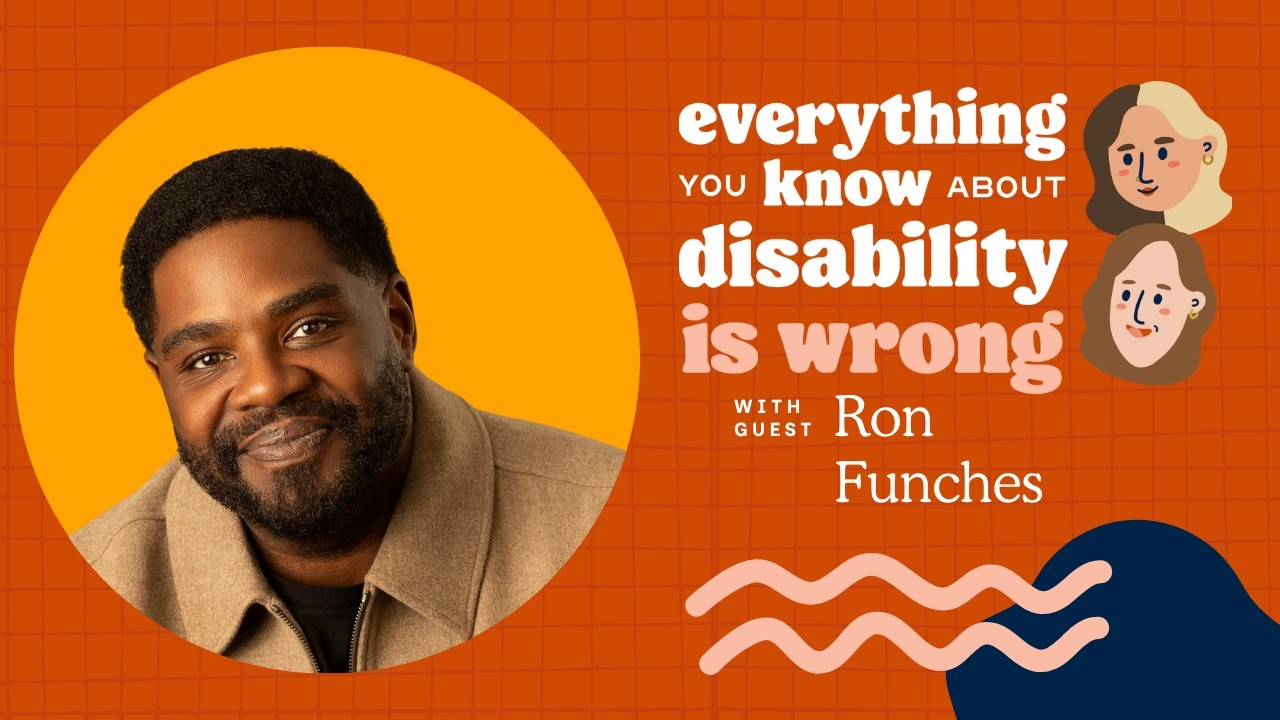
Episode 52: Free to Be Me: Ron Funches on Autism and Meeting Yourself Where You Are
Comedian Ron Funches reflects on autism, parenting, and self-acceptance, and on supporting autistic people at every stage.
Listen Now
Published on April 16, 2026.
Watch Video
Episode 52 Show Notes
On this episode of Everything You Know About Disability Is Wrong, we’re joined by Ron Funches, a stand-up comedian, actor, and recent cast member on The Traitors. Ron shares his perspective as both an autistic adult and a parent of an autistic son, reflecting on how his recent diagnosis has deepened his understanding of himself, his family, and the power of self-acceptance.
Through humor and honesty, Ron discusses what autism acceptance looks like in real life—from recognizing shared traits with his son to navigating the transition to adulthood, caregiving challenges, and the importance of meeting people where they are. This conversation reinforces the importance of acceptance, accessible support, and empowering people with disabilities to thrive on their own terms.
Easterseals is committed to supporting autistic individuals and caregivers with resources, services, and community.
Transcript
Ron Funches:
I've learned so much, not just about autism, not just about my son or about being a dad. My son's taught me so much about me and about the world. He just does what works for him and what makes him happy. And in turn has taught me to do what works for me and make me happy.
Music Interlude:
One, two, three, let's go. Everything you Know about Disability is Wrong!
Erin Hawley:
Hi listeners. Welcome to another episode of Everything You Know About Disability is Wrong. On today's show for our autism acceptance campaign, we're talking about meeting people where they are and supporting autistic adults and their caregivers. And today on the show, they have a great guest which can share on both of those sides.
Lily Newton:
Our guest today is Ron Funches. Ron is the human embodiment of a warm hug that somehow learned to roast you with love. A master of joyful disarming standup. He's released multiple acclaimed comedy specials. And
Erin Hawley:
He's also a fan favorite. On my favorite show, he talks The Traitors, Apple TV's Looped, Fox's New Girl, and so much more. And Ron has a prolific voice acting career. I usually hear him in Pixar's Inside Out, too. DreamWork's Trolls franchise, and Harley Quinn.
Lily Newton:
He's a performer whose superpower is turning warmth and weirdness into razor-sharp jokes and into pure delight. We are so excited to have him on the pod. Ron has been one of my longtime favorite comedians. So when it was in pop culture that he was being publicly diagnosed and joining an autism journey he'd actually been on for a while. I was so excited that we could reach out. So welcome to the show, Ron. We're so excited to have you.
Ron Funches:
Oh, thank you so much for having me. Appreciate you and that beautiful intro as well. Thank you so much.
Lily Newton:
Yeah, it’s always great to brag about how cool our guests are.
Ron Funches:
I appreciate that. Thank you.
Lily Newton:
So before we dive into the interview questions, let's go ahead and do our audio descriptions. This is Lily speaking. I am a multiracial woman and I have a split hair down the middle that is half blonde, half brunette. I'm wearing all black as usual, and I'm wearing the necklace that I will fidget with throughout the episode. I have a bunch of stacks of disability related books behind me because I don't like shelves. And I'll pass it to Erin to give your audio description.
Erin Hawley:
Hi, this is Erin. I have red hair and blue eyes. I'm sitting in a wheelchair and I have a white shirt on with sparkles. I don't know if you can tell. It's shiny. And I'm sitting in my bedroom and I'll pass it to Ron.
Ron Funches:
Hi, I'm Ron. I'm an African American male. I am wearing a black hat that I got from a can of the store that was given to me as a gift. I have a beard. I am wearing a blue crew neck that has my name on it that just says punches because that's fun to me. And then I'm wearing some blue pants. I am in my office, which is also a place where I don't get any work done because there's too many video games. There's two arcade machines behind me. It's Pac-Man Machine and then a Street Fighter two machine in Kicks you were wandering the direct description of that. And then a couple, and then a bunch of video game-related memorabilia.
Erin Hawley:
I love that. I love video games. So I was so excited to see your background. I love
Ron Funches:
It. Thank you. Yeah, I love video games as well. I have my whole life, and then now it feels like I just run a museum. Nice.
Lily Newton:
I love that. Fans, if you're listening, I'm sure you've been following Ron's incredible story. You've shared it on a lot of other podcasts. We won't make you retell your diagnostic story if you don't want to, because that feels like what we always get asked on podcasts. But I am interested in what was your initial reaction specifically to autistic people who were messaging you since you were not new to the autism community?
Ron Funches:
It was just interesting for me and kind of an affirmation of things that have been going on over the past few months. I mean, once I had left the castle after taping the Traitors, I knew that in some ways I just did not like most of these people and that was fine. And in some ways they just didn't like me and that's also fine. But I also felt that even amongst some of the people that I did enjoy, there were these misconceptions about me or the way that I was presenting to them that I didn't understand. I mean, to me, I felt like I was fully engaged and happy and excited to be there. And then some of the people would be like, "Do you even want to be here?" These type of things that were throwing me off. So it just kind of sat with me for a while.
And then as this show was airing, a lot of the ways that people were trying to diagnose me felt very negative and more like they were just trying to make fun of me. And so I was just like, that's just normal. But then as I got more messages that were more positive and more about people saying that they had saw themselves in similar situations, it made me just kind of embrace it more and just want to speak out about it because I was still going through my diagnosis at the time. So I didn't want to necessarily be public about it until I was fully done with it, which I am firmly a believer in self-diagnosis. I don't have any issue with that. But just for my own history and what my son is diagnosed 20 years ago and it was a much different process and involved a lot of blood work and things that were kind of traumatizing for him.
And so just out of respect of what he went through, I felt like I had to go get officially diagnosed. But when I got just the outpouring of support, I decided to just be more honest about it while I was still going through it.
Lily Newton:
Thank you. I was always very anxious and dealt with other mental health stuff. So I feel like I was on the diagnostic process forever, but there was just not a radar for me being autistic because of, I'm sure as you know, the conversation around autism has changed a lot in the last 20 years.
Ron Funches:
Yeah, a lot. I don't even think I had heard much about the word until the year or so before my son was diagnosed. And then in that time, there's been so many changes in the community and the way that people want to be represented. And I think that's been beautiful to see. And like you said, I remember when my mom, this is just funny because my mom had been very hesitant about accepting my dick diagnosis, but she was very on the forefront of getting my son diagnosed. She was the one who brought it to my attention. And I just remember being very defensive and just being like, "Oh, he's just weird like me. " And I was like, "Well, yeah."
Lily Newton:
Yeah. I had a similar thing because I was diagnosed with autism and ADHD at the same time, and my mom was very like, "You don't have ADHD. My brain works the same as yours." Flash forward, she now has an ADHD diagnosis, but she was having a hard time with it because it is hard to accept, maybe it's just how we function, but sometimes not. It's hard to accept on many levels.
Ron Funches:
I think especially as a parent that A, I think sometimes you feel like you did something wrong, and if it was for me, getting diagnosed in my 40s, I imagine my mom was just like, "Oh, if I missed something like this, was I a bad mom?" And so I am personally just a big believer of it's just been great to learn more about myself and to be able to accept some things about myself and have a place where I can get information and references about making my life work better. I just assumed everybody had violent reactions to fluorescent lights at Walmart. I didn't think that ... I was like, "Why do they make these?" We all hate them.
Lily Newton:
I really appreciate what you just said though about ... It's interesting how it's kind of a double-edged sword of you feeling that pressure of is there something wrong when your young child is being diagnosed? But then on the other side of things, if you go a long time and don't get diagnosed until much later, it can have the same kind of feeling of like, "Well, did I miss something?" And I think that's very timely just of with all the conversations happening with autism right now, I think there is so much pressure on autistic families in general. That's not really a question. I just thought that what you said was really poignant because it really shared that truth. No,
Ron Funches:
Thank you. Well, I just think it's important to never look at these type of things as flaws or negatives, but the proponent, and probably because I'm a big nerd, these are just parts of my character sheet where I have points in this area and then in other areas, I don't have as many points and that's okay. But I'm crushing in some areas, but in all of these things are what helps make me individually me. And it's just been great to kind of use it to ... For me, it was a big helper on ... My oldest son was nonverbal for so long and still his vocabulary is what some would term limited. It's very easy for me to communicate with him. But I often wondered if he had ever felt less than or had issues with it and the fact that I could go 42 years and not know.
And most of my time it was spent being like, "Why is everybody else so dumb? What's everybody?
Why does everybody know? They don't get what's going on here and they don't see it. " And so I was like, "Oh, he probably feels much the same way," where it's just different wavelengths and you're like, "Oh, this person's just not getting me. " But I love me and I love everything that's about me and I try to instill that in my son. So it's just been nice to have that. And also it's just nice to go from just being an ally and caretaker to being like, "Oh, we're swimming together. I'm not just rooting for you on the sidelines or pulling you along. We're both in this together." So it's been nice for me and my son in that regard.
Lily Newton:
Yeah. What was your son's initial response when -
Ron Funches:
He didn't care at all. He didn't get a crap, couldn't care less. Literally just goes, "Yeah," and then goes, "I already knew." And that was it.
Lily Newton:
It must be kind of rewarding to have been an affirming caregiver for someone who is autistic and been affirming to their brain being great how it is and this is just who they are. Is it hard to turn that back on yourself and listen to
Ron Funches:
Things you've said?
Lily Newton:
Oh yeah.
Ron Funches:
That'd be fun, right? Wow. If I had been a real jerk to him his whole life and turned around and I was like, "Oh, me. "No, luckily I was a good dad, so that was ...
Lily Newton:
There's a little bit of getting to ... The whole time you were kind of gently parenting the autistic child in you.
Ron Funches:
And myself. Yeah. I mean, that's what they always say, right? Most of life is just meeting different versions of yourself, right?
Lily Newton:
Yeah, that's very true.
Ron Funches:
That's what they say. That's what people say.
Lily Newton:
That's what they say. I think one reason also I was excited to have you on the show is this, just I think some people still have a hard time understanding what we mean when we say autism is a spectrum and it presents differently for people. And I think there's still a lot of people who have this idea that it's a little bit autistic to a lot autistic versus different traits that present differently. So I'm wondering, and I know you're still pretty early in this diagnosis process, but have there been any autistic traits that you have seen in yourself that you recognize that now you and your son have a shared trait that presents quite differently between the two of you?
Ron Funches:
Yeah, in some ways, yeah. I mean, we both have different texture issues that I just assume were just preferences, but I've always ... I love banana flavors, would never eat a banana to save my life. The texture of it is just disgusting to me. But then bigger than that, just kind of ... I think watching some of the clips back from the show where I could see some of the same facial mannerisms that I share with my son when we kind of both ... And I think because of my job, I was really good at masking. I mean, that's the majority of my job. But when you're on a show like that and the camera's on you 18, 20 hours a day, I couldn't under the stress and pressure. I couldn't really mask that well. And so to see me when I'm trying to just shut off and see the same kind of eye contact avoidance and stuff that I see in my son were things that I really noticed that were traits that we shared.
And that was one of the reasons why, because when I watch it, I was like, "Oh, I've seen that face."
Lily Newton:
That's a funny thing. I think when I was first starting to tell people I was autistic, I was always really nervous that they would be like, "No, you're not. " And I would get that sometimes from non-autistic people, but autistic people were always like, "Well, yeah, because you do this. " And I'd be like, 'Well, I didn't know that about myself, but I'm glad you see it. "
Ron Funches:
Yeah, no, I know several people before, but I'd always just been like, "Oh, I've been around it, so I see it."
Lily Newton:
Well, yeah, I was wondering that because one of the questions I was thinking of asking was that have you since being diagnosed, realized that maybe any of your close friends might be autistic because I saw you diagnosed the whole friend group
Ron Funches:
Before. Yeah. I mean, that was one of the reasons why I went to go get it because that was a year prior, one of my best friends and another comedian, Blair Socci, she got diagnosed with autism. I actually just did a podcast with her and she said that when she got her diagnosis, I was the first person she thought of. And that was a big one as well. And that was even before the show where I was just kind of being like, "Well, I relate with her the most. I get you. " And then there have just been several other coworkers I knew. My girlfriend, I won't call her current because I hope it's for a long, long time. My girlfriend is also on the spectrum, but she's not diagnosed, but we would just have these conversations about her past and her history and she would just be like, "A lot of people make fun of me because different things." And I say some silly things sometimes.
And then another month ago by, and then she was just like, I was looking at some pictures with my mom and I just remembering how I didn't even really talk till I was five. And I was like, "Baby, you're autistic."
Lily Newton:
That's the best. The best is when you get that one fact that's like, oh, one of my friends who I do standup stuff with, we did a storytelling show together and I've always in his standup thought like there's some autistic things going on here. And then the storytelling show we did, he randomly mentions, I didn't start speaking until I was five, but I would sing before I was five. And as he was walking off the stage, he just looked at me and went, "Don't even," because he knew I was going to be like, "You are autistic." Which everyone should come to their journey at their own pace, but as a friend when you start to see it, it's hard not to- It's like
Ron Funches:
Anything, like breaking up with a bad partner, your friends could tell you all day long, you won't see it until it's time. Yeah, I think the same with this type of thing. It's just been nice. It's given me ... I don't know if I would've been ready to deal with that or have the time or mental space to deal with it before. And now it's been helpful for me. It's helpful with my comedy and my writing. I've been able to come from a better, more defined space is what I would call it, where I understand more about what I'm doing as opposed to just being like, "Well, I'm just doing me. " And now I'm like, "Oh, no wonder a large proportion of my fan base is on the spectrum." I always just assumed because they knew about my son, but I'm like, "Oh no, my comedy is autism coded. It's just what I do. " So to be able to know that and write from that format, it's been very helpful for me.
Lily Newton:
That's so awesome to hear. It sounds like you are in a good place of acceptance, which is great for this autism acceptance episode. I think phrases like autism acceptance can feel sometimes a little abstract. And what would it even mean by that? And you have a way with words, so I'd love to hear your thoughts.
Ron Funches:
I believe it's just about both accepting yourself, what you would consider a fault or what you traits to yourself that maybe things that you don't aren't as polished or glittery, but I think it's about also accepting others. And like you've said earlier, just meeting people where they are through comedy, through my son, it's just always something that I've learned to be better at is just because someone doesn't relate to something in the same way I do or react to something the same way I do, I don't use that as a way to judge someone. I think especially when you have disabilities that aren't as visible to other people, it's something I've always been on my mind about my son and especially as he gets larger and as a black man and as someone who does not always follow directions, I always worry about him with dealing with the law and dealing with police officers and just people ... Because when he was younger, people gave him more grace because they would just see a kid and just be like, "Oh, he's just a kid being a kid." And now as he's in his 20s and he'll come up and ask you what state you've been to or what video game you played in 96, sometimes you can see they're like, "What's going on?
" And part of me always wanted to be like, "Oh, he has autism. He has autism." And I've learned more and more to just let his interactions play out and just let him be him. And you learn a lot about other people from that. So for me, autism acceptance, it's just never coming in with preconceived notions about how someone acts unless they're actively trying to harm you or being ... There's obviously examples where that is too much of an extreme, but if someone's just doing their own thing, a little bit aloof or sings a lot, I just kind of let the people be themselves. I think that's the best thing you can do as a friend, as a partner, on any level is the best thing that you can do is just let someone be them and don't just be like, "I don't have to fully understand you to love you.
I can just let you be you. " And the parts that I don't fully get, I love exploring.
Lily Newton:
Yeah, that is such an important thing. And also, I think sometimes a really awesome part of when you do have those friendships where you're both autistic and there is the level of like, "Yeah, I don't get why you like that. It's very different to how I feel about that, but I don't feel the need to try to get on the same page." Whereas sometimes I think that those misunderstandings happen a lot for me when it feels like someone is trying to get me on their page and I'm like, "No, there's nothing wrong with your page, but I'm not interested in it. "
Ron Funches:
Yeah, no. Yeah. My last marriage was a lot like that because my family, they know me. And to a specific example, if we're at a Christmas party or an event, my social battery just runs out quickly and I will engage and I will be around and then a certain point I won't say anything and I will just leave and go to my room. And my friends and my family all know that. And my ex would just be like, "Come on, you need to come in and engage and you need to think. " And I'd be like, "I can't ... No, that doesn't feel good for me. " And the fact that that wasn't something that was acceptable was probably why we're not together. And I've just been working on lately in my comedy, my main focus is kind of just flipping because to me, sometimes autism, acceptance is as if someone is a nuisance or is someone that you need to tolerate.
I've been working on material that I call autistic superiority. And it's just focusing on the things that have really ... The fact that I used to be like 370 pounds and I lost 140 pounds full natural, which I don't judge anyone who chooses any other way. I am on Zepbound now. But at the time I lost it full natural. I made myself a good actor and a great comedian in a way that was faster than a lot of people would expect. And it's all, not all, but partially because of the skills that I have from being autistic, from being able to hyper focus that when I do love something, I fully engage myself in it and I research it and I learn about it and I don't stop until I achieve it. And it's shown in my life and in my business. And so these are things I think should be celebrated in people and in whatever form that makes you good.
My son, Malcolm, he's such a tremendous artist. He's a great painter. He's a great style, just a great dresser. And he's also one of the kindest humans I've ever met in my life. He's so kind to his grandmother, to just strangers, to anyone that he's around. He's really good human in ways that you don't often see in someone you would term neurotypical.
Lily Newton:
Yeah. I think one, obviously anytime we can lead with strengths is awesome because I agree that Autism Acceptance Month, I think is an awesome time period where we can highlight things, but the word acceptance does sometimes come with that like, why do I need to be accepted? Can't I just be? But I love the way you pointed that out. And I do think with comedy specifically, there is a level of that gift of observance and pointing out like, "This is like this. " It is like a very-
Ron Funches:
Yeah, that's what I felt autistic still. The Traitors was so wild because I could see their cycles and see their things. And then I'd point it out and they'd be like, "No, we're not doing that.”
Lily Newton:
You're like, "Yes, you are.” You saw it.
Ron Funches:
You clearly are. I just watched it play out.
Lily Newton:
The pattern recognition being seen as like, oh, this person's a know- it-all or this person is such a common autistic experience. I feel like it's like, I'm just following the pattern. Well, this is a good segue because Erin, I promised we would not get too far in the episode without digging into Traitors a tiny bit because Aaron's a huge fan. I also love the Traitors because of Erin.
Erin Hawley:
Really? I didn't know that.
Lily Newton:
At our first New Jersey team session at your place, you were talking about it and that's why I watched the last season before this one.
Erin Hawley:
Nice. Yeah. I had questions.
Ron Funches:
Yes.
Erin Hawley:
So when you're sitting around the table, I was roving for people, are you there for hours? How long does that take?
Ron Funches:
Yeah, you're there usually at least an hour, about between 45 minutes to an hour and a half. You're kind of sitting around going around the table. Usually Alan comes in and does his intro that you see on TV, and then he will leave for a little bit, and then everybody starts talking, and then when he comes back in, you know that things are about to start wrapping up.
Erin Hawley:
Oh okay. I thought for some reason it was like five hours. I don't know why.
Ron Funches:
Oh, it feels like it. Oh, but yeah, no, it's a very intense, about an hour, an hour and a half.
Erin Hawley:
Oh, okay. That's not as long as I thought. And also, I'm curious, I know you don't sleep in the castle, right? You're at the hotel, I'm assuming. How does that work?
Ron Funches:
Oh Erin, you have some secrets that I can't tell you.
Erin Hawley:
All right, I'm sorry.
Lily Newton:
No, they sleep in the castle.
Ron Funches:
I'll tell you. I'll tell you after we're done recording here.
Erin Hawley:
All right. I love behind-the-scenes stuff. So anything you can share, I'm excited to hear.
Ron Funches:
I will say that it's very, very secretive how they do it. They do shuttle you around a bit. I will say you do spend the main majority of the day in the castle. You're in the castle a good 18 hours a day. And then the rest of it, you're kind of blindfolded and moved around. You don't really ever see anyone. So either you're in the castle interacting with everyone or you're kind of sequestered in your room by yourself and you can't even open the door or go down to check ... Well, you wouldn't get mail, but you can't go to the gym, you can't go anywhere. You have to stay in your room until someone comes and gets you.
Erin Hawley:
Oh, okay. That makes sense. It is really a beautiful location, but it's so pretty.
Ron Funches:
It's very, very pretty. That's the thing I would say for sure. The grounds, that's one of the reasons I wanted to go was to see it in person. And I will say that seeing it on TV does not do it justice when you can actually see how large the grounds are, how much space there is and the peacocks walking around and all the other different animals and see la la. And then also the fact that they would have all these paintings that kind of indicated what our next missions would be. And then you'd go in and eat breakfast. You wouldn't hear anything, but then you'd go in and you go back out and all the paintings would be changed and all these things would be moved around and you'd be like, "When did they do this? " Because you would never hear it, you wouldn't see anything, but it was like Disney Imagineering is what it felt like.
Erin Hawley:
Oh, that's cool.
Lily Newton:
Yeah. It sounds like it would be pattern recognition everywhere. And I think we saw that in your season where just such a classic ... It was sometimes hard to watch how messed Understood you were, because it feels very much like the autistic recurrence of he's literally just saying exactly what he saw and there's some miscommunication going on that this is seeming like ... But I mean, The Traitors I guess adds a whole other layer of masking because there's also this playing a faithful or traitor part too.
Ron Funches:
That was also a lesson of how ... And to me it was always like, well, I'm a comedian. I love words, but there were some things that were autistic traits of how literal I take things and how important words became to me. And so to me, when I was like, oh, I'm a faithful, I am a good person. I'm not going to lie. I'm not going to be mean to anyone. I'm going to help everyone out on our thing. I'm going to be a faithful person. And so I'm like, okay, if someone's a traitor, they're going to be lying to me. They're going to be manipulative. They're going to be doing these things that they shouldn't be doing. And then I was like, oh no, wait, that's just what they do no matter what.
So it was very confusing to me because I was like, oh, this person's a liar. They're a traitor. And there's moments where I'm very in it and I'm just like, oh, you're for sure a traitor, you're lying. I know you're a lying, because I knew they were lying, but I didn't know that that didn't matter. To me, it made it simple that it was like, okay, if you're faithful, you tell the truth. And if you're a traitor, you're a liar. But again, it just was just part of where I was like, oh, okay, I just take things very, very literally sometimes.
Erin Hawley:
Yeah. And I have to keep reminding myself that as a viewer, we know who the traitors are. So sometimes it's like, how can they not tell that he's a traitor or whatever? And it's like that we have that understanding that everyone else there doesn't know what the audience knows.
Ron Funches:
Yeah. That's one thing I think is fun to watch, especially when I knew everything that had happened while it was still playing out on TV and to watch people be like, "Oh, I know this is going to happen," or, "I know that is going to happen." Or, "How can they not tell they're the traitor?" And it's just so fun because you really, when you're there, you don't ... It's so hard because when I was watching it, I'd be like, "Oh, I'll figure it out. I'm smart. I'll find a liar." But when you get there, you don't know who is what. Everyone's loud and wrong and you have to pick somebody and do something. And so you end up looking silly no matter what. And then everybody online is like, "You're an idiot." I was like, "Well, you would do just as bad if you were in there!”
Lily Newton:
Yes. And the added layer of neurotypical people, I won't make an overarching statement, tend to make statements by asking questions like, "Why did you do this thing?" Usually, they're actually saying, "You shouldn't have done this thing." And that's something that took me a very long time to learn because I would offend people by being like, "Why did you do that? " And they would think I was saying that that was a problem. And I feel like even before your arc and the traitors, I was always watching it with that view of like, man, there's got to be some neurodivergent people in here who are just making themselves look suspicious because they're not necessarily conforming to neurotypical conversation standards.
Ron Funches:
Yeah. I mean, I've never been great at small talk, so I knew that would be an issue, but I was always like, "I'm just going to always tell the truth." And to be there being like ... Literally, I think I lied one time and everyone was like, "No, you're lying to me. You're in my face." I don't know what to say to you. I just don't care about your families and I don't want to ... We're going to be together for a couple weeks and we're never going to hang out later. So why would I ask you about your kids? Why would I ... That doesn't make any sense to me.
Lily Newton:
Yeah. Well, that makes perfect sense to me, Ron, but I'm also autistic. I don't know. I don't know how that ... So you've talked about in some older standup, you've talked about your anxiety and just being a kind of anxious person in general. Curious just in general how your relationship with your own mental health is following this diagnosis.
Ron Funches:
I think my mental health is good. It's a sliding scale. I mean, I saw my therapist yesterday. She thinks it's great. She thinks I'm doing very well. So I would say, I think just acceptance, knowing more about yourself, then there's just always so much to learn and everybody's always learning externally, but there's so much ... You can spend a lifetime learning about yourself. And so to be in my mid- 40s, early 40s and just have a new thing to learn about myself is pretty awesome and gives me, again, a lot to talk about, which is great because I just shot a special, so I needed new material. Love
Lily Newton:
That. Love that. Yeah. And I think that the internal experience, obviously I only know my own, which has always been autistic, but there is so much that can be mined from in there. And I do feel like we spend a lot of time trying to learn externally. There is so much to dive into there. But I love what you said specifically on, "Oh, at some point I'll stop doing this or I'll stop needing that support kind of thing when you're in the mental health standpoint." Because I say this a lot. I have always also sliding scale mental health, but the therapist thinks I'm doing good now and I've always had mental health issues that have sometimes reared worse than others. But when I was in the world of just mental health, it felt like I was seeking some kind of cure, like there was the right pill I was going to take or I was going to figure something out and then it was going to be gone.
And so it always felt like I was not doing enough to beat this thing versus once I found out I was autistic and I started to look at mental health from the lens of disability and same thing like this, "Okay, if I need to do this before I leave the house to be able to ... Whatever I need to do to feel comfortable, maybe it's not something that I have to grow out of. Maybe this is just the way I live my life." And I think that's a message I hope listeners take from this episode and just in general talking about acceptance. If you feel like you have to beat something or that you're overcoming, there might be a little more room for accommodation and care for the ways that maybe you do things a little differently and that's okay.
Ron Funches:
I agree. Couldn't add any more. That's perfect.
Lily Newton:
I do want to mention, just because you have this caregiver perspective, that's, I think, a really important perspective and really doesn't get talked about that often. Your son is an adult now, and one of the things that a lot of caregivers deal with is the care cliff, meaning when their kids age out of certain services or supports, it becomes almost increasingly more difficult to find and afford these services because they're no longer covered by things. What was that youth to adult transition like for your family and what kind of supports were either gained or lost? Did you experience that care cliff?
Ron Funches:
Yeah, of course. Everybody does. This thing that you get scared about when you age out of school years, you have such more funding and more programs while they're of school age. I've had to deal with a lot of things. I mean, luckily out here in California, we have the regional center that still provides services until he's like 25. Getting him conserved was a big part of being able to continue services for him. So I would say that if there's anyone who is a caregiver of someone who's about to become of age, that I would really hop on conservatorship as quickly as you can because there's things that just came up as he became of age that I did not expect and that he had to answer on his own and made him very uncomfortable. And so it was just something that where I realized that even though he's an adult, I still have to do these things to continue to protect him.
I think a lot of my time earlier was spent being like, "Oh, I need help in doing this and I'm going to have a son that may live with me for his adult life." And it used to be something I feared, but it is something that's been a joy for me. He's such a great roommate. He's the best. I don't know how our dishwasher works. He does. I don't.
He keeps this house running. He takes care of everything and takes trash out, just really runs this house. And it's gone from me being more afraid of what it meant that I'd have to live with him forever to now. And I wouldn't know what it'd be like to live without him. And so if we come to that point, I will certainly support it and help him with it. But as far as going back to the care cliff, I think it's something I still deal with and still scares me because it went from being like, okay, I got to protect my son by getting money and kind of felt like I had to Rapunzel him and build this walls to keep him safe. And then realizing I'm like, "Oh, I can't do that. " He's an adult. He likes to go out with his friends. He has activities he likes to do where he does not want me there.
And I had to learn to just be like, I have to let him live in a real world and learn more things about the access bus that he has access to, or even just letting him use Uber, which has been good because then I can at least track his rides. Just still learning to keep pushing him to be more independent, but while still trying to find safeguards, whether it's having him on my find my iPhone so I can keep track of him. So it's like a weird balance where I keep trying to let him be free. At the same time, I'm looking and just being like, "I just have to be scared. I just have to be scared and he'll be back." Because there was times where we just, I couldn't take him to events or parks or anything where he would just start off and then he'd be gone and we'd search for him.
And we went to a Clippers game last week for my birthday and we went to the lounge to go eat and then someone recognized me. And so I took a picture with him and then I turned around and he's gone. And so it immediately took me back to where he was like four or five. And I'm just like, "Where is he? Where is he? Are we going to have to go call security and find him and stuff?" And then I just took a moment and I was like, "Relax. You're like 20 feet away from where you guys were staying. Just walk back to the room and see if he's there." And of course he was. So it's just learning to continue to not put limiters on him and just be like, "I just got to let it figure out. " And then right now I just worry about what type of work could we find for him, what type of job, what out it being something that is just like ... When I was a kid, they'd always just, if you were in special education or anything, they'd just be like, "You go clean up after the neurotypical kids." And that's always been something I'm like, "I don't want my son doing that."
I mean, he ended up getting a job at a grocery store and a job clean and stuff, and he loved it. And I was like, "Okay, I just got to let him beat him and do whatever he wants to do. " But I can't say, that's probably my biggest fear right now. It's just like, how do we transition from ... Because even right now he goes to this at Asner Foundation, but even that's just for another year. So to answer your question, I don't know how I'm dealing with a cliff. It's something that I think about and I just try to deal with on a day-to-day basis. But I would recommend for others, again, just a conservatorship and to just try to extend services for as long as possible.
Lily Newton:
Well, thank you for being willing to talk about all of that. I think it is such an important topic. And we have been just trying to really understand the state of caregivers and how we can be better supportive from Easterseals because everything you just said really solidified the need for resources for caregivers need to be abundant and easily accessible and easily understood because caregivers are juggling so much. And I think that's a part that gets often lost is how ... It's not just that these services are hard to find. They're also hard to understand how to use. Some of the people we've spoken to have talked about realizing that they needed to get on a wait list 10 years ago to be considered for these certain types of waivers and things.
It is something that I do hope gets spoken about just more in regular life, everyday culture, because I think that especially as funding and services are being cut in places, we're going to continue to see this. And caregivers and individuals with disabilities, we have a lot to face if we don't understand that disabled kids become disabled adults and we can't just stop having support when people turn 25.That's just ridiculous.
Ron Funches:
Oh, absolutely. I mean, I love you see some of the businesses that hire exclusively disabled adults or adults with autism and always appreciate places like that that make end effort because I mean, I agree with you a hundred percent. You can't cut services and also not have jobs. It doesn't work in that regard, but that we could talk for another three hours about my feelings on that. But I think that's another thing that my own diagnosis has helped me with is I've always been on a side, but now I'm just fully don't mess with me and my friends.
Lily Newton:
Yeah. Yeah. Being placed within the community, you can be even stronger. There's a level of none of that over performative ally you're in.
Ron Funches:
Yeah.
Lily Newton:
Exactly as angry as you want. It's a you thing. Yeah. It's certainly an odd time to be autistic, but a great time to have it be at least a little bit more in culture. And I hope with people like yourself, Ron, who have experienced many different versions of what autism can look like, I think hopefully we can change narratives a little bit. And I just want to end on asking, you've already touched on it a bit, but so much of caregiving narratives are kind of dominated by the burden side of things or how difficult they are, which is not an issue of the person who needs care, but really an issue of these inaccessible systems. But as Erin and I know from our own experiences, the caregiver relationship can be truly incredible. And I would just love to hear what's the good side? What are the best parts of ... I know you just said that living with your son is awesome.
What's a takeaway message to caregivers who might feel like daunted?
Ron Funches:
It's just that, I mean, I think most of us know the individual days that can be rough for you and can make you feel like you're spending your life in the service of others and sacrificing some of your own wants. But overall, I've learned so much, not just about autism, not just about my son or about being a dad. My son's taught me so much about me and about the world and about looking through traditions and things that we just do because we're taught culturally to do them and how my son doesn't have that, how he just does what works for him and what makes him happy. And in turn, that's taught me to do what works for me and make me happy. He's taught me to accept myself.
He loves how he looks. He loves his weight. He loves everything about himself he's happy with. And I think a lot of times when you're in a neurotypical world, you're really taught not to do that at all, never to be happy with yourself, to always find something wrong with you. And just to watch how he has none of that, that he loves himself, that he knows who he is. He knows he's a good person. He knows he's handsome. He knows he's smart. He doesn't have anything that belittles or lowers himself to make other people happy. And that's one of the best lessons I've ever learned is to just feel free to be me and fly and show my vocabulary, show how smart I am to not lower myself because it makes other people comfortable. April Fool's Day with him is one of the best days in the world.
He plays the best April Fool's pranks of all time. They're so funny. They're different. Every year he labels them so that you're not surprised, which is always fun. That's
Lily Newton:
That’s so nice.
Ron Funches:
It's very nice.
Lily Newton:
You said April Fool's Day and I literally was like, autistic trauma. No, I hate pranks.
Ron Funches:
He'll put a little plastic spider and then a Post-it note that says fake spider.
Lily Newton:
That's the kind of April Fools I could get on with. I'm cool
Ron Funches:
With that. My favorite one last year, I'm so excited for this year. Last year, he just led me to the backyard and pointed at a bush. And then I go, "What?" And he goes, "I peed here." I go, "That's your April Fools?" And he goes, "Yeah."
Lily Newton:
Yeah, yes.
Ron Funches:
"You're not supposed to be here." And I did.
Lily Newton:
That's a perfect April Fools, actually. He got the format perfectly.
Ron Funches:
He really did. So my life is just full of laughter and just a lot of fun activities. And I won't say it hasn't been tough, but it's been the most motivating thing for me. I don't think I'd be nearly as successful as I am or try the things I've tried if it wasn't for the motivation that my son has given me. And I think a lot of people who are caregivers can understand that statement. A lot of people are always like, "Oh, to be a parent is a gift." And I think in the world of autism, I won't be surprised when people know about determined to go children and things of that nature. So I think when you are entrusted with a child like that, it is a sign that you are given something special to take care of and to a treasure. And my son truly is a treasure and the fact that I've helped nourish him to be himself is probably the best thing I've ever done with my life.
So those are the positives, I think.
Lily Newton:
Oh yeah. Just those little positives. That was so wonderful. That was so, so great. And I think really sums up the episode of this. I meant to actually say this, you have a bit where you're talking about cake versus pie.
That I think is the best allegory for autistic masking. The pie is just the pie, just showing up as you are. And I think that is this whole episode has just been a good reminder of autism acceptance looks like what you want to make it look like. And I think autistic autonomy is really important as well. So thank you for coming on our show and just being willing to chat about this. I hope that you're not getting too tired of talking about this because I'm sure a lot of people have a lot of questions.
Ron Funches:
No, I prefer to talk about this. No, most people just want to talk about the game and stuff, which is also fun. But no, these are things I'm passionate about. I love talking about this. So I appreciate the ability to be more in depth and talk about people who have a knowledge base about it instead of who are just asking rudimentary questions or just doing things for buzz. So I appreciate you.
Lily Newton:
Yeah, we try to do that on the show. It's fun to be in the same world that you're now welcome with open arms into, that we have just kind of this shared vocabulary and understanding usually of bullshit, but we understand the bullshit we face, which understanding the bullshit you go through is a powerful connector.
Ron Funches:
Absolutely. War buddies.
Lily Newton:
Well, it is Ron's time in the world for real. It is so wonderful. And as an autistic person to see you getting the reception you're getting, but also talking about autism openly has been really wonderful. So I really do just, as a fan of yours, this has been a really affirming thing to watch and to see that you obviously accept this diagnosis and just be so proudly you. It reminds me to be proudly me. So I'm really appreciative and this is an amazing episode to have for April this year. I really hope we can continue to work with you, Ron.
Ron Funches:
Please. I'd love to.
Lily Newton:
And Erin, as always, I love you. Thank you for co-hosting this show with me.
Erin Hawley:
Of course. It's amazing. Thank you so much.
Lily Newton:
And to our listeners, viewers, however you're digesting this episode, thank you for being here. Thanks for hanging out. And we will see you next time on another episode of Everything You Know About Disability is Wrong.
Music Interlude:
Oh my goodness. You are such an inspiration. Wow, you really are. You're so strong. Can I pet your service dog? One, two, three, let's go! We are artists, parents, teachers. Good guys, bad guy students, leaders. I'm not your inspiration. No, I'm fully who I am. Got my own expectations that don't fit into your plans. I'm not your sad story, so I wrote it in this song. Everything you know about disability is wrong! Yeah, everything you know. Yeah, everything you know about disability is wrong!
Legal
Sign up for Emails from Easterseals
Get exciting news, helpful resources, & inspiring stories delivered to your inbox each month.